




Japan’s ‘Truss Moment’ Is Here. Bond Market Slumps, Japan’s Second-Largest Bank to Double Down?
TradingKey - At the start of 2026, Japan experienced its own "Truss moment."
On January 19, Japan's new Prime Minister Sanae Takaichi announced the end of long-standing fiscal austerity policies and plans to dissolve the House of Representatives this week for a snap election on February 8. This political and macroeconomic shift, combined with weak government bond auction results, instantly triggered a chain reaction of sell-offs in the Japanese Government Bond (JGB) market.
The following day, JGB yields surged to 2.35%, hitting their highest level since February 1999. Yields on 30-year and 40-year bonds broke through 3.875% and 4.215%, respectively, with the latter entering the "4% era" for the first time in history. The JGB market saw its most violent volatility since 2007, with several traders calling it the "most chaotic trading day in recent years."
At the same time, weak results from a 20-year bond auction exacerbated concerns over Takaichi's fiscal policies, creating a vicious cycle of "sell-off, heightened anxiety, and more selling."
Is Japan repeating the UK gilt crisis?
Pooja Kumra, European and UK rates strategist at TD Securities, stated that the "shock" formed by sustained pressure on super-long JGBs is transmitting to global interest rate markets. De-risking and margin calls remain realistic risks that could trigger a broader market reaction, making the situation comparable to the 2022 UK gilt crisis.
The so-called "Truss moment" refers to 2022, when former UK Prime Minister Liz Truss proposed unfunded tax cuts, leading to a collapse in market confidence and a plunge in government bonds, forcing her resignation shortly thereafter. Today, a similar scene is playing out in Japan.
Sanae Takaichi vowed to end excessive fiscal austerity and implement large-scale investment and tax-cut plans. She stated that Japan needs to boldly break free from old fiscal constraints, asserting that the country "must enhance risk-response capabilities to drive long-term growth where taxes fund future taxes." Her team intends to implement expansionary fiscal policies, such as cutting the consumption tax, but the vague sources of funding have sparked deep market concern.
Meanwhile, consecutive failures in 20-year JGB auctions indicate a sudden drop in bond demand and a rapid decline in market liquidity. Bloomberg data shows the JGB liquidity index has surged to an all-time high, reflecting a severe imbalance in market supply and demand.
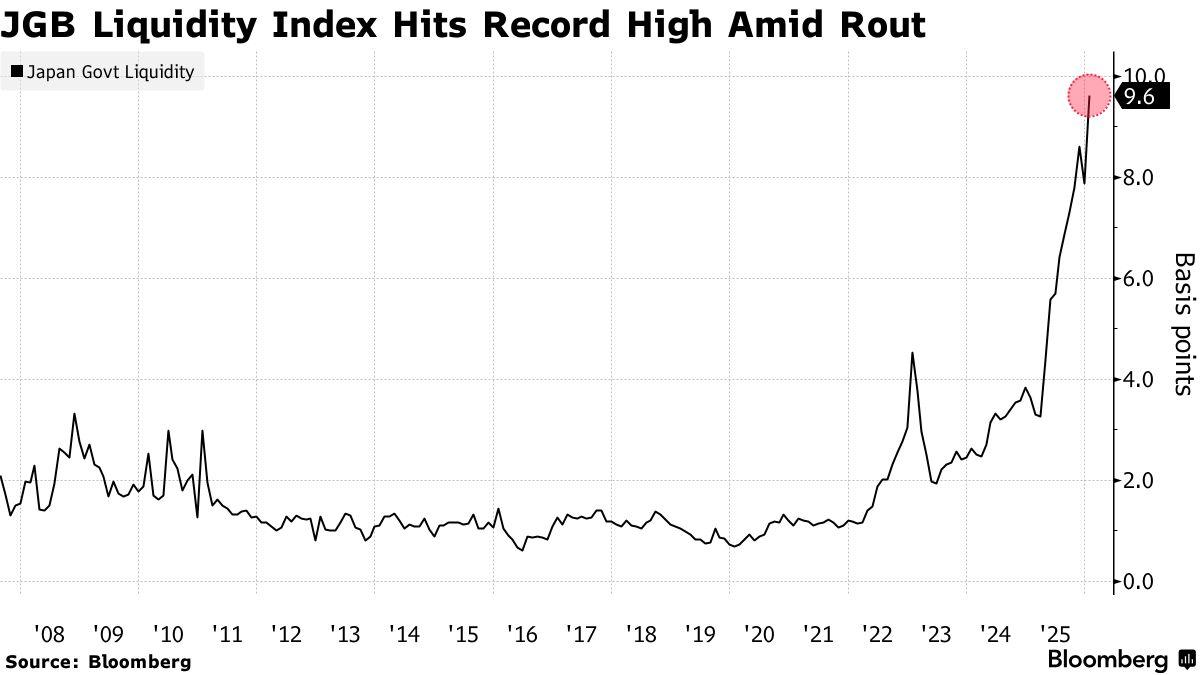
U.S. Treasury Secretary Bessent remarked: "The volatility in the Japanese bond market has reached 'six sigma.' If this were to happen in the U.S. Treasury market, the 10-year yield could skyrocket by 50 basis points."
The Bank of Japan's Dilemma
During this politically sensitive period with an upcoming snap election and high fiscal policy uncertainty, the Bank of Japan is caught in a dual dilemma between "fighting inflation" and "stabilizing the market," finding itself in a difficult spot.
Tim Sun, a senior researcher at HashKey Financial Services Group, pointed out that if Japan uses interest rate hikes to curb the JGB sell-off, global liquidity will be rapidly squeezed. However, if it maintains the status quo without intervening, JGB yields and the exchange rate could spiral out of control simultaneously, creating a chain reaction.
In his view, the central bank is unlikely to tighten policy abruptly in the short term, instead preferring a strategy of "trading time for space" to manage the current crisis. Key measures include strengthening market communication, stabilizing expectations, and taking unconventional steps if necessary—such as currency intervention or targeted bond purchases—to keep yield volatility within a tolerable range.
Tim Sun emphasized that as one of the world's largest sovereign creditors, Japan's JGB market is massive and deeply embedded in the global financial system. If long-term JGB yields continue to rise, it will prompt domestic capital to withdraw from overseas assets like U.S. Treasuries or European bonds and return home. This would drive up global borrowing costs and compress valuation multiples for risky assets. This spillover effect poses a substantial shock to global capital markets.
UBS traders also noted that Japan's current predicament is somewhat similar to the 2022 UK gilt crisis. The issue lies not only in the fiscal easing measures themselves but, more critically, in the lack of coordination with the central bank's objectives. On one hand, the new government is making high-profile promises of fiscal expansion, while on the other, the central bank faces a dilemma between inflationary pressures and bond market turmoil.
A more complex situation is that Takaichi's expansionary fiscal path has increased market unease regarding the future of the yen and the bond market. If the policy logic is inconsistent, confidence in the coordination between the government and the central bank will erode quickly, and the "envisioned dividends" will vanish.
Regarding market expectations for possible intervention by the Bank of Japan, several analysts believe there is indeed feasibility in terms of policy tools.
For example, resuming unlimited bond purchases at fixed rates to cap long-term yields is an option for suppressing further yield increases in the short term. However, such an operation could be interpreted as debt monetization—where the central bank finances the government by printing money to buy bonds—thereby triggering concerns about Japan's fiscal sustainability and exacerbating yen sell-off sentiment.
Furthermore, policymakers might choose to delay the balance sheet reduction (quantitative tightening) originally planned to start in 2026, maintaining the current pace of JGB purchases to stabilize market liquidity. Regarding communication, the central bank might use more dovish or vague language in upcoming monetary policy meetings to guide market sentiment toward a soft landing.
While these measures could alleviate market pressure in the short term, the core issues remain unresolved. If the new government fails to send clear signals about maintaining fiscal discipline, investors will continue to reassess Japan's long-term risks. Even with frequent intervention by monetary authorities, such actions might only briefly delay, rather than reverse, risk repricing.
Regarding whether the "ultimate weapon"—unlimited bond purchases—will eventually be deployed, Gareth Berry stated that there is currently no indication the Bank of Japan intends to activate the mechanism immediately. He noted that this policy tool, introduced by former Governor Haruhiko Kuroda, remains a "backup option." While current Governor Kazuo Ueda has consistently demonstrated a more restrained monetary policy stance, he may have no other choice if the market continues to destabilize.
Is Japan's second-largest bank preparing to "buy the dip"?
Sumitomo Mitsui Financial Group (SMFG), Japan's second-largest commercial bank, has stated plans to significantly increase its holdings of domestic sovereign bonds once the JGB market stabilizes, rebuilding its allocation. Arihiro Nagata, the bank’s head of global markets, revealed that the goal is to double its current JGB portfolio of approximately 10.6 trillion yen (about $67 billion) once yield volatility settles.
This move indicates that the major financial institution intends to shift its focus from overseas bond investments toward the Japanese domestic market.
In an interview, Nagata admitted that while the market remains volatile, the bank will "return strongly" to the bond market as soon as the surge in yields eases. He disclosed that Sumitomo Mitsui has already begun making small-scale purchases as 30-year JGB prices gradually trend toward a fair value range.
Currently, the securities portfolio of Sumitomo Mitsui Banking Corporation, a subsidiary of the group, consists primarily of overseas bonds, with holdings of approximately 12 trillion yen.
Although SMFG's current JGB holdings are mainly concentrated in short-term bonds with an average duration of just 1.7 years—and its peak holdings in March 2022 reached 15.8 trillion yen—Nagata stated that the future rebuilding of positions could "far exceed" that historical high.
Despite market concerns over the rapid surge in long-term yields, Nagata noted that at the beginning of this week, the 30-year yield had gradually returned to near-fair levels, after having spiked by more than 25 basis points in a single day.
However, he also emphasized that the bond market is currently influenced by concerns regarding Takaichi's fiscal policies and the risk of the main opposition party driving up inflation. Therefore, yields may still climb further, and Sumitomo Mitsui has not yet chosen to "go all in."
Recommended Articles


