




If I Could Only Buy and Hold 1 ETF, I'd Stock Up on This One in 2026
Key Points
ETFs require less effort than individual stocks, yet they can be incredibly powerful investments.
Growth ETFs can help you earn above-average returns over time.
A long-term outlook can reduce the risk of losing money during a market downturn.
- 10 stocks we like better than Vanguard Admiral Funds - Vanguard S&P 500 Growth ETF ›
Long-term investing is one of the most effective ways to build wealth while minimizing the impact of market volatility, and exchange-traded funds (ETFs) are low-maintenance investments that let you buy into hundreds of companies at once with next to no effort on your part.
Choosing the right ETF can be tricky, though, especially with so many to choose from. But if I could only choose one to buy and hold for decades, there's one I'd stock up on in 2026.
Where to invest $1,000 right now? Our analyst team just revealed what they believe are the 10 best stocks to buy right now, when you join Stock Advisor. See the stocks »

Image source: Getty Images.
A growth ETF that offers some stability
Generally speaking, many ETFs fall into one of two camps: those designed for stability and those aiming for growth. Some funds, though, can do both.
The Vanguard S&P 500 Growth ETF (NYSEMKT: VOOG) only includes stocks from the S&P 500 (SNPINDEX: ^GSPC). These companies are among the largest and strongest in the U.S., and many are industry leaders with a long history of weathering economic instability.
However, this fund doesn't include all of the stocks from the S&P 500. Rather, it only holds those with the most potential for growth. This can help balance risk and reward by focusing on stocks that have both proven track records and room to grow. With its more targeted approach, it's also less likely to get bogged down by lower-performing stocks.
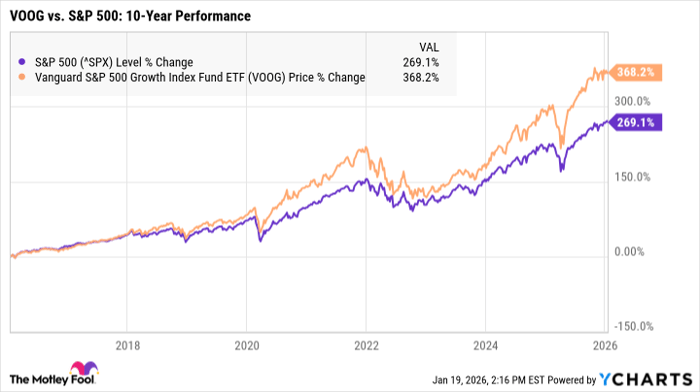
^SPX data by YCharts
Over the past decade, the Vanguard S&P 500 Growth ETF has significantly outperformed the S&P 500 with total returns of 368%. In other words, if you'd invested $10,000 a decade ago, you'd have around $47,000 with this ETF versus around $37,000 with a standard S&P 500 ETF.
One crucial risk to consider
It's important to note that while this ETF has beaten the market over many years, its short-term performance has been rockier. This is true for many growth-focused funds, as they tend to lean heavily on tech stocks -- which are notoriously volatile.
If you choose to invest, be sure you're willing and able to stay invested for five to seven years or longer. Even strong investments can experience nauseating downturns if the market takes a turn for the worse, but you won't technically lose any money unless you sell your investment for less than you paid for it. By riding out the storm until stock prices recover, you'll likely regain any lost value.
The Vanguard S&P 500 Growth ETF offers some of the stability of an S&P 500-tracking fund, as it only contains large, strong stocks. But its narrower focus on growth stocks can also help it deliver above-average returns over time, making it a smart option for investors looking for long-term gains with less risk than some other growth funds.
Should you buy stock in Vanguard Admiral Funds - Vanguard S&P 500 Growth ETF right now?
Before you buy stock in Vanguard Admiral Funds - Vanguard S&P 500 Growth ETF, consider this:
The Motley Fool Stock Advisor analyst team just identified what they believe are the 10 best stocks for investors to buy now… and Vanguard Admiral Funds - Vanguard S&P 500 Growth ETF wasn’t one of them. The 10 stocks that made the cut could produce monster returns in the coming years.
Consider when Netflix made this list on December 17, 2004... if you invested $1,000 at the time of our recommendation, you’d have $470,587!* Or when Nvidia made this list on April 15, 2005... if you invested $1,000 at the time of our recommendation, you’d have $1,091,605!*
Now, it’s worth noting Stock Advisor’s total average return is 930% — a market-crushing outperformance compared to 192% for the S&P 500. Don't miss the latest top 10 list, available with Stock Advisor, and join an investing community built by individual investors for individual investors.
See the 10 stocks »
*Stock Advisor returns as of January 21, 2026.
Katie Brockman has positions in Vanguard Admiral Funds-Vanguard S&P 500 Growth ETF. The Motley Fool has no position in any of the stocks mentioned. The Motley Fool has a disclosure policy.
Recommended Articles


