




Dow Jones Industrial Average bottoms out as trade war cycle repeats itself
- The Dow Jones shed 220 points from last week’s close as investors pull back following fresh trade war rhetoric.
- US President Donald Trump has vowed to impose new trade tariffs on Europe, European leaders were quick to respond.
- Trump’s fresh tariff threats come on the heels of facing political friction over his suggestion that he take over Greenland.
- Market momentum remains subdued on Monday overall with American markets taking a break for Martin Luther King Day.
The Dow Jones Industrial Average (DJIA) ripped open the new trading week on a tariff-fueled weak note, reminiscent of trade war fears that knocked around equity markets early in 2025. A year later, the Trump administration is still grappling with picking a lane and staying in it.
US President Donald Trump has ramped up his assertions that the US should “own” Greenland, going so far as to suggest that he no longer feels an obligation to “think purely of Peace” (sic), suggesting that part of his newfound aggressive stance on Greenland is owed in part to Trump getting snubbed for the annual Nobel Peace Prize. According to messages between Trump and Norwegian Prime Minister Jonas Gahr Støre obtained by media outlets, Støre reminded Trump that the Nobel Prize is administered by an independent committee, not the Norwegian government.
Trump wants Greenland, but resistance remains firm
President Trump has vowed to impose a 10% tariff on US exports bound for eight European countries, including Denmark, Norway, Sweden, France, Germany, the United Kingdom, the Netherlands and Finland, beginning on February 1.Tariffs would ramp up to an additional 25% by the summer months if the European Union doesn’t break off an entire nation and grant it to the US. US exports to the European economic zone have amounted to very little at the best of times, and it took European leaders a little under two hours to respond to Trump’s newest tariff threats over the weekend with a reciprocal tariff threat. Counter tariffs have had a profound effect on multiple American industrial sectors over the past year, and European leaders are expected to deliver a targeted tariff list that will lean on ongoing US economic pain points.
US markets are in low-volume mode as most American exchanges take the Martin Luther King Day holiday. US equity markets will be back in force from Tuesday, just in time for a fresh update to the ADP Employment Change 4-week average, followed by a scheduled speech from President Trump on Wednesday, with a hot update to US Personal Consumption Expenditure Price Index (PCE) inflation on Thursday. Friday will wrap up the trading week with a fresh round of S&P Global Purchasing Managers Index (PMI) survey results for January.
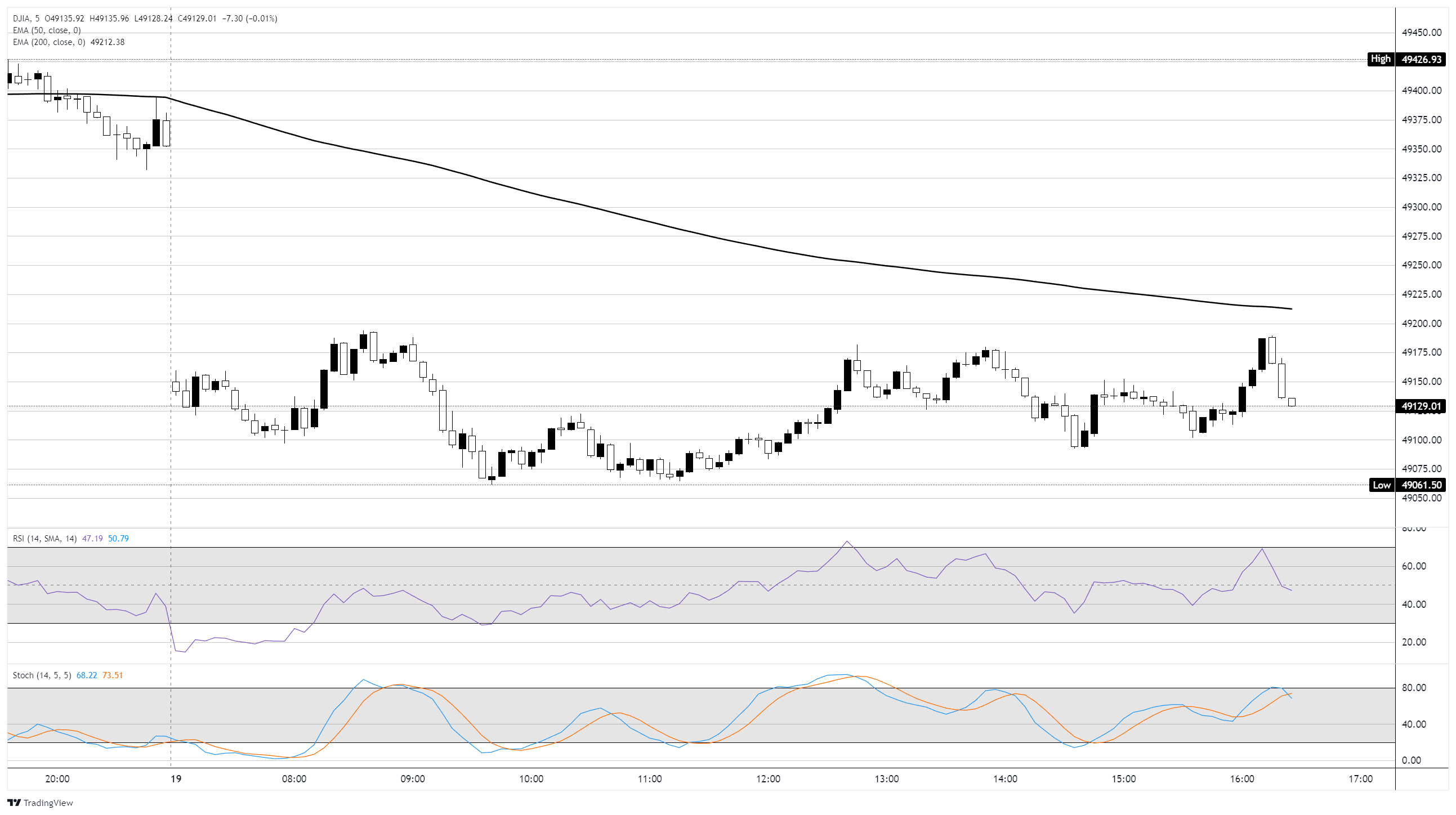
Dow Jones 5-minute chart
Dow Jones FAQs
The Dow Jones Industrial Average, one of the oldest stock market indices in the world, is compiled of the 30 most traded stocks in the US. The index is price-weighted rather than weighted by capitalization. It is calculated by summing the prices of the constituent stocks and dividing them by a factor, currently 0.152. The index was founded by Charles Dow, who also founded the Wall Street Journal. In later years it has been criticized for not being broadly representative enough because it only tracks 30 conglomerates, unlike broader indices such as the S&P 500.
Many different factors drive the Dow Jones Industrial Average (DJIA). The aggregate performance of the component companies revealed in quarterly company earnings reports is the main one. US and global macroeconomic data also contributes as it impacts on investor sentiment. The level of interest rates, set by the Federal Reserve (Fed), also influences the DJIA as it affects the cost of credit, on which many corporations are heavily reliant. Therefore, inflation can be a major driver as well as other metrics which impact the Fed decisions.
Dow Theory is a method for identifying the primary trend of the stock market developed by Charles Dow. A key step is to compare the direction of the Dow Jones Industrial Average (DJIA) and the Dow Jones Transportation Average (DJTA) and only follow trends where both are moving in the same direction. Volume is a confirmatory criteria. The theory uses elements of peak and trough analysis. Dow’s theory posits three trend phases: accumulation, when smart money starts buying or selling; public participation, when the wider public joins in; and distribution, when the smart money exits.
There are a number of ways to trade the DJIA. One is to use ETFs which allow investors to trade the DJIA as a single security, rather than having to buy shares in all 30 constituent companies. A leading example is the SPDR Dow Jones Industrial Average ETF (DIA). DJIA futures contracts enable traders to speculate on the future value of the index and Options provide the right, but not the obligation, to buy or sell the index at a predetermined price in the future. Mutual funds enable investors to buy a share of a diversified portfolio of DJIA stocks thus providing exposure to the overall index.
Recommended Articles


