




Bitcoin Price Forecast: BTC extends gains above $71,000 as liquidity conditions improve
- Bitcoin extends its gains, trading above $71,000 on Thursday after surging more than 7% the previous day.
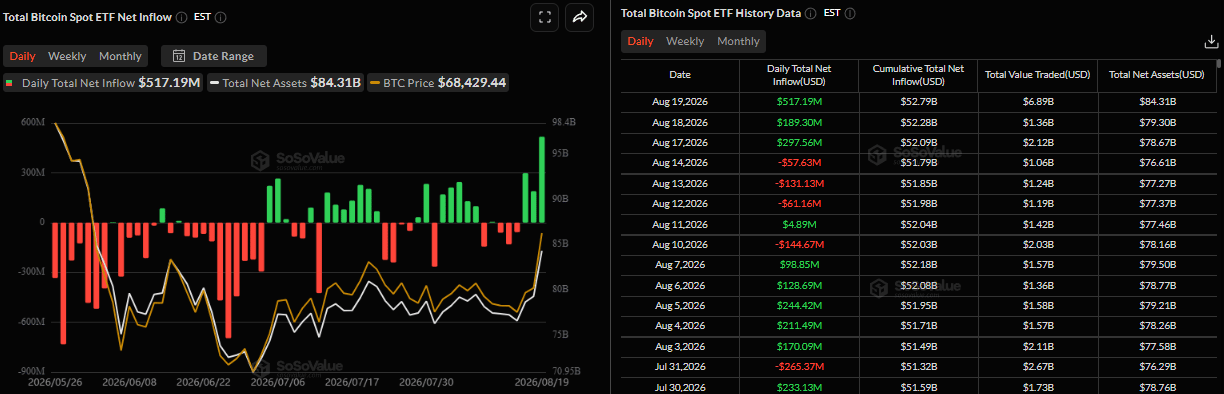
- US-listed spot ETFs recorded an inflow of over 517 million on Wednesday, the highest single-day inflow since early May.
- US Treasury’s decision to double its debt buyback operations boosts liquidity and helps trigger a short squeeze across BTC.
Bitcoin (BTC) extends its gains, inching toward $72,000 at the time of writing on Thursday, as crypto markets continue to cheer the US Treasury’s decision to double its debt buyback operations. The move has sharply improved market sentiment and liquidity conditions, helped trigger a short squeeze, and overall provided a positive catalyst for the broader crypto market.
Improved liquidity conditions trigger short squeeze
The US Department of the Treasury announced on Wednesday that it will double the size of some of its buyback operations aimed at supporting liquidity in the longer-dated Treasury securities market.
Reuters reported that the Treasury will increase liquidity support buybacks for longer-dated nominal coupon securities from $2 billion to at least $4 billion per operation.
The increased Treasury buyback operation signaled improved liquidity conditions, eased liquidity concerns and boosted risk appetite. The move also contributed to a short squeeze across the crypto market, with BTC surging more than 7%, reaching a daily high of $70,000 on Wednesday.
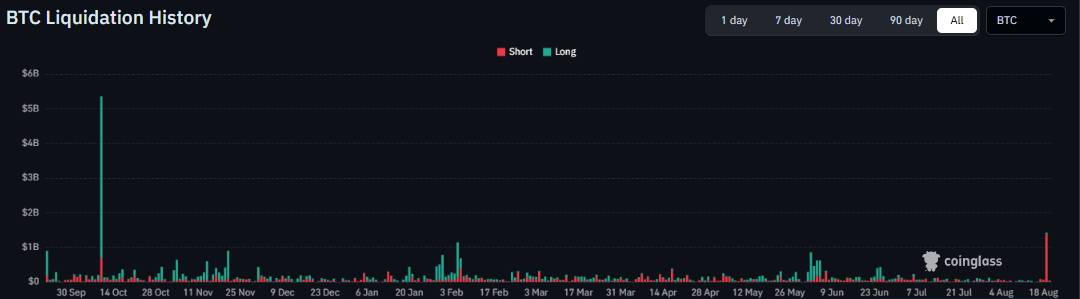
CoinGlass liquidation data shows that 172,642 traders were liquidated in the last 24 hours, totaling nearly $3 billion across the crypto market.
Bitcoin saw an extreme positioning imbalance, with shorts accounting for 96.6% of positions. The crowded positioning contributed to a sharp short squeeze, with total liquidations of over $1.45 billion in BTC. This marked the largest single-day liquidation event since October 10, when the US announced higher tariffs on Chinese imports.
Institutional demand strengthens
SoSoValue data showed spot ETFs recorded a $517.19 million inflow on Wednesday, the highest single-day gain since early May. Renewed institutional interest reflects growing demand for Bitcoin and supports its price outlook.
Bitcoin Price Forecast: How high can BTC go?
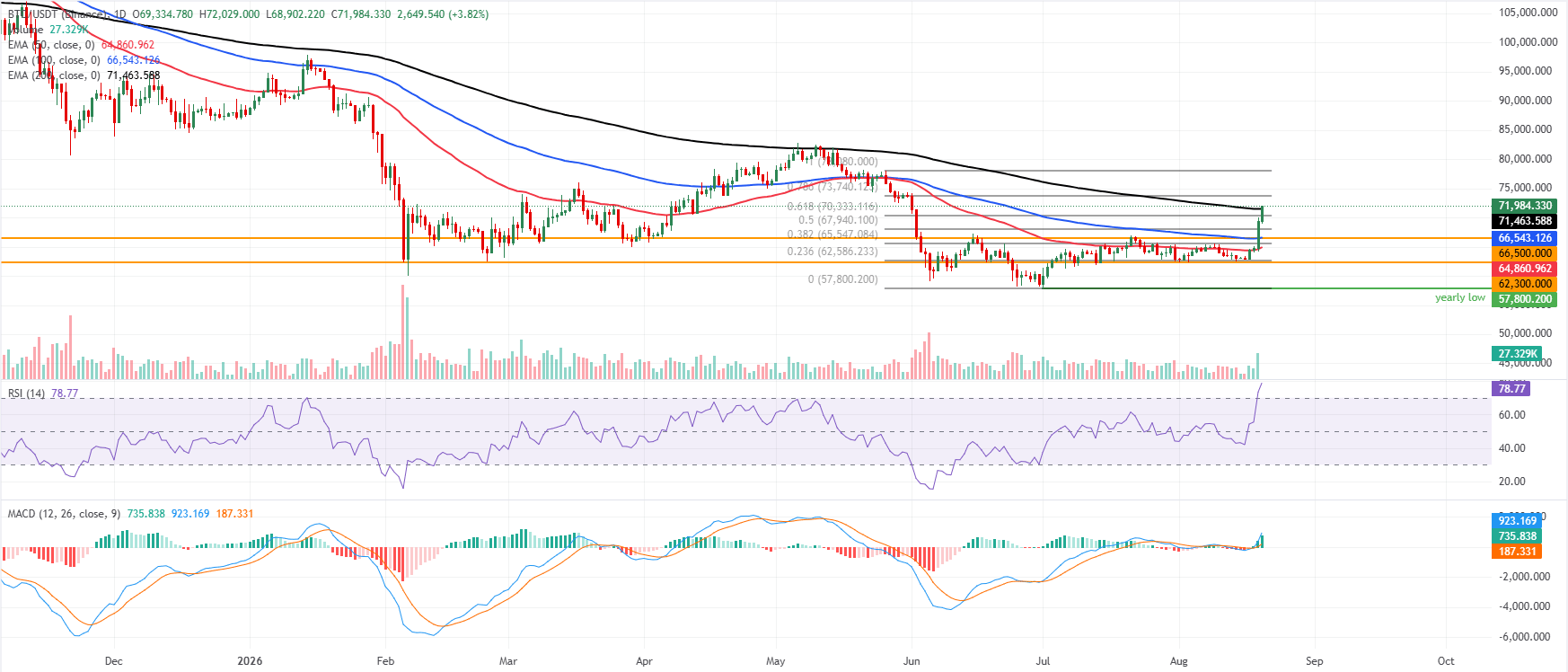
Bitcoin price trades near $72,000 on Thursday, maintaining a bullish near-term bias as price holds above the major Exponential Moving Averages (EMAs). The 200-day EMA at $71,463 reinforces immediate trend support beneath spot, while the 100-day and 50-day EMAs at $66,543 and $64,860 underpin the broader constructive structure.
The 61.8% Fibonacci retracement at $70,333 (drawn from the May 26 high of $78,080 to the yearly low of $57,800 recorded on July 1) adds another layer of nearby demand.
Momentum remains stretched, with the Relative Strength Index (RSI) hovering in overbought territory near 79 and the Moving Average Convergence Divergence (MACD) firmly positive, suggesting strong but potentially vulnerable upside pressure.
On the topside, initial resistance is seen at the 78.6% Fibonacci retracement, located around $73,740, where fresh supply could emerge if the rally extends.
On the downside, immediate support is defined by the 200-day EMA at $71,463, followed by the 61.8% retracement at $70,333. Deeper pullbacks would find a more congested demand area between the 50% retracement level at $67,940 and the 100-day EMA at $66,543, closely aligned with horizontal support at $66,500. Below that, medium-term support levels stack at the 38.2% Fibonacci retracement at $65,547 and the 23.6% Fibonacci retracement at $62,586, ahead of the structural floor near $62,300.
(The technical analysis of this story was written with the help of an AI tool. Know more.)
Bitcoin, altcoins, stablecoins FAQs
Bitcoin is the largest cryptocurrency by market capitalization, a virtual currency designed to serve as money. This form of payment cannot be controlled by any one person, group, or entity, which eliminates the need for third-party participation during financial transactions.
Altcoins are any cryptocurrency apart from Bitcoin, but some also regard Ethereum as a non-altcoin because it is from these two cryptocurrencies that forking happens. If this is true, then Litecoin is the first altcoin, forked from the Bitcoin protocol and, therefore, an “improved” version of it.
Stablecoins are cryptocurrencies designed to have a stable price, with their value backed by a reserve of the asset it represents. To achieve this, the value of any one stablecoin is pegged to a commodity or financial instrument, such as the US Dollar (USD), with its supply regulated by an algorithm or demand. The main goal of stablecoins is to provide an on/off-ramp for investors willing to trade and invest in cryptocurrencies. Stablecoins also allow investors to store value since cryptocurrencies, in general, are subject to volatility.
Bitcoin dominance is the ratio of Bitcoin's market capitalization to the total market capitalization of all cryptocurrencies combined. It provides a clear picture of Bitcoin’s interest among investors. A high BTC dominance typically happens before and during a bull run, in which investors resort to investing in relatively stable and high market capitalization cryptocurrency like Bitcoin. A drop in BTC dominance usually means that investors are moving their capital and/or profits to altcoins in a quest for higher returns, which usually triggers an explosion of altcoin rallies.
Recommended Articles


