




L2 Builders Join Discourse on Buterin’s Scaling Model as $HYPER Brings SVM Speed to $BTC
- Vitalik Buterin’s push for stage 2 rollups has created a rift between Ethereum purists and L2 developers who prioritize execution speed over rigid decentralization milestones.
- Capital is increasingly rotating away from philosophical scaling debates and toward ecosystems that offer high-performance, “snap-execution” environments for DeFi.
- The industry is moving beyond viewing Bitcoin solely as digital gold, instead exploring its potential as a secure settlement layer for complex, programmable smart contracts.
- Leveraging the Solana Virtual Machine (SVM), Bitcoin Hyper has raised over $31M by bringing high-speed modular execution to the Bitcoin network.
The debate over blockchain scalability has shifted from simple throughput to a fundamental questioning of the Layer 2 purpose. Ethereum co-founder Vitalik Buterin recently sparked an industry-wide ‘rollup rethink,‘ arguing that the original vision of L2s as the primary scaling engine ‘no longer makes sense’ if they fail to fully inherit Ethereum’s security.
This shift toward demanding ‘Stage 2’ maturity, removing the ‘training wheels’ of centralized security councils, has drawn pushback from major builders. While figures like Arbitrum’s Steven Goldfeder maintain that L2s remain essential for massive scale, others, like Base’s Jesse Pollak, acknowledge that L2s must now differentiate through specialization rather than just being Ethereum but cheaper.’

This tension has left a market gap for solutions that prioritize raw, specialized performance without waiting for the slow crawl of base-layer decentralization milestones.
That friction matters because it exposes a massive gap in current market infrastructure. While Ethereum developers debate the philosophical nuances of decentralized sequencers and specialized roles, capital is quietly rotating toward ecosystems that prioritize raw throughput without sacrificing settlement security.
The market creates a vacuum for solutions that can offer the best of both worlds, the liquidity of a major L1, combined with the snap-execution of a high-performance L2.
Enter the Bitcoin Layer 2 thesis. Investors are looking past the Ethereum deadlock to see if Bitcoin, historically viewed as digital gold rather than a compute layer, can handle the load.
Emerging protocols are attempting to graft high-speed execution environments directly onto Bitcoin’s Proof-of-Work foundation. Leading this charge is Bitcoin Hyper ($HYPER), a project leveraging the Solana Virtual Machine (SVM) to solve the latency issues that have plagued Bitcoin scaling for years.
SVM Integration and Modular Network Design
Bitcoin Hyper ($HYPER) distinguishes itself through a L2 modular blockchain architecture that decouples transaction execution from final settlement. By integrating the Solana Virtual Machine (SVM), the protocol enables parallel transaction processing, a significant departure from Bitcoin’s sequential model, allowing for theoretical throughput exceeding 12,000 TPS and sub-second finality.
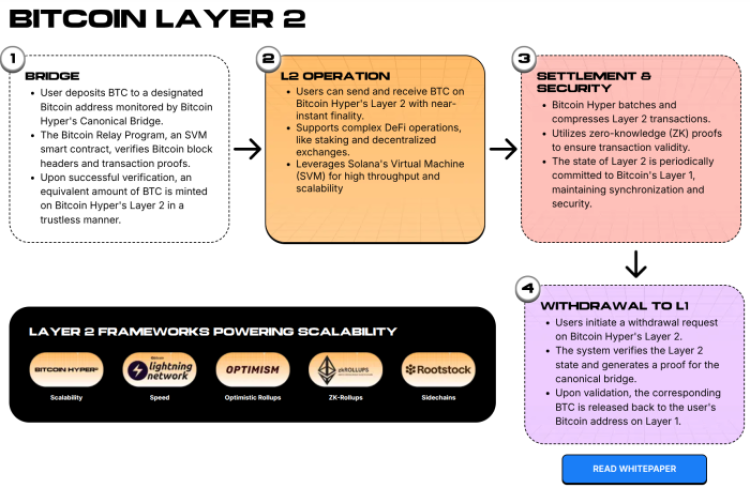
The system’s core functionality relies on two primary technical pillars:
- The Canonical Bridge: A decentralized gateway where users lock native $BTC on the Bitcoin base layer to mint wrapped tokens ($wBTC) on the Layer 2. This process utilizes Zero-Knowledge (ZK) proofs to verify state transitions, ensuring that assets remain secure without requiring a centralized intermediary.
- Dual-Layer Security: While execution occurs on the high-speed SVM layer, the protocol periodically batches and anchors L2 state data back to the Bitcoin Mainnet. This ensures the network benefits from Solana’s agility while inheriting Bitcoin’s immutable security for final settlement.
Furthermore, Bitcoin Hyper transitions the Bitcoin user experience into a Proof-of-Stake (PoS) environment. Unlike the energy-intensive mining required on the base layer, $HYPER tokens facilitate a low-energy consensus mechanism on the L2.
This allows for native staking, where participants secure the network and manage governance through a decentralized DAO, effectively transforming Bitcoin from a passive asset into a functional, yield-generating compute layer.
Buy $HYPER now for $0.0136751
Incentivized Staking and Governance Infrastructure
Beyond its execution layer, Bitcoin Hyper is built on a utility-driven tokenomics model where the $HYPER token serves as the network’s lifeblood for gas fees, staking, and governance.
To ensure a stable rollout, the project employs a dynamic APY system for presale participants, which currently allows investors to stake their tokens immediately to earn rewards before the mainnet launch. This is designed to bootstrap liquidity and decentralize the initial set of token holders who will eventually participate in the network’s DAO.
To manage the transition from presale to the open market, the protocol utilizes a 7-day vesting period for staked rewards. This mechanism acts as a technical buffer against volatility, ensuring that as the Solana-compatible smart contracts go live, the network maintains enough staked collateral to remain secure.
The structure, combined with a non-custodial bridging approach, aims to provide a high-performance DeFi environment that remains ‘opt-in’ for Bitcoin holders. This will allow them to move assets between the ‘digital gold’ of the L1 and the high-velocity compute engine of the L2 at will.
If you want a full project rundown, we’ve got you covered with our ‘What is Bitcoin Hyper?‘ guide.
$HYPER’s already caught significant attention, having raised over $31M, and offering 37% staking rewards. The market’s clearly after a solution to the old blockchain trilemma, and Bitcoin Hyper might have the answer.
EXPLORE THE $HYPER PRESALE HERE
This article is for informational purposes only and does not constitute financial advice. Cryptocurrency investments are highly volatile and carry a high risk of loss. Always conduct your own due diligence before investing.
Recommended Articles


