




Ripple Price Forecast: XRP holds support as key on-chain indicator signals potential bullish turnaround
- XRP stabilizes above $1.90 short-term support, but remains below the 50-day EMA resistance.
- XRP Long-Term Holder NUPL on-chain indicator resets, signaling a potential floor price and bullish shift.
- XRP ETFs' inflows resume despite broader market volatility and low retail interest.
Ripple (XRP) is consolidating above $1.90, a short-term support level, at the time of writing on Thursday. This mild uptick marks two consecutive days of a strengthening technical outlook, following recent market-wide volatility.
XRP Long-Term Holder signals fresh accumulation
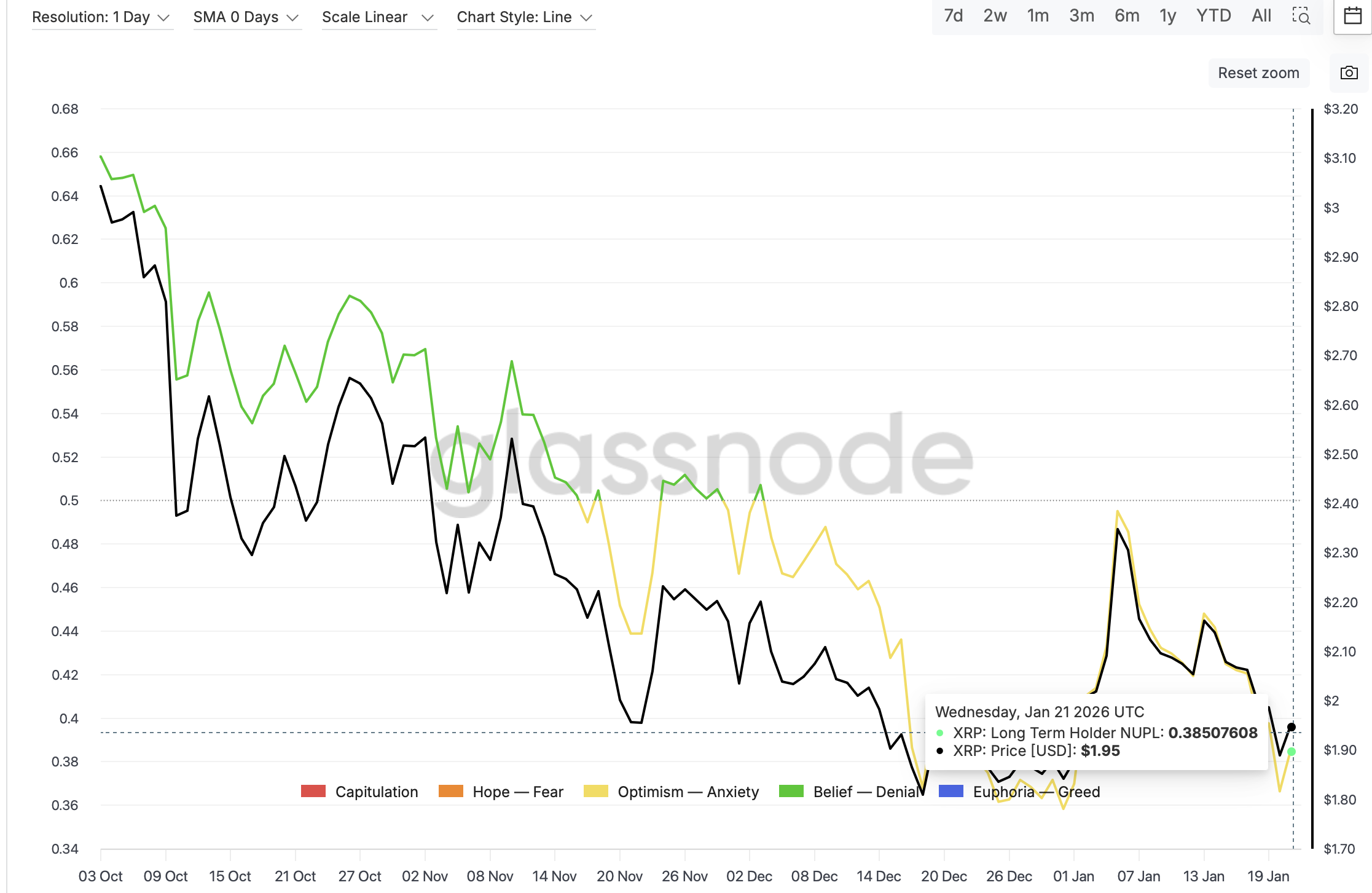
The XRP Long-Term Holder Net Unrealized Profit/Loss (LTH-NUPL) indicator has reset to levels historically associated with accumulation phases and local price floors. Glassnode’s data shows that the LTH-NUPL ratio indicates a transition to optimism at 0.39.
A continued recovery in this metric would keep investors interested in XRP as accumulation drives prices higher. The LTH-NUPL considers transactions with a lifespan of at least 155 days and serves as an indicator of long-term investor behaviour.
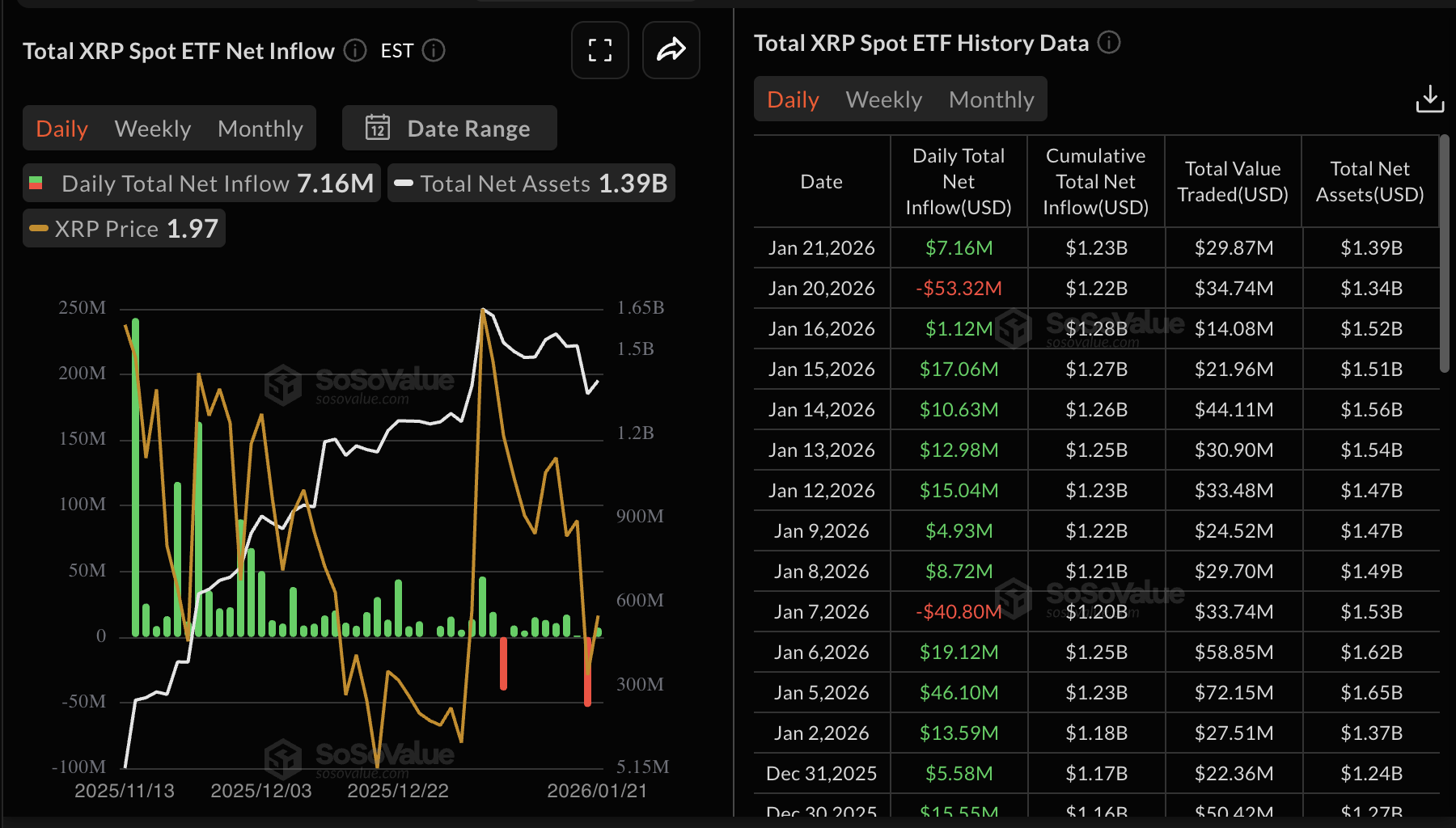
Meanwhile, institutional investors are leaning back into risk, as evidenced by inflows into Exchange Traded Funds (ETFs). SoSoValue data shows approximately $7 million in inflows on Wednesday, led by Bitwise’s XRP ETF with over $5 million and Franklin Templeton’s XRPZ with $1 million. The cumulative total inflow currently stands at $1.23 billion, and the net assets at $1.39 billion.
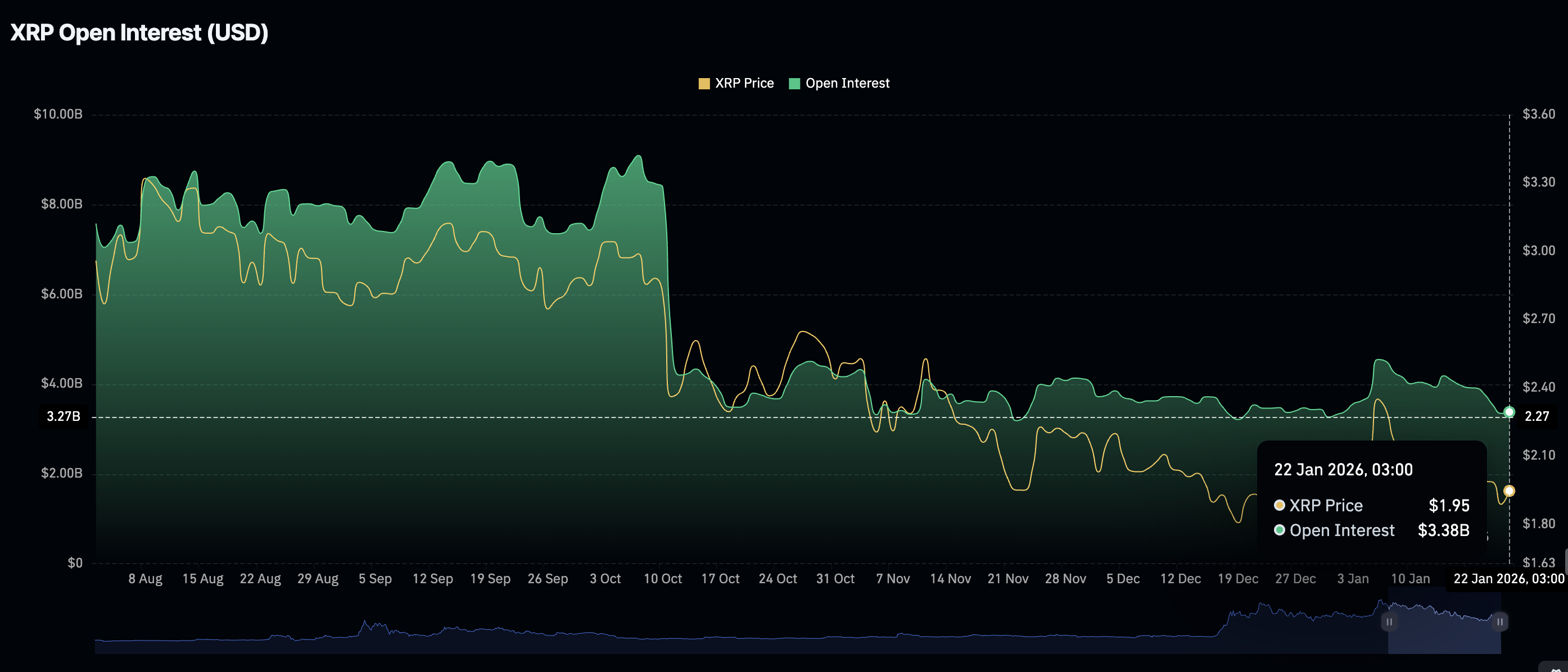
Retail interest in XRP remains largely subdued despite institutional investors leaning back into risk. CoinGlass shows futures Open Interest (OI) averaging $3.38 billion on Thursday, up slightly from $3.35 the previous day. The OI has declined from $4.55 billion recorded on January 6, underlining the prevailing risk-off sentiment. Low retail interest may constrain XRP’s upside.
Technical outlook: XRP defends support amid mixed signals
The Moving Average Convergence Divergence (MACD) indicator remains below the signal line on the daily chart, confirming XRP’s short-term bearish momentum. The histogram bars, which are expanding below the zero line, may prompt investors to reduce exposure, adding to the selling pressure.
Meanwhile, the $1.90 support level remains critical for XRP to sustain bullish momentum and reclaim the $2.00 psychological threshold. Beyond this range, the 50-day Exponential Moving Average (EMA) caps the upside at $2.05, the 100-day EMA at $2.18 and the 200-day EMA at $2.30.
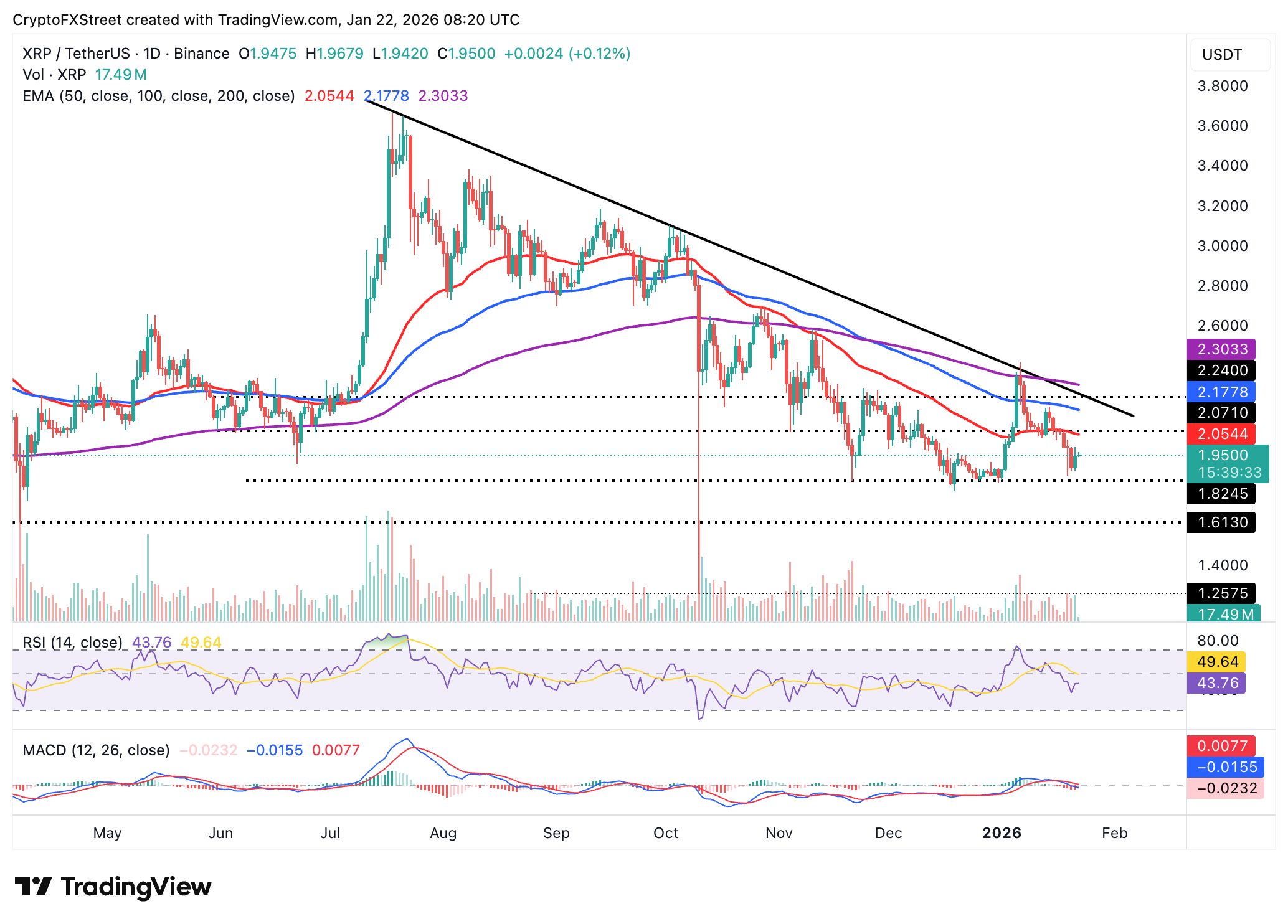
However, the Relative Strength Index (RSI) has risen to 44 on the daily chart, indicating that bearish momentum is fading. A sustained move above the 50 midline would signal a shift from bearish to bullish momentum. Conversely, a daily close below the $1.90 support could accelerate downside pressure toward Monday’s low of $1.85.
Cryptocurrency metrics FAQs
The developer or creator of each cryptocurrency decides on the total number of tokens that can be minted or issued. Only a certain number of these assets can be minted by mining, staking or other mechanisms. This is defined by the algorithm of the underlying blockchain technology. On the other hand, circulating supply can also be decreased via actions such as burning tokens, or mistakenly sending assets to addresses of other incompatible blockchains.
Market capitalization is the result of multiplying the circulating supply of a certain asset by the asset’s current market value.
Trading volume refers to the total number of tokens for a specific asset that has been transacted or exchanged between buyers and sellers within set trading hours, for example, 24 hours. It is used to gauge market sentiment, this metric combines all volumes on centralized exchanges and decentralized exchanges. Increasing trading volume often denotes the demand for a certain asset as more people are buying and selling the cryptocurrency.
Funding rates are a concept designed to encourage traders to take positions and ensure perpetual contract prices match spot markets. It defines a mechanism by exchanges to ensure that future prices and index prices periodic payments regularly converge. When the funding rate is positive, the price of the perpetual contract is higher than the mark price. This means traders who are bullish and have opened long positions pay traders who are in short positions. On the other hand, a negative funding rate means perpetual prices are below the mark price, and hence traders with short positions pay traders who have opened long positions.
Recommended Articles


