
Bitcoin ‘Death Cross’ Panic Returns: History Says It’s A Late Signal

Source Newsbtc

Bitcoin’s “death cross” is back in the group chat. And yes, the emails too. Matthew Sigel, head of digital assets research at VanEck, said he’s been “getting questions from clients” about the latest death cross print — the 50-day moving average slipping under the 200-day — and answered with the kind of data dump that tends to calm people down.

“Lagging indicator,” Sigel wrote on X, alongside a table of every Bitcoin death cross going back to 2011. The summary stats are clean: the 6-month median return after a death cross is +30%, the 12-month median is +89%, and the “positive hit rate” is 64%.

Another Bitcoin Death Cross, Another Missed Bottom?

But the interesting bit isn’t just the returns. It’s Sigel’s market regime column — basically a hint that the same technical signal can mean wildly different things depending on where you are in the cycle.
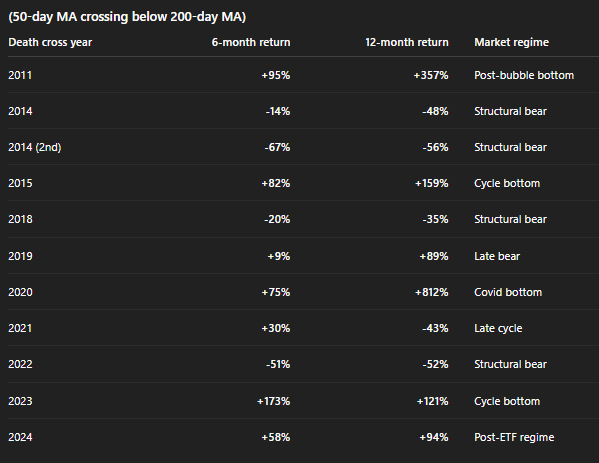
Bitcoin death cross history

Take the ones tagged as some version of “bottom.” In 2011 (“post-bubble bottom”), the death cross showed up around the wreckage of an early-cycle blow-off, and the next 12 months were +357%. In 2015 (“cycle bottom”), it was +82% at six months and +159% at 12 months — classic post-capitulation behavior where trend indicators catch up late, after price has already stabilized and started to turn.

2020 (“Covid bottom”) is the extreme example: forced liquidation, policy response, then a monster rebound (+812% over 12 months). And 2023 is also tagged “cycle bottom,” with +173% at six months and +121% at 12 months — the kind of “this is awful until it isn’t” regime crypto does better than any asset class.

Now look at “structural bear.” That label shows up in 2014 (twice), 2018, and 2022 — and the forward returns are mostly ugly: 2014 prints -48% and -56% over 12 months, 2018 is -35%, and 2022 is -52%. Different environment. Less “washout and bounce,” more “trend is down because the system is deleveraging,” whether that’s miners, credit, exchanges, or macro liquidity tightening. In those regimes, a death cross isn’t a late alarm — it’s the moving averages confirming that the downtrend is real and persistent.

The in-between tags matter too. 2019 is marked “late bear,” with +9% at six months and +89% at 12 — choppy, uneven, but improving as the cycle turns. 2021 is “late cycle”: +30% at six months, then -43% at 12, which fits a regime where trend signals can whipsaw while distribution and macro tightening creep in.

And then there’s 2024: “post-ETF regime,” with +58% at six months and +94% at 12. That tag is doing a lot of work. It suggests the backdrop isn’t just “price vs. moving averages,” but structural demand (ETFs), different liquidity plumbing, and a market that may behave less like pure reflexive leverage and more like a hybrid of trad-fi flows plus crypto-native positioning.

So the takeaway isn’t “death crosses are bullish.” That’s not true. It’s that the signal is mostly a trailing mirror — and the regime you’re actually in (bottoming, late bear, structural deleveraging, late cycle, post-ETF flow market) is what decides whether it’s a fake-out, a confirmation, or just noise with a scary name.

At press time, Bitcoin traded at $86,631.
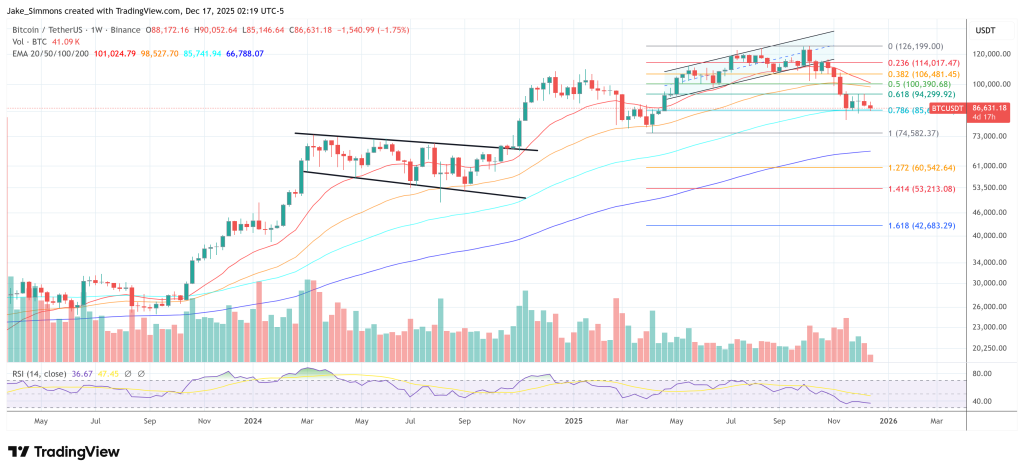
Bitcoin price
Disclaimer: For information purposes only. Past performance is not indicative of future results.
placeholder
US Dollar's Decline Predicted in 2026: Morgan Stanley's Outlook on Currency VolatilityMorgan Stanley forecasts a 5% drop in the dollar by mid-2026, attributed to continued Fed rate cuts. A recovery may follow as growth improves and funding currency dynamics shift favorably toward the euro and Swiss franc.
Author  Mitrade
Nov 25, Tue
Morgan Stanley forecasts a 5% drop in the dollar by mid-2026, attributed to continued Fed rate cuts. A recovery may follow as growth improves and funding currency dynamics shift favorably toward the euro and Swiss franc.
placeholder
Gold's Historic 2025 Rally: Can the Momentum Last Through 2026?Following a historic surge in 2025 that saw prices climb over 60% and break records more than 50 times, gold investors are now looking ahead to assess whether the precious metal can sustain its momentum into 2026. Despite outperforming most major asset classes and heading for its best annual performance since 1979, analysts are divided on the outlook—with some seeing further room for gains and others cautioning that risks are rising.
Author  Mitrade
Dec 09, Tue
Following a historic surge in 2025 that saw prices climb over 60% and break records more than 50 times, gold investors are now looking ahead to assess whether the precious metal can sustain its momentum into 2026. Despite outperforming most major asset classes and heading for its best annual performance since 1979, analysts are divided on the outlook—with some seeing further room for gains and others cautioning that risks are rising.
placeholder
Asian Stocks Retreat as Tech Woes and China's Economic Concerns Weigh HeavyMost Asian markets fell on Monday, led by declining technology shares amid weak U.S. earnings guidance. Chinese stocks showed relative resilience, but wider economic fears suggest increased stimulus pressures.
Author  Mitrade
Dec 15, Mon
Most Asian markets fell on Monday, led by declining technology shares amid weak U.S. earnings guidance. Chinese stocks showed relative resilience, but wider economic fears suggest increased stimulus pressures.
placeholder
Cryptocurrencies Extend Losses as Year-End Caution and Thinning Liquidity Weigh on MarketThe cryptocurrency market declined on Monday, mirroring a pullback in global risk assets as investors turned cautious ahead of key U.S. economic data. The broad-based retreat highlighted thinning liquidity and growing risk aversion across financial markets as the year draws to a close.
Author  Mitrade
Yesterday 08: 11
The cryptocurrency market declined on Monday, mirroring a pullback in global risk assets as investors turned cautious ahead of key U.S. economic data. The broad-based retreat highlighted thinning liquidity and growing risk aversion across financial markets as the year draws to a close.
placeholder
Australian Interest Rate Cuts Postponed to 2027 Amid Rising Inflation Pressures, Westpac PredictsWestpac analysts forecast the Reserve Bank of Australia will hold interest rates steady through 2026, with potential cuts now expected in early to mid-2027 due to resurging inflation and labor market concerns.
Author  Mitrade
9 hours ago
Westpac analysts forecast the Reserve Bank of Australia will hold interest rates steady through 2026, with potential cuts now expected in early to mid-2027 due to resurging inflation and labor market concerns.
goTop
quote