

Wall Street FOMO Over Vanguard’s Bitcoin ETF Pivot: $HYPER Rides the Wave
What to Know:
- Vanguard’s embrace of spot Bitcoin ETFs adds another giant gatekeeper to the BTC on-ramp, channeling retirement and retail capital into the asset.
- As Bitcoin becomes an ETF-friendly macro asset, traders seeking more upside are rotating toward higher-risk ecosystem plays and infrastructure tokens.
- Bitcoin Hyper targets Bitcoin’s limitations on speed, fees, and programmability by integrating SVM on a modular Layer 2 anchored to $BTC settlement.
- The Bitcoin Layer 2 race is intensifying as projects compete to capture DeFi, gaming, and payments flows that the base Bitcoin network cannot natively support.
For years, Vanguard stood out as the big asset manager that wanted nothing to do with spot Bitcoin ETFs.
That stance quietly shifted, and the pivot matters. When a $9+ trillion retirement giant opens the door to $BTC exposure, it adds another massive gatekeeper to the on-ramp for mainstream capital. It saw $BTC rally on Tuesday, jumping back up to the $92K mark from a recent dip below the $86K region.
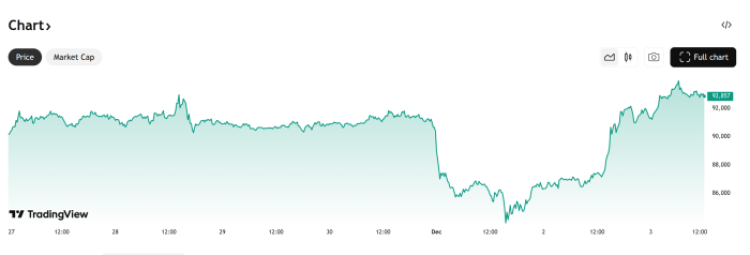
You now have BlackRock, Fidelity, and Vanguard funneling retirement portfolios, 401(k)s, and brokerage accounts into spot Bitcoin. That flow doesn’t just push up $BTC’s market cap; it changes how traditional investors think about crypto risk. Bitcoin starts to look like ‘digital gold core holding,’ not a speculative side bet.
The knock-on effect is obvious for traders: if Bitcoin becomes the safe, ETF-wrapped asset, the search for higher-octane upside moves further out on the risk curve. That’s where ecosystem plays, infrastructure tokens, and early-stage presales come in.
Bitcoin Hyper ($HYPER) is positioning itself exactly in that lane, pitching itself as a Bitcoin-native Layer 2 with Solana-grade performance.
As capital crowds into spot BTC via TradFi rails, the question for more aggressive crypto traders isn’t ‘Should I own Bitcoin?’ anymore. It’s ‘Where can I get leveraged exposure to the Bitcoin network’s growth without using actual leverage?’
For some, that answer increasingly looks like ecosystem bets such as Bitcoin Hyper (HYPER) and other high-throughput Bitcoin Layer 2s.Why Wall Street’s Bitcoin Obsession Pushes Attention To Layer 2
Wall Street’s ETF embrace solves one thing: easy Bitcoin exposure inside familiar accounts. It doesn’t solve Bitcoin’s technical pain points. The base layer still processes roughly 7 transactions per second, with confirmation times measured in minutes and fees that spike into double digits when mempools clog.

That limitation is a feature for store-of-value purists, but a brick wall for anyone wanting DeFi, gaming, or consumer apps atop Bitcoin.
So you’re seeing a rush of infrastructure projects racing to bolt smart contracts and high throughput onto $BTC without compromising its settlement assurances.
Competing visions include Ordinals-centric tooling, sidechains like Rootstock, and experimental rollup frameworks.
In that crowded field, Bitcoin Hyper ($HYPER) is pitching itself as a unique contender, differentiating through Solana Virtual Machine (SVM) compatibility. It has an explicit focus on traders and DeFi power users looking to amplify Bitcoin’s upside rather than just hold ETF shares.
You can buy $HYPER for $0.013365 while it’s still in its presale, and take advantage of 40% staking rewards.Bitcoin Hyper’s Bet: Solana Performance, Bitcoin Settlement
Zooming in, Bitcoin Hyper ($HYPER) markets itself as ‘the first ever Bitcoin Layer 2 with SVM integration,’ aiming to deliver performance that can exceed Solana’s own execution speeds.
Anchored by a canonical bridge that links Bitcoin’s security to high-speed execution, Bitcoin Hyper’s modular architecture combines the best of both worlds. The system relies on Bitcoin L1 for settlement while offloading processing to a real-time SVM Layer 2, where a single sequencer commits state roots on-chain.

This bridge allows you to escape L1 congestion and access an ecosystem of instant, low-cost wrapped $BTC payments, NFTs, and DeFi. With support for Rust SDKs and Solana-style APIs, Bitcoin Hyper brings high-performance gaming and complex smart contracts to Bitcoin. If you want more info, check out our ‘What is Bitcoin Hyper’ guide.
The market seems to be paying attention as the Bitcoin Hyper presale has raised over $28.8M so far. And smart money is moving. High-net-worth wallets have been making purchases as large as $500K.
Our experts see a potential end-of-2026 high of $0.08625, which, if you bought at today’s price, would see you with a potential ROI of over 545%.
If you believe Vanguard and its peers will keep funneling conservative capital into spot Bitcoin, Layer 2s like $HYPER offer a different angle: upside tied not just to $BTC’s price, but to whether Bitcoin can finally host high-throughput applications at scale.
Join the $HYPER presale.Remember, this isn’t intended as financial advice, and you should always do your own research before investing.
Authored by Aaron Walker, NewsBTC — https://www.newsbtc.com/news/vanguard-etf-pivot-causes-fomo-as-hyper-rides-the-wave
Recommended Articles


