




Gold confined to range ahead of Fed rate decision, USD steadies
- Gold holds steady above $4,200 as traders turn cautious ahead of Wednesday’s Federal Reserve interest rate decision.
- US Dollar steadies and Treasury yields climb, limiting upside for XAU/USD while keeping the metal confined to its one-week range.
- Technically, XAU/USD remains trapped in a tight range, with consistent dip-buying interest emerging around the $4,200-$4,180 zone.
Gold (XAU/USD) kicks off the week on a quiet note, with traders reluctant to take fresh positions ahead of the Federal Reserve’s (Fed) interest rate decision on Wednesday. At the time of writing, XAU/USD is trading around $4,210, extending its consolidation phase within the familiar one-week range.
Attention remains squarely on the Fed’s monetary policy meeting, with markets gearing up for another interest rate cut at the final policy decision of 2025, which would bring the Federal Funds Rate down to the 3.50%-3.75% range.
However, the latest Personal Consumption Expenditures (PCE) data and mixed labour indicators are prompting markets to consider that the Fed may opt for a more measured approach to additional monetary policy easing heading into 2026, which in turn is helping the US Dollar (USD) stabilise and pushing Treasury yields higher.
Beyond monetary policy, geopolitical risks also remain in focus, as the Russia-Ukraine war and renewed tensions between Thailand and Cambodia continue to provide a supportive backdrop for Gold.
Market movers:
- The US Dollar Index (DXY), which tracks the Greenback against a basket of six major currencies, is trading around 98.97, staging a modest recovery after dipping to 98.79 earlier in the Asian session. Meanwhile, Treasury yields are edging higher across the curve, with the benchmark 10-year hovering near 4.155%, its highest level in more than two weeks.
- US data released on Friday showed that PCE inflation continues to stall, signalling that disinflation progress is slowing. Core PCE, the Fed’s preferred gauge, rose 0.2% MoM in September, matching expectations, while the annual rate eased only slightly to 2.8% from 2.9%. Headline PCE also held steady at 0.3% MoM and 2.8% YoY.
- Labour data released last week painted a mixed picture. ADP Employment Change unexpectedly declined by 32,000 in November, sharply missing expectations for a 5,000 increase after a revised 47,000 gain in October. Challenger Job Cuts dropped to 71.3K from 153.1K, while Initial Jobless Claims declined to 191K, beating expectations for 220K and down from 218K the previous week.
- According to the CME FedWatch Tool, markets assign around an 87% probability of a 25 basis point (bps) rate cut at the upcoming Fed meeting.
- According to the World Gold Council (WGC) report published on December 5, global gold ETFs recorded their sixth consecutive month of inflows in November, adding US$5.2 billion as assets under management climbed to a record US$530 billion.
Technical analysis: XAU/USD holds range as $4,250 caps upside
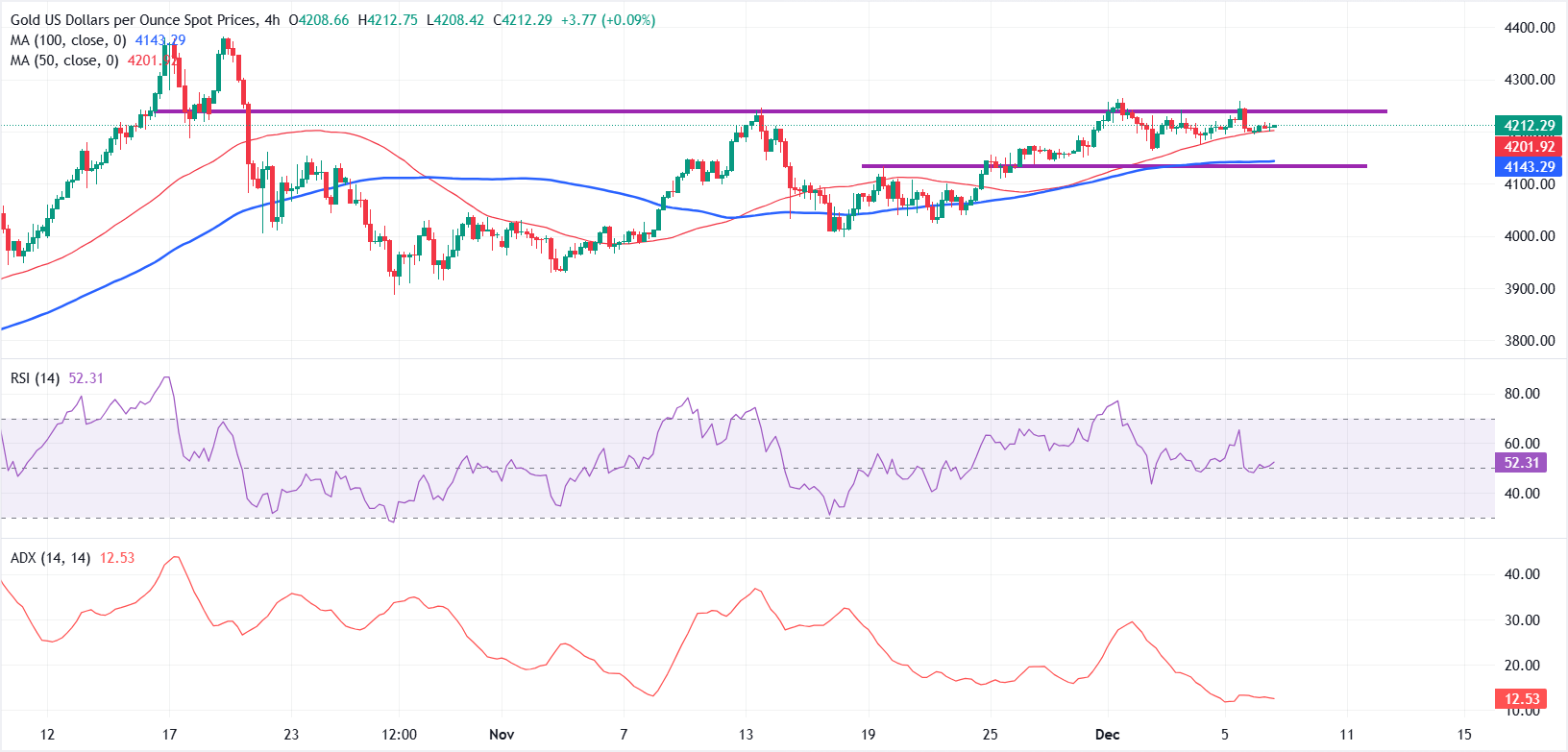
Gold (XAU/USD) remains range-bound, with repeated dip-buying interest emerging in the $4,200-$4,180 zone. On the 4-hour chart, the 50-period SMA is acting as immediate dynamic support near $4,201, while the 100-period SMA around $4,142 provides a deeper cushion.
On the upside, $4,250 continues to cap advances and stands as a firm barrier that bulls must clear to regain momentum. A sustained break above this ceiling would shift the bias more decisively in favour of buyers and open the door for a retest of the all-time highs.
Momentum signals remain muted. The Relative Strength Index (RSI) is hovering near 52, reflecting a neutral stance and aligning with the current consolidation phase. Meanwhile, the Average Directional Index (ADX) at 12.7 indicates very weak trend strength, confirming that XAU/USD lacks directional conviction and remains stuck in a sideways structure.
Gold FAQs
Gold has played a key role in human’s history as it has been widely used as a store of value and medium of exchange. Currently, apart from its shine and usage for jewelry, the precious metal is widely seen as a safe-haven asset, meaning that it is considered a good investment during turbulent times. Gold is also widely seen as a hedge against inflation and against depreciating currencies as it doesn’t rely on any specific issuer or government.
Central banks are the biggest Gold holders. In their aim to support their currencies in turbulent times, central banks tend to diversify their reserves and buy Gold to improve the perceived strength of the economy and the currency. High Gold reserves can be a source of trust for a country’s solvency. Central banks added 1,136 tonnes of Gold worth around $70 billion to their reserves in 2022, according to data from the World Gold Council. This is the highest yearly purchase since records began. Central banks from emerging economies such as China, India and Turkey are quickly increasing their Gold reserves.
Gold has an inverse correlation with the US Dollar and US Treasuries, which are both major reserve and safe-haven assets. When the Dollar depreciates, Gold tends to rise, enabling investors and central banks to diversify their assets in turbulent times. Gold is also inversely correlated with risk assets. A rally in the stock market tends to weaken Gold price, while sell-offs in riskier markets tend to favor the precious metal.
The price can move due to a wide range of factors. Geopolitical instability or fears of a deep recession can quickly make Gold price escalate due to its safe-haven status. As a yield-less asset, Gold tends to rise with lower interest rates, while higher cost of money usually weighs down on the yellow metal. Still, most moves depend on how the US Dollar (USD) behaves as the asset is priced in dollars (XAU/USD). A strong Dollar tends to keep the price of Gold controlled, whereas a weaker Dollar is likely to push Gold prices up.
Recommended Articles


