




Pound Sterling clings to gains against US Dollar ahead of US CPI data
- The Pound Sterling trades firmly near 1.3470 against the US Dollar ahead of the US inflation data release for December.
- Fed’s Bostic warns of high inflation and stresses the need to bring it under control.
- Rising concerns about the Fed’s independence could hit the US sovereign rating.
The Pound Sterling (GBP) holds onto Monday’s gains around 1.3470 against the US Dollar (USD) during the European trading session on Tuesday. The GBP/USD pair trades firmly ahead of the United States (US) Consumer Price Index (CPI) data for December, which will be published at 13:30 GMT.
Investors will monitor the US CPI data to get fresh cues on the current price growth in the economy and the Federal Reserve’s (Fed) monetary policy outlook. However, the impact of inflation figures is set to be limited on market expectations regarding interest rates in the near term, as Fed officials are more concerned about labor market risks.
In the December policy meeting, the Fed reduced interest rates by 25 basis points (bps) to 3.50%-3.75% in an attempt to contain employment risks and stated that there are “no inflation concerns in the long run”. “It doesn't feel like a hot economy,” Fed Chair Jerome Powell said in the press conference after the decision, adding, “Evidence is growing that services inflation has come down, and goods inflation is entirely due to tariffs.”
On the contrary, Atlanta Fed President Raphael Bostic warned in an interview with radio station WLRN on Friday that inflation is “too high” and the central bank needs to get it “under control”.
The US core inflation – which excludes volatile food and energy items – is expected to have risen at a faster pace to 2.7% YoY in December from 2.6% the previous month, with the headline figure growing steadily by 2.7%. Month-on-month (MoM), both headline and core CPI are estimated to have grown by 0.3%.
Daily Digest Market Movers: Pound Sterling trades calmly while UK GDP data takes centre stage
- The Pound Sterling trades broadly firm against its major currency peers, except the New Zealand Dollar (NZD), on Tuesday. The GBP gains as market sentiment for currencies that are facing limited fiscal and monetary risks remains upbeat, following criminal charges against Fed’s Powell over mismanaging funds allocated for the renovation of Washington’s headquarters.
- On Monday, US federal prosecutors sent a subpoena to Jerome Powell, which directs an inquiry into his statements in his testimony at the Senate in June 2025 and an examination of his spending records.
- In response, Fed’s chair stated that these criminal charges are a consequence of the central bank setting “interest rates based on its assessment of the public interest rather than the president's preferences”.
- On the domestic front, investors keenly await the United Kingdom (UK) monthly Gross Domestic Product (GDP) and the factory data for November, which are scheduled for Thursday. The Office for National Statistics (ONS) is expected to show that the economic growth remained flat after declining 0.1% in October. Meanwhile, MoM Manufacturing Production is estimated to have grown steadily by 0.5%, with Industrial Production remaining flat.
- Meanwhile, the outlook of the US Dollar has become uncertain as market experts believe that criminal charges against Jerome Powell are an attack on the Fed’s independence, a scenario that could hit the US sovereign rating. Analysts at Fitch Ratings have also noted that the central bank’s independence has been a key factor behind the strong US credit rating.
- This week, investors will also focus on the US Retail Sales and the Producer Price Index (PPI) data for December, which will be released on Wednesday.
Technical Analysis: GBP/USD holds 50% Fibo retracement at 1.3402
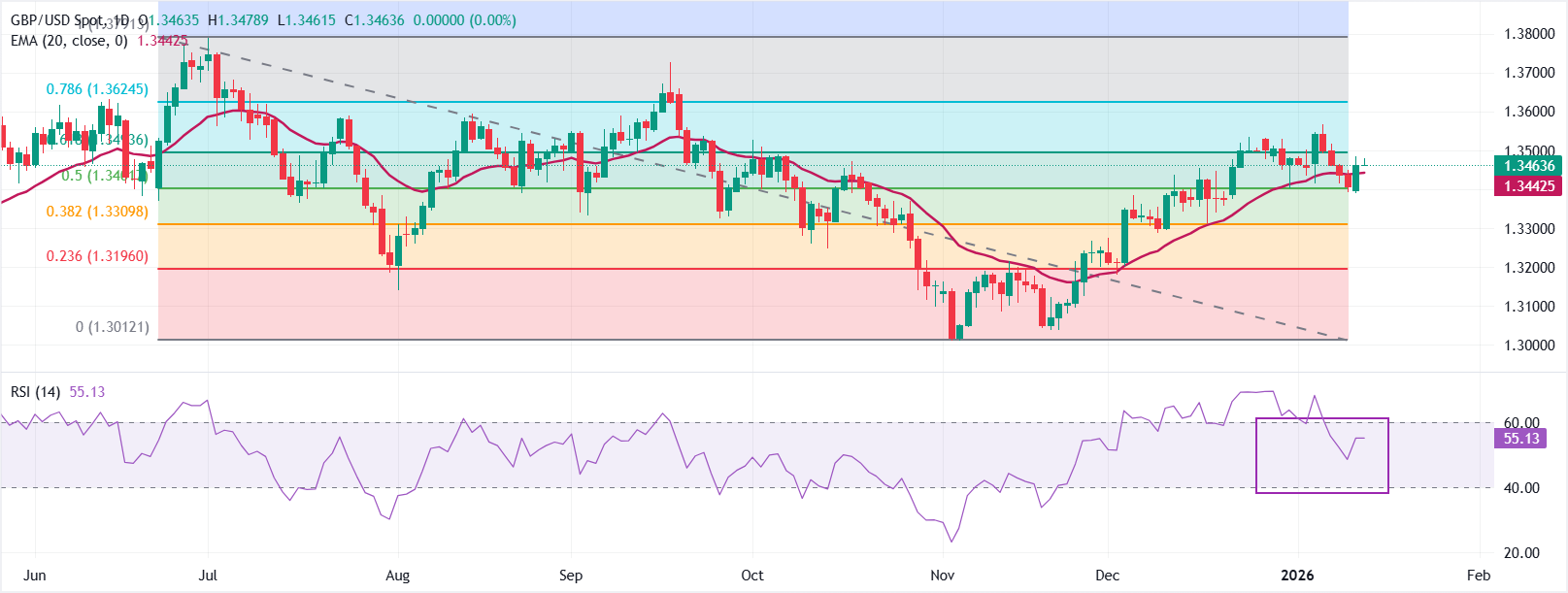
GBP/USD trades flat around 1.3463 at the press time. The 20-day Exponential Moving Average at 1.3442 is rising, with price holding above it to preserve short-term upside traction.
The 14-day Relative Strength Index (RSI) at 55 (neutral) indicates steady momentum rather than aggressive trend extension.
Measured from the 1.3791 high to the 1.3012 low, the pair wobbles inside the 50% Fibonacci retracement at 1.3402 and the 61.8% Fibonacci retracement at 1.3494. A break above the latter would improve the recovery profile and open the door towards the September 17 high of 1.3726, while a failure to clear overhead resistance would keep the rebound capped and encourage consolidation around the rising average.
(The technical analysis of this story was written with the help of an AI tool.)
Pound Sterling FAQs
The Pound Sterling (GBP) is the oldest currency in the world (886 AD) and the official currency of the United Kingdom. It is the fourth most traded unit for foreign exchange (FX) in the world, accounting for 12% of all transactions, averaging $630 billion a day, according to 2022 data. Its key trading pairs are GBP/USD, also known as ‘Cable’, which accounts for 11% of FX, GBP/JPY, or the ‘Dragon’ as it is known by traders (3%), and EUR/GBP (2%). The Pound Sterling is issued by the Bank of England (BoE).
The single most important factor influencing the value of the Pound Sterling is monetary policy decided by the Bank of England. The BoE bases its decisions on whether it has achieved its primary goal of “price stability” – a steady inflation rate of around 2%. Its primary tool for achieving this is the adjustment of interest rates. When inflation is too high, the BoE will try to rein it in by raising interest rates, making it more expensive for people and businesses to access credit. This is generally positive for GBP, as higher interest rates make the UK a more attractive place for global investors to park their money. When inflation falls too low it is a sign economic growth is slowing. In this scenario, the BoE will consider lowering interest rates to cheapen credit so businesses will borrow more to invest in growth-generating projects.
Data releases gauge the health of the economy and can impact the value of the Pound Sterling. Indicators such as GDP, Manufacturing and Services PMIs, and employment can all influence the direction of the GBP. A strong economy is good for Sterling. Not only does it attract more foreign investment but it may encourage the BoE to put up interest rates, which will directly strengthen GBP. Otherwise, if economic data is weak, the Pound Sterling is likely to fall.
Another significant data release for the Pound Sterling is the Trade Balance. This indicator measures the difference between what a country earns from its exports and what it spends on imports over a given period. If a country produces highly sought-after exports, its currency will benefit purely from the extra demand created from foreign buyers seeking to purchase these goods. Therefore, a positive net Trade Balance strengthens a currency and vice versa for a negative balance.
Recommended Articles


