




EUR/USD recovery loses steam as focus shifts to US CPI data
- EUR/USD steadies above 1.1650 on Tuesday after rejection at the 1.1700 area the previous day.
- Hawkish comments by Fed's Williams provided some support to the US Dollar on Monday.
- The market is bracing for a strong US CPI reading later on Tuesday.
EUR/USD is trading practically flat, near 1.1650 at the time of writing on Tuesday, after pulling back from the 1.1700 area. Some bullish comments by the New York Federal Reserve’s (Fed) President John Williams eased market concerns about the central bank’s independence and provided some footing to an ailing US Dollar (USD) on Monday.
Investors sold the US Dollar across the board on Monday’s early trading, following a report by the New York Times affirming that the US Government was initiating a criminal investigation against the Fed Chairman, Jerome Powell.
The action marks an escalation in an extended conflict between US President Donald Trump and Powell, which raises questions about the central bank’s independence and threatens the status of the US Dollar as a reserve currency.
Macroeconomic data is expected to return to the focus on Tuesday, as the US Bureau of Labour Statistics (BLS) releases the December US Consumer Price Index (CPI) report. Price pressures are expected to have remained well above the Fed’s 2% target, with core inflation ticking up. Barring surprises, these figures are likely to endorse the positions of the Fed's hawkish party.
Euro Price Today
The table below shows the percentage change of Euro (EUR) against listed major currencies today. Euro was the strongest against the Japanese Yen.
| USD | EUR | GBP | JPY | CAD | AUD | NZD | CHF | |
|---|---|---|---|---|---|---|---|---|
| USD | 0.03% | -0.04% | 0.43% | -0.01% | 0.09% | -0.11% | -0.00% | |
| EUR | -0.03% | -0.06% | 0.41% | -0.04% | 0.06% | -0.14% | -0.03% | |
| GBP | 0.04% | 0.06% | 0.47% | 0.03% | 0.13% | -0.08% | 0.03% | |
| JPY | -0.43% | -0.41% | -0.47% | -0.43% | -0.34% | -0.55% | -0.43% | |
| CAD | 0.01% | 0.04% | -0.03% | 0.43% | 0.10% | -0.11% | 0.00% | |
| AUD | -0.09% | -0.06% | -0.13% | 0.34% | -0.10% | -0.20% | -0.09% | |
| NZD | 0.11% | 0.14% | 0.08% | 0.55% | 0.11% | 0.20% | 0.11% | |
| CHF | 0.00% | 0.03% | -0.03% | 0.43% | -0.00% | 0.09% | -0.11% |
The heat map shows percentage changes of major currencies against each other. The base currency is picked from the left column, while the quote currency is picked from the top row. For example, if you pick the Euro from the left column and move along the horizontal line to the US Dollar, the percentage change displayed in the box will represent EUR (base)/USD (quote).
Daily Digest Market Movers: Concerns about Fed's independence keep weighing on the US Dollar
- The Euro (EUR) has lost ground but remains above Friday's lows, with the US Dollar still vulnerable amid the US Government's attacks on the Fed's independence.
- Fitc Ratings warned on Monday that the Fed's independence is a key factor supporting the US AA++ sovereign rating and that they will continue monitoring the governance, including "checks and balances," in their assessment of the US ratings.
- S&P Global Ratings also said that Fed credibility is a key pillar of US sovereign creditworthiness. In a previous report, the rating agency also warned that the US rating would come under pressure if the strength of American institutions is undermined.
- New York Fed President Johnsn Williams provided some support for the US Dollar on Monday, stating that recent Fed decisions have moved “the modestly restrictive stance closer to neutral” and that he expects a healthy economy in 2026. Williams also said that he sees monetary policy well-positioned to support the stabilisation of the labour market, and that he sees no reason to cut interest rates anytime soon.
- The market is pricing a 95% chance that the Fed will keep interest rates unchanged at its January meeting, and hopes of a rate cut in March have dropped to 24% from 41% one week ago, according to data released by the CME Group's Fedwatch tool.
- The release of the US CPI report, due later on Tuesday, might shed some more light on the Fed's monetary policy path. Headline inflation is seen growing steadily at a 2.7% yearly pace, while core inflation, the most relevant from the monetary policy perspective, is seen ticking up to 2.7% YoY, from 2.6% in November.
Technical Analysis: EUR/USD holds within the descending channel
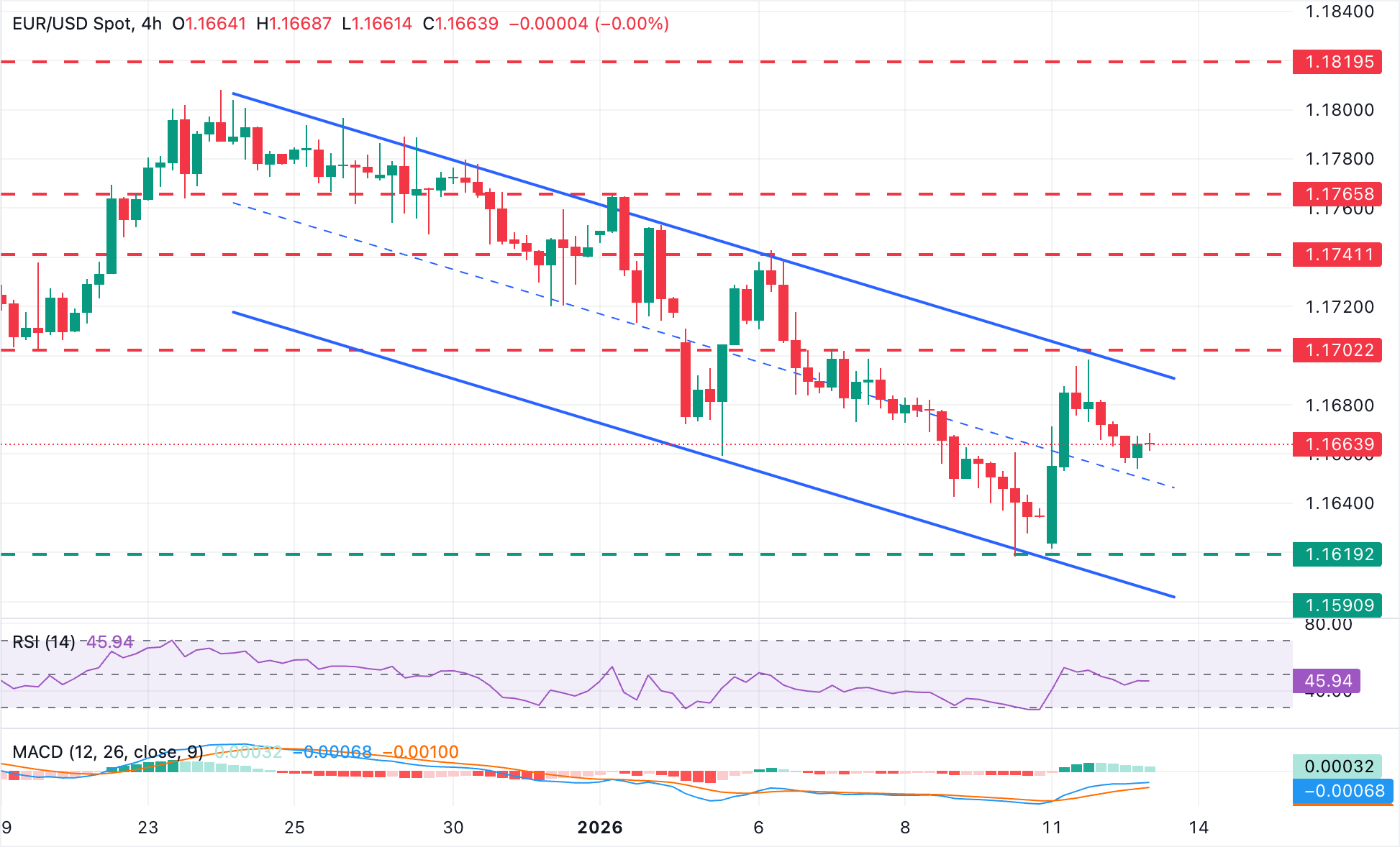
The EUR/USD pair keeps the broader bearish trend from late December highs intact. The pair failed to breach resistance at 1.1700 and returned to the mid-range of the 1.1600s.
Technical indicators are mixed on the 4-hour chart. The Moving Average Convergence Divergence (MACD) line remains above the signal line, but the histogram bars are contracting, which highlights a waning upside momentum. The Relative Strength Index (RSI) has pulled back below 50, showing a neutral-to-bearish stance.
The intraday low, at 1.1653, is likely to provide some support, ahead of Friday's low of 1.1618 and the channel's bottom, now at the 1.1600 area. To the upside, trendline resistance is now at 1.1694, a few pips below Monday's high. A confirmation above this level clears the path towards the January 6 high, at the 1.1740 area.
(The technical analysis of this story was written with the help of an AI tool.)
Euro FAQs
The Euro is the currency for the 20 European Union countries that belong to the Eurozone. It is the second most heavily traded currency in the world behind the US Dollar. In 2022, it accounted for 31% of all foreign exchange transactions, with an average daily turnover of over $2.2 trillion a day. EUR/USD is the most heavily traded currency pair in the world, accounting for an estimated 30% off all transactions, followed by EUR/JPY (4%), EUR/GBP (3%) and EUR/AUD (2%).
The European Central Bank (ECB) in Frankfurt, Germany, is the reserve bank for the Eurozone. The ECB sets interest rates and manages monetary policy. The ECB’s primary mandate is to maintain price stability, which means either controlling inflation or stimulating growth. Its primary tool is the raising or lowering of interest rates. Relatively high interest rates – or the expectation of higher rates – will usually benefit the Euro and vice versa. The ECB Governing Council makes monetary policy decisions at meetings held eight times a year. Decisions are made by heads of the Eurozone national banks and six permanent members, including the President of the ECB, Christine Lagarde.
Eurozone inflation data, measured by the Harmonized Index of Consumer Prices (HICP), is an important econometric for the Euro. If inflation rises more than expected, especially if above the ECB’s 2% target, it obliges the ECB to raise interest rates to bring it back under control. Relatively high interest rates compared to its counterparts will usually benefit the Euro, as it makes the region more attractive as a place for global investors to park their money.
Data releases gauge the health of the economy and can impact on the Euro. Indicators such as GDP, Manufacturing and Services PMIs, employment, and consumer sentiment surveys can all influence the direction of the single currency. A strong economy is good for the Euro. Not only does it attract more foreign investment but it may encourage the ECB to put up interest rates, which will directly strengthen the Euro. Otherwise, if economic data is weak, the Euro is likely to fall. Economic data for the four largest economies in the euro area (Germany, France, Italy and Spain) are especially significant, as they account for 75% of the Eurozone’s economy.
Another significant data release for the Euro is the Trade Balance. This indicator measures the difference between what a country earns from its exports and what it spends on imports over a given period. If a country produces highly sought after exports then its currency will gain in value purely from the extra demand created from foreign buyers seeking to purchase these goods. Therefore, a positive net Trade Balance strengthens a currency and vice versa for a negative balance.
Recommended Articles


