


Berkshire Hathaway Still Has Not Sold Its Bank of America Stake. Here's What That Tells Long-Term Investors.
Key Points
Berkshire Hathaway recently sold its entire stake in Visa and Mastercard.
However, Bank of America remains Berkshire Hathaway's fourth-largest holding.
Berkshire seems to be seeking value rather than riding the wave of expensive fintech stocks.
- 10 stocks we like better than Bank of America ›
Now that Warren Buffett's reign at Berkshire Hathaway (NYSE: BRKA)(NYSE: BRKB) has ended after more than six decades, attention has turned to its new CEO, Greg Abel, and how his strategies may differ from Buffett's.
Since Buffett's departure, Berkshire has made notable moves, including exiting 16 positions in the first quarter, with giants such as Visa (NYSE: V), Mastercard (NYSE: MA), Amazon, and UnitedHealth Group among them. However, one thing that remained was its large stake in Bank of America (NYSE: BAC), a stock it first bought in 2011. As of March 31, Bank of America accounts for 8% of Berkshire Hathaway's stock portfolio (its fourth-largest holding).
Will AI create the world's first trillionaire? Our team just released a report on the one little-known company, called an "Indispensable Monopoly" providing the critical technology Nvidia and Intel both need. Continue »
Considering how long Bank of America has been one of Berkshire's largest holdings and how it has stood firm amid one of the portfolio's largest rebalancing events, here are some takeaways for long-term investors.

Image source: The Motley Fool.
There's more value to be found in traditional banks right now
Berkshire's decision to exit its Visa and Mastercard positions while keeping its Bank of America position is notable because it signals how the company views traditional money-center banks versus more premium fintech-leaning companies. At the time of this writing, Visa and Mastercard are trading at 25.1 and 25.4 times their projected earnings over the next 12 months, respectively. Bank of America is trading at 11.6.
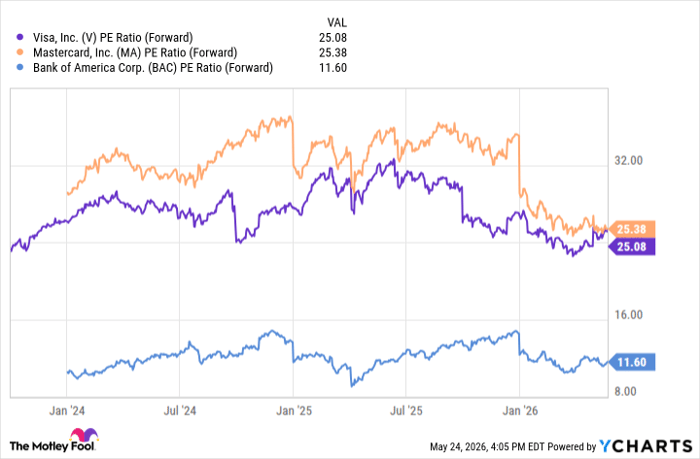
V PE Ratio (Forward) data by YCharts
Admittedly, comparing the valuations of Bank of America to those of Visa and Mastercard isn't a perfect apples-to-apples comparison because the latter operate asset-light "toll booth" transaction models, but there is a noticeable gap in valuations between the two types of financial stocks. It's clear which way Berkshire is leaning based on its recent moves (and non-moves).
Should the average investor follow suit?
It's important to remember that the average investor and a trillion-dollar company with hundreds of billions in cash ($397.4 billion as of March 31) don't always have the same investing goals or needs. Berkshire's selling Visa and Mastercard but sticking to Bank of America isn't an indictment on Visa or Mastercard (I'm a fan of Visa's stock). Both companies have a competitive moat that Buffett has always preached about.
However, the main takeaway here for long-term investors is the value Berkshire sees in a fairly priced traditional bank that provides long-term stability and above-average income (its current dividend yield is around 2.1%). Valuations aren't always the most important factor when investing in a stock, but they're worth considering because high valuations can cap a stock's upside.
If you're a long-term investor looking for value, then Bank of America is a good go-to. However, if you want major plays in the expansion of fintech, then it's worth investing in Visa or Mastercard.
Should you buy stock in Bank of America right now?
Before you buy stock in Bank of America, consider this:
The Motley Fool Stock Advisor analyst team just identified what they believe are the 10 best stocks for investors to buy now… and Bank of America wasn’t one of them. The 10 stocks that made the cut could produce monster returns in the coming years.
Consider when Netflix made this list on December 17, 2004... if you invested $1,000 at the time of our recommendation, you’d have $472,852!* Or when Nvidia made this list on April 15, 2005... if you invested $1,000 at the time of our recommendation, you’d have $1,317,207!*
Now, it’s worth noting Stock Advisor’s total average return is 984% — a market-crushing outperformance compared to 210% for the S&P 500. Don't miss the latest top 10 list, available with Stock Advisor, and join an investing community built by individual investors for individual investors.
See the 10 stocks »
*Stock Advisor returns as of May 27, 2026.
Bank of America is an advertising partner of Motley Fool Money. Stefon Walters has positions in Visa. The Motley Fool has positions in and recommends Amazon, Berkshire Hathaway, Mastercard, and Visa. The Motley Fool recommends UnitedHealth Group. The Motley Fool has a disclosure policy.
Recommended Articles


