


Is Caterpillar a Buy, Sell, or Hold Amid the Iran War?
Key Points
Like so many stocks, Caterpillar dipped immediately following the start of the war in Iran.
But the heavy machinery stock fought off that weakness and rebounded in a big way.
The company continues to reward shareholders with stock repurchases and dividends.
- 10 stocks we like better than Caterpillar ›
The war in Iran commenced on Feb. 28, meaning March 2 was the first trading day on which investors could express their views on the conflict. Over the next three weeks, the S&P 500 dipped 4.4%.
Caterpillar (NYSE: CAT), the second-largest member of the Dow Jones Industrial Average, was worse for wear, tumbling 6.7% over those three weeks. However, the industrial stock has since rebounded epically, gaining 9.9% for the month-long period ending May 22.
Will AI create the world's first trillionaire? Our team just released a report on the one little-known company, called an "Indispensable Monopoly" providing the critical technology Nvidia and Intel both need. Continue »
That price action suggests Caterpillar is a buy, even if the war in Iran hasn't been officially resolved. But is it?
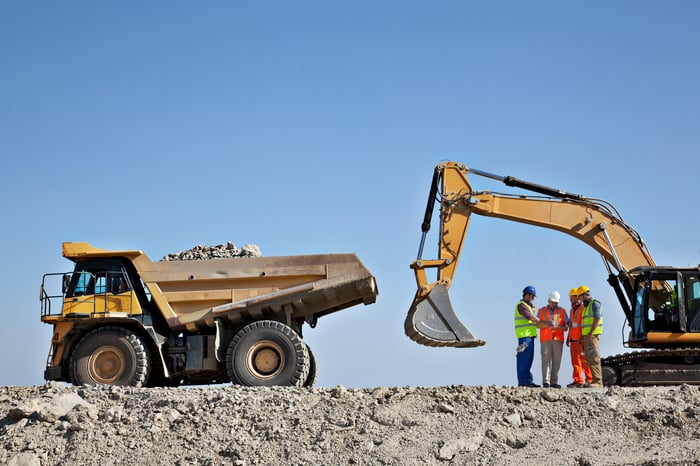
Caterpillar stock was punished when the war in Iran started, but it has rebounded in a big way. Image source: Getty Images.
Assuming the ceasefire holds, or the U.S. and Iran reach a deal to end the conflict, Caterpillar can retain the buy label and potentially position itself to make a run at the four-figure club. Maybe even as soon as next year. Maybe sooner. Let's examine what needs to go right for this stock to reach that rarefied air.
Some moving pieces
As it relates to the intersection of Caterpillar stock and the Iran war, there's at least one certainty: any renewed escalation of military action would likely weigh on the shares. The markets' initial reaction to the start of the war included punishment of cyclical stocks, of which Caterpillar is one, and materials stocks. That's relevant because the industrial machinery giant counts materials companies among its clients.
Still, it's not a stretch to say Caterpillar's March weakness amid geopolitical volatility was more sentiment-driven than it was an indictment of the company's fundamentals. The company posted a 22% jump in first-quarter sales, which is impressive in its own right and even more so when considering that March is part of that quarter. The company also emerged from the quarter with a record backlog, indicating that customers continued to make purchases even as tensions flared in the Middle East.
Caterpillar's top-line resilience in the face of geopolitical headlines is largely driven by its status as the industrial face of the artificial intelligence (AI) boom. In simple terms, a hyperscaler or real estate developer setting out to build a new AI data center needs gear manufactured by Caterpillar or one of its competitors.
That proof is in the pudding. Caterpillar's power and energy unit notched a 22% increase in first-quarter sales, with the company overtly highlighting data centers as a catalyst behind that jump.
The industrial company's data center exposure isn't a 2026 phenomenon, though CEO Joe Creed acknowledges some customers are pushing to start work right away. Importantly, Creed also noted on the company's earnings conference call that some of the machinery giant's booked orders extend into 2028, indicating that, war or not, Caterpillar can offer investors some of the visibility they crave.
More Caterpillar catalysts
Caterpillar's status as one of the largest industrial companies is undoubtedly strengthened by its exposure to AI. It is a testament to management's ability to swiftly pivot into a high-octane category and grab pole position in that space.
However, there are other reasons to like this stock, including its exposure to industrial reshoring. Spending on new American manufacturing facilities is surging, confirming that there's solid, potentially durable long-term demand for Caterpillar gear that AI doesn't drive. The reshoring theme is one for Caterpillar investors to monitor, as it's top of mind for politicians in both parties.
Second, Caterpillar's shareholder rewards efforts weren't hindered by the war in Iran. In the first quarter, the company spent $5 billion on stock repurchases (presumably some of which was spent after the war started) and $700 million on dividends. The company concluded the quarter with $4.1 billion in enterprise cash, confirming it has the capacity to continue reducing its share count while compensating shareholders with cash dividends. Those factors add to the "buy" label.
Should you buy stock in Caterpillar right now?
Before you buy stock in Caterpillar, consider this:
The Motley Fool Stock Advisor analyst team just identified what they believe are the 10 best stocks for investors to buy now… and Caterpillar wasn’t one of them. The 10 stocks that made the cut could produce monster returns in the coming years.
Consider when Netflix made this list on December 17, 2004... if you invested $1,000 at the time of our recommendation, you’d have $477,813!* Or when Nvidia made this list on April 15, 2005... if you invested $1,000 at the time of our recommendation, you’d have $1,320,088!*
Now, it’s worth noting Stock Advisor’s total average return is 986% — a market-crushing outperformance compared to 208% for the S&P 500. Don't miss the latest top 10 list, available with Stock Advisor, and join an investing community built by individual investors for individual investors.
See the 10 stocks »
*Stock Advisor returns as of May 26, 2026.
Todd Shriber has no position in any of the stocks mentioned. The Motley Fool has positions in and recommends Caterpillar. The Motley Fool has a disclosure policy.
Recommended Articles


