


South Korean Stocks Reach New High Above 8,000 Points as Asia-Pacific Markets Diverge
Tradingkey - On May 26, major Asia-Pacific stock markets showed divergent performance. China's A-shares opened lower and traded sideways before a late-session recovery pushed the Shenzhen Component Index and ChiNext Index into the green. The Japanese market pulled back slightly after hitting a record high in the previous session. Meanwhile, the South Korean market staged a strong catch-up rally upon resuming trade after the holiday, once again refreshing its all-time high to become the standout performer in the Asia-Pacific region today.

Performance of Mainland China, Japan, and South Korea stock indices, Source: TradingView
In the Chinese market, the three major A-share indices collectively opened lower in the morning, experienced weak volatility during the session, and saw some recovery toward the close. By the closing bell, the Shanghai Composite Index fell 0.17% to 4,145.37 points; the Shenzhen Component Index rose 0.12% to 15,876.16 points; and the ChiNext Index gained 0.54% to 4,043.07 points. The combined turnover of the two main exchanges and the Beijing Stock Exchange totaled 3.24 trillion yuan, an increase of 37.9 billion yuan from the previous trading day, indicating that market trading remains highly active.
From a sectoral perspective, the semiconductor and computing hardware supply chains saw an across-the-board correction, with the photolithography, CPO, and memory sectors leading the decline. Commercial aerospace, ultra-high voltage (UHV), AI applications, and photovoltaic themes also performed weakly. Conversely, the non-ferrous metals, chemical, and brokerage sectors strengthened, while PCB and Unitree robotics concept stocks remained active. The non-ferrous metals sector led the gains, with prominent performances from stocks such as Aluminum Corporation of China (Chalco), Zhaojin Mining, and Jinduicheng Molybdenum (JDC), reflecting a rotation of capital toward resources and pro-cyclical sectors after a short-term cooling in tech stocks.
In the Japanese market, the Nikkei 225 Index pulled back after hitting a record high in the previous session. Market data showed the Nikkei 225 fell 0.25% on Tuesday to close at 64,995.87. The correction in Japanese stocks was primarily driven by profit-taking, while investors continued to monitor the impact of the Middle East situation on Japan's inflation and energy import costs.
Looking at individual stocks and sectors, Japanese technology and AI-related stocks adjusted following their previous rallies, with Kioxia Holdings, Fujikura, and Advantest all retreating. However, SoftBank Group surged 10.91%, with its cumulative gain over the past four trading days exceeding 50%, serving as a major pillar for the Japanese market. Meanwhile, Bank of Japan Deputy Governor Ryozo Himino stated that the central bank remains committed to further interest rate hikes, though the pace will depend on the impact of the Middle East conflict on Japan's economy and inflation outlook, leading the market to remain cautious about the high-level performance of Japanese stocks.
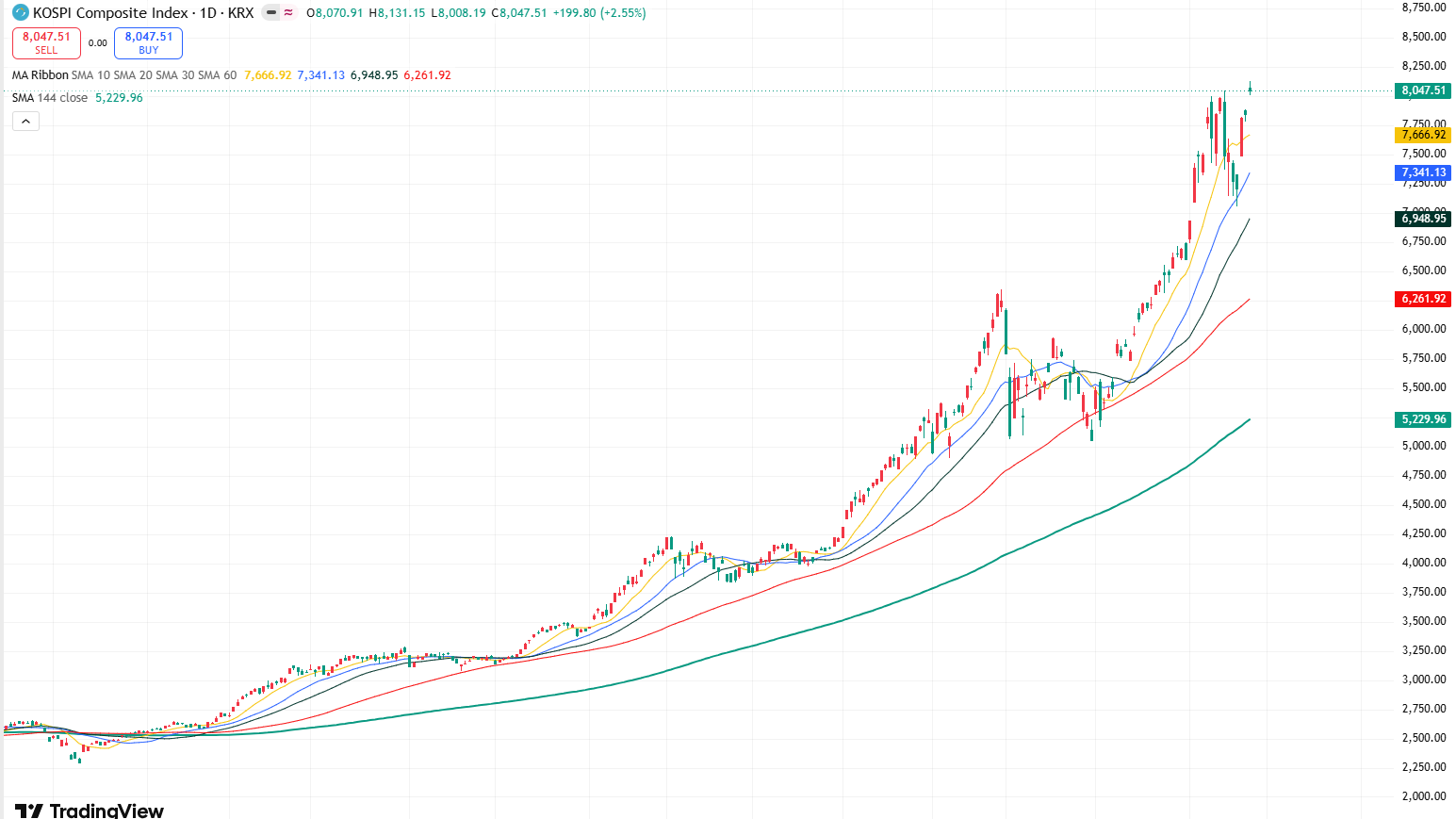
KOSPI Index Daily Chart, Source: TradingView
The South Korean market was the highlight of the Asia-Pacific region today. The KOSPI Index rose sharply after resuming trade from the holiday, setting another record high and closing above the 8,000-point threshold. Compared to the structural divergence in A-shares and the high-level correction in Japanese stocks, the performance of Korean stocks was more aggressive, reflecting the market's continued pursuit of the AI, semiconductor, and export supply chains.
In terms of market sentiment, this round of gains in South Korean stocks continues the strong performance of tech heavyweights seen throughout this year. The global boom in AI infrastructure investment continues to support expectations for memory chips, advanced processes, and the server supply chain. As one of the core markets in the global semiconductor supply chain, South Korea continues to attract foreign capital. Simultaneously, positive signals from U.S.-Iran negotiations have eased market concerns regarding a resurgence in energy prices and global inflation, further boosting the performance of risk assets.
Looking ahead, whether the Asia-Pacific markets can sustain this risk appetite will depend on the progress of U.S.-Iran negotiations, fluctuations in oil prices, the trajectory of the U.S. dollar and Treasury yields, and the performance of global tech stocks. In particular, following the KOSPI's new high, whether semiconductor heavyweights like Samsung Electronics and SK Hynix can continue to attract capital will be key to judging the sustainability of the regional technology narrative. For A-shares and Japanese stocks, short-term focus will be on whether they stabilize after the tech correction and whether high-level indices face further pressure from profit-taking.
Recommended Articles


