


Opinion: President Donald Trump Has Set New Fed Chair Kevin Warsh Up for Failure -- and Wall Street Will End Up Paying the Price
Key Points
The Dow Jones Industrial Average, S&P 500, and Nasdaq Composite have historically thrived under Donald Trump -- but his presidency hasn't been without bouts of historic volatility.
New Fed Chair Kevin Warsh aims to reshape the central bank by trimming down its balance sheet and redefining how we think about inflation.
However, Trump's handpicked successor to Jerome Powell has been dealt a losing hand, with rapidly rising inflation creating a no-win scenario for Warsh and Wall Street.
- 10 stocks we like better than S&P 500 Index ›
From a statistical standpoint, Wall Street has enjoyed having Donald Trump in the White House. The iconic Dow Jones Industrial Average (DJINDICES: ^DJI), widely followed S&P 500 (SNPINDEX: ^GSPC), and growth stock-dominated Nasdaq Composite (NASDAQINDEX: ^IXIC) soared 57%, 70%, and 142%, respectively, during Trump's first term; and they've rallied by 14%, 23%, and 32%, as of May 19, 2026, since his second, non-consecutive term began.
However, not all of President Trump's actions lead to tailwinds for the stock market. For instance, his tariff and trade policy, introduced in early April 2025 and invalidated by the U.S. Supreme Court in February 2026, ignited historic elevator-down moves for the Dow, S&P 500, and Nasdaq Composite over the course of a week.
Will AI create the world's first trillionaire? Our team just released a report on the one little-known company, called an "Indispensable Monopoly" providing the critical technology Nvidia and Intel both need. Continue »

President Trump delivering remarks to Congress. Image source: Official White House Photo.
Another bout of historic downside volatility may be brewing. While Trump seemingly couldn't wait to show now-former Fed Chair Jerome Powell to the door (Powell remains on the Board of Governors), he's left his handpicked successor, Kevin Warsh, in a virtual no-win scenario -- and it's the stock market that'll likely end up paying the price.
Kevin Warsh wants to reshape the central bank
Based on Warsh's testimony before the Senate Banking Committee, he has big plans for America's foremost financial institution.
Arguably, the biggest change the new Fed chair wants to make is to the central bank's bloated balance sheet. He's been a harsh critic of the Fed's expanding assets since stepping down from the Board of Governors on March 31, 2011. Between August 2008 and March 2022, the total assets held by Federal Reserve banks (primarily U.S. Treasury bonds and mortgage-backed securities) jumped roughly tenfold to nearly $9 trillion. As of May 13, 2026, the Fed had over $6.7 trillion in assets on its balance sheet.
Kevin Warsh Nomination: one reason why market players are interpreting it as a hawkish pick- I agree-is because of his views on the need for a radical balance sheet reduction.
-- Joseph Brusuelas (@joebrusuelas) January 30, 2026
The $31 trillion-dollar American economy demands liquidity & financing needs that are larger than what... pic.twitter.com/zYunGAItV8
Warsh has made it clear that he wants the central bank to stop being an active market participant when it's not necessary. This would entail selling a majority of the Fed's balance sheet assets.
Powell's successor also spoke of altering how we think about inflation. Rather than relying on a rigid 2% long-term inflation target, Warsh's definition of price stability is far vaguer: "I believe that price stability should be a change in prices such that no one's talking about it."
Removing hardline parameters (and potentially forward-looking guidance, known as the dot plot) would presumably afford the Federal Open Market Committee (FOMC) -- the 12-person body, including Warsh, responsible for setting the nation's monetary policy -- more maneuverability.
But the current economic environment isn't conducive to what the new Fed chair needs to succeed with his central bank overhaul -- and the blame lies squarely with President Trump.

Image source: Getty Images.
Trump's actions have set Fed Chair Kevin Warsh up for failure
Warsh is taking the helm at one of the most challenging times in modern history. The FOMC is historically divided, and the American economy is attempting to digest not one but two price shocks, both courtesy of decisions made by the president.
The first decision, noted earlier, was to impose sweeping global and reciprocal tariffs. The price stickiness of these duties on imported goods is still filtering through the U.S. economy and modestly lifting the inflation rate.
The second concurrent price shock is the Iran war. Not long after President Trump gave the order for U.S. military forces to attack Iran on Feb. 28, Iran closed the Strait of Hormuz to nearly all commercial vessels. This response has effectively cut off 20% of the world's crude oil demand and sent energy prices soaring.
⛽ Average U.S. gas prices per gallon on May 6, per AAA:
-- NBC News (@NBCNews) May 6, 2026
• Regular: $4.54 (⬆️ $1.56 since war in Iran began on Feb. 28)
• Premium: $5.39 (⬆️ $1.85 since war began)
• Diesel: $5.67 (⬆️ $1.81 since war began)
The impact on consumers was almost immediate, with fuel prices climbing at the fastest pace in more than 30 years. However, this is just the first phase of what energy price shocks typically look like. The next phase involves higher transportation and production costs for businesses that are almost always passed on to consumers. It's essentially a second wave of inflation from the same event.
In February, before the effects of the Iran war showed up in energy prices, U.S. trailing 12-month (TTM) inflation was a modest 2.4%. In April, TTM inflation clocked in at 3.8%. By May, the Cleveland Fed's Inflation Nowcasting tool predicts an inflation rate of almost 4.2%.
Trump nominated Warsh with the expectation that he'd press for rate cuts. Warsh has previously stated that productivity gains and wage growth from the artificial intelligence revolution can spur interest rate cuts.
Wall Street was also expecting rate cuts at the start of 2026. Lower lending rates were being priced in as a catalyst for the AI data center build-out.
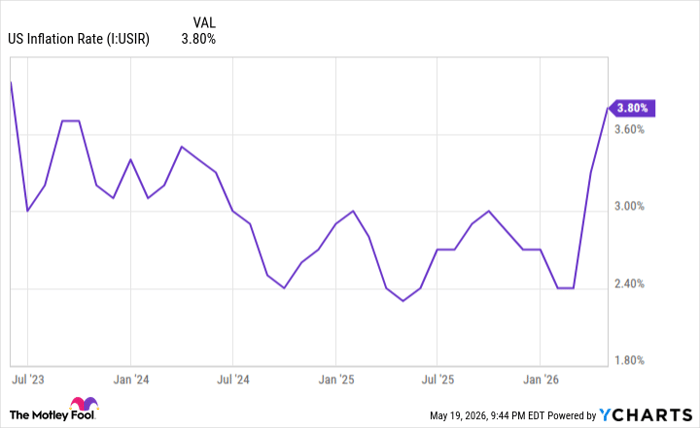
US Inflation Rate data by YCharts.
However, the president's actions (tariffs and the Iran war) have set Warsh up for disaster. Rapidly rising inflation makes appeasing Trump and Wall Street virtually impossible. Warsh and the FOMC may be left with little choice but to shift to a neutral or hiking bias and eventually raise interest rates to stabilize prices. Doing so could pull the rug out from beneath a historically expensive bull market.
The new Fed chair's desire to remove rigid inflation targets may also hit a snag. With all eyes (investors and consumers) on soaring prices, any attempt by the new head of the central bank to alter or obfuscate forward-looking interest rate forecasts may be viewed negatively.
Kevin Warsh has been set up for failure, and he may inadvertently take the stock market down with him.
Should you buy stock in S&P 500 Index right now?
Before you buy stock in S&P 500 Index, consider this:
The Motley Fool Stock Advisor analyst team just identified what they believe are the 10 best stocks for investors to buy now… and S&P 500 Index wasn’t one of them. The 10 stocks that made the cut could produce monster returns in the coming years.
Consider when Netflix made this list on December 17, 2004... if you invested $1,000 at the time of our recommendation, you’d have $481,589!* Or when Nvidia made this list on April 15, 2005... if you invested $1,000 at the time of our recommendation, you’d have $1,345,714!*
Now, it’s worth noting Stock Advisor’s total average return is 993% — a market-crushing outperformance compared to 208% for the S&P 500. Don't miss the latest top 10 list, available with Stock Advisor, and join an investing community built by individual investors for individual investors.
See the 10 stocks »
*Stock Advisor returns as of May 23, 2026.
Sean Williams has no position in any of the stocks mentioned. The Motley Fool has no position in any of the stocks mentioned. The Motley Fool has a disclosure policy.
Recommended Articles


