


Is the Market Losing Steam as May Winds Down?
Key Points
Summer can be a rough time on Wall Street, as families take vacations and trading slows down.
Market history suggests that the period from May to Oct. yields less impressive returns.
- 10 stocks we like better than Vanguard S&P 500 ETF ›
The S&P 500 index (SNPINDEX: ^GSPC), which you can easily buy with an exchange-traded fund like Vanguard S&P 500 ETF (NYSEMKT: VOO), has turned lower in recent days. The ongoing geopolitical conflict in the Middle East, high energy prices, and broader inflation have consumers and investors worried about an economic slowdown. Could the market lose some steam heading into the summer?
The best months and the worst months
"Sell in May and go away" is an old Wall Street saying that highlights a historical performance difference between certain periods of the year. There's some data to back the saying up, too. Historically, the S&P 500 index has gained around 2% between May and Oct., but gained 7% between Nov. and April. Small-cap and global stocks see a similar pattern, according to Fidelity Investments.
Will AI create the world's first trillionaire? Our team just released a report on the one little-known company, called an "Indispensable Monopoly" providing the critical technology Nvidia and Intel both need. Continue »

Image source: Getty Images.
The recent market turn could be a harbinger of this historical pattern repeating itself. Still, there are nuances to consider. For example, according to Fidelity, the S&P 500 index has lost around 2% of its value between May and Oct. since 1990, even worse than the longer-term record. But the finance giant notes that the S&P 500 has "fallen 56% of the time."
In other words, 44% of the time since 1990, the market rose over the May to Oct. span. The down years clearly offset the up years, but selling in May and going away doesn't always work out. Indeed, averages often mask fairly large year-by-year differences when data are examined year by year.
There are reasons to be worried, but stick to your plan
To be fair, the summer is when many families go on vacation, and trading often slows down. And this year, there are very real economic worries as the summer gets underway. It would be understandable if you wanted to sell your stocks out of fear that the market is slowing down.
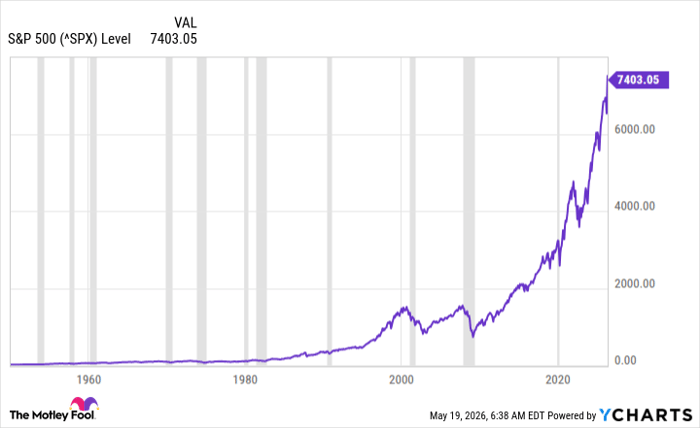
^SPX data by YCharts
However, history is pretty clear that staying invested is a winning strategy. If you look back to the 1950s, recessions have been little more than temporary setbacks as the S&P 500 index continues its long-term march higher. Trying to time the market by jumping in and out of stocks could boost your returns, but very few investors consistently make it work.
The problem is even larger if you buy individual stocks instead of broad-based indexes, like the S&P 500. Why sell a stock that you spent time researching just because the calendar month has changed? Presumably, your investment thesis has nothing to do with the month of the year. If you bought a stock for a reason and that reason hasn't changed, selling in May makes little sense, even if you come back and repurchase it in Nov.
The market could be slowing down, but so what?
If stock market history is any guide, the S&P 500 could be slowing down as May comes to an end. The summer could be a weak patch, performance-wise. But it is also possible that 2026 doesn't conform to the historical averages, and selling individual stocks makes little sense if you have a long-term investment thesis. Most investors should probably stick to their long-term plan and avoid market timing, even if they are based on a catchy old Wall Street saying.
Should you buy stock in Vanguard S&P 500 ETF right now?
Before you buy stock in Vanguard S&P 500 ETF, consider this:
The Motley Fool Stock Advisor analyst team just identified what they believe are the 10 best stocks for investors to buy now… and Vanguard S&P 500 ETF wasn’t one of them. The 10 stocks that made the cut could produce monster returns in the coming years.
Consider when Netflix made this list on December 17, 2004... if you invested $1,000 at the time of our recommendation, you’d have $481,589!* Or when Nvidia made this list on April 15, 2005... if you invested $1,000 at the time of our recommendation, you’d have $1,345,714!*
Now, it’s worth noting Stock Advisor’s total average return is 993% — a market-crushing outperformance compared to 208% for the S&P 500. Don't miss the latest top 10 list, available with Stock Advisor, and join an investing community built by individual investors for individual investors.
See the 10 stocks »
*Stock Advisor returns as of May 22, 2026.
Reuben Gregg Brewer has no position in any of the stocks mentioned. The Motley Fool has positions in and recommends Vanguard S&P 500 ETF. The Motley Fool has a disclosure policy.
Recommended Articles


