


Nvidia's Latest AI Partner Was a Bargain Hiding in Plain Sight. Is It Still a Buy?
Key Points
Corning manufactures fiber-optic cables, a critical component for AI-related data transfers.
The company's stock was in a multiyear slump prior to the AI revolution.
Capacity constraints could bring that growth to a screeching halt.
- 10 stocks we like better than Corning ›
Artificial intelligence (AI) investment has supercharged the share prices of tech giants like Amazon (NASDAQ: AMZN) and Alphabet (NASDAQ: GOOGL) (NASDAQ: GOOG). Over the last three years, since the AI revolution began, their stock prices have surged 117% and 216%, respectively. Meanwhile, chipmaker Nvidia (NASDAQ: NVDA) has seen its shares soar more than 597% as it dominated the market for high-end AI processors.
But AI has transformed more than just tech giants. It's even electrified the stocks of sleepy manufacturers whose businesses had little or nothing to do with microprocessors, computer components, or AI-powered software. One such company was 175-year-old U.S. manufacturer Corning (NYSE: GLW), and it was a bargain hiding in plain sight.
Will AI create the world's first trillionaire? Our team just released a report on the one little-known company, called an "Indispensable Monopoly" providing the critical technology Nvidia and Intel both need. Continue »
Corning's shares have skyrocketed 259% in the past year thanks to AI, and it has a new Nvidia partnership in the works. Is it still a buy?
Image source: Nvidia.
Why Corning was such a bargain
Until 2024, Corning -- which makes high-tech glass products like smartphone and TV screens and fiber-optic communications cable -- was in a long-term stock price slump. In the five years between 2018 and 2023, the company's stock price returned just 0.8%. Compare that to the S&P 500's total return of 90.3% over that period.
Much of this was due to factors beyond Corning's control. The company had been rapidly growing revenue during the 2000s and early 2010s through its display technologies segment, which benefited from the rapid growth of the smartphone market and the size of LCD TV screens. But by 2016, 77% of U.S. adults already owned a smartphone, and further market penetration slowed dramatically.
Meanwhile, while only 32% of TVs sold in 2009 had screens 40 inches or larger, that number had ballooned to 83% by 2019, slowing the growth of the company's LCD display glass and causing display glass prices to plummet.
A sleeper hit
Even as display glass revenue was slumping, Corning's fiber-optic cable business was steadily growing as fiber-optic TV and internet cables were being deployed across the U.S. and around the world. In the first quarter of 2017, the company's optical communications business surpassed its display technologies segment as the biggest revenue generator for the company.
Unfortunately, fiber-optic cable was a low-margin product at the time. In that same quarter, the company generated just a 10% profit margin on its optical communications sales, compared to a 33.8% profit margin on its display technologies sales.
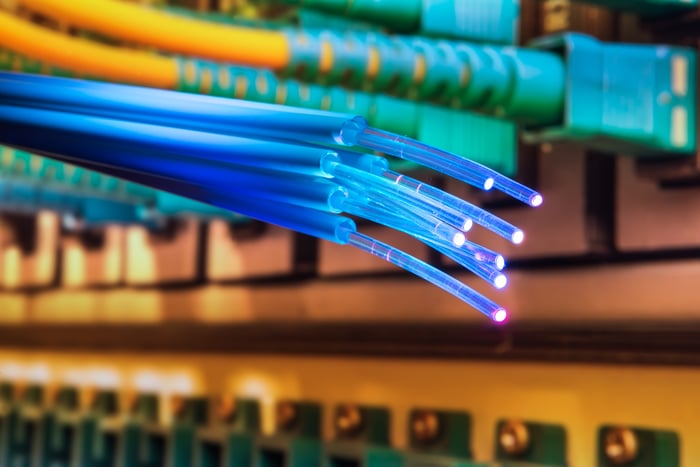
Image source: Getty Images.
But fiber-optic cables were (and are) the fastest transmitters of large amounts of data. Although some other types of transmission cables, like twinax copper cables, have lower latency over short distances, they can't handle the massive bandwidth that fiber optic cables can. In 2018, Corning realized that, despite their data transmission capabilities, fiber-optic cables weren't being deployed by (non-AI) data centers because they couldn't make the tight turns required to connect multiple servers. In response, Corning engineered a thinner, more flexible fiber-optic cable.
This meant that when AI technology arrived and required massive amounts of data transmission both outside and inside data centers, Corning's fiber-optic cable was the obvious choice and suddenly in very high demand. So high, in fact, that Corning's stock took off like a rocket:
Is it still a bargain?
Given Corning's 259% stock price growth over the last year, is it still a bargain?
On the one hand, the company's fiber-optic cable business appears to be growing faster than ever. Net income from its optical communications segment rose 28% year over year in 2024 and 71% year over year in 2025, about twice as fast as segment revenue growth. But in Q1 2026, net sales soared 36% year over year while net income shot up a jaw-dropping 93%. If growth keeps accelerating like that, Corning's stock might indeed be considered a "bargain."
But manufacturing constraints might ruin the party. Corning has essentially maxed out the current production of its in-demand fiber-optic cables. Nvidia just stepped in to help Corning increase its manufacturing capacity by building three new facilities, but those facilities will take time to build.
Until then, it's unclear whether Corning can sustain its growth over the long term. It has more than 4,000 optical communications patents and dominates the North American fiber-optic cable market, which gives it a big competitive moat. However, given its current lofty valuation, smart investors might want to wait for a more attractive entry point or at least more clarity on how manufacturing constraints might affect future returns.
Should you buy stock in Corning right now?
Before you buy stock in Corning, consider this:
The Motley Fool Stock Advisor analyst team just identified what they believe are the 10 best stocks for investors to buy now… and Corning wasn’t one of them. The 10 stocks that made the cut could produce monster returns in the coming years.
Consider when Netflix made this list on December 17, 2004... if you invested $1,000 at the time of our recommendation, you’d have $475,063!* Or when Nvidia made this list on April 15, 2005... if you invested $1,000 at the time of our recommendation, you’d have $1,369,991!*
Now, it’s worth noting Stock Advisor’s total average return is 994% — a market-crushing outperformance compared to 207% for the S&P 500. Don't miss the latest top 10 list, available with Stock Advisor, and join an investing community built by individual investors for individual investors.
See the 10 stocks »
*Stock Advisor returns as of May 22, 2026.
John Bromels has positions in Alphabet, Amazon, Corning, and Nvidia. The Motley Fool has positions in and recommends Alphabet, Amazon, Corning, and Nvidia. The Motley Fool has a disclosure policy.
Recommended Articles


