


Nasdaq Composite Has a Rough Morning; Dow Holds Up Better (Barely)
Key Points
The 30-year Treasury yield climbed to 5.19%, its highest level since before the 2008 financial crisis.
Alphabet and Amazon were the biggest drags on the Nasdaq and S&P 500 despite dropping only 2% to 3%.
Days like Tuesday are noise, not a signal to sell quality companies.
- 10 stocks we like better than NASDAQ Composite Index ›
Tuesday morning wasn't exactly kind to stock investors, but there's no need to panic.
All three major indexes spent the session underwater, with the Nasdaq Composite (NASDAQINDEX: ^IXIC) taking the hardest punch. As of around 12:43 p.m. ET, the Dow Jones Industrial Average (DJINDICES: ^DJI) was down 0.31%, the S&P 500 (SNPINDEX: ^GSPC) had slipped 0.51%, and the Nasdaq was nursing a 0.86% loss after twice dipping more than1.4% between 10 ET and 11 ET.
Will AI create the world's first trillionaire? Our team just released a report on the one little-known company, called an "Indispensable Monopoly" providing the critical technology Nvidia and Intel both need. Continue »
The Nasdaq suffered the steepest losses, plunging sharply in the first hour of trading before staging a choppy rebound. All three indexes ticked higher in unison after noon ET.
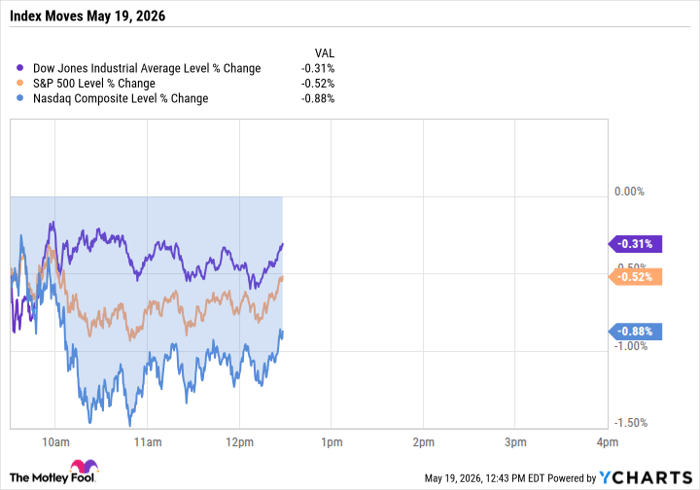
^DJI data by YCharts
Why stocks are struggling
Rising bond yields dominated Wall Street's conversation.
The 30-year Treasury Bond yield climbed to 5.19%, its highest level since before the 2008 financial crisis. Higher long-term rates increase borrowing costs for corporations and reduce the present value of future earnings, a combo that hits growth-oriented technology stocks especially hard.
That math showed up in the biggest point-shaving losers of each market index. Alphabet (NASDAQ: GOOG) (NASDAQ: GOOGL) dropped about 2% by midday, while Amazon (NASDAQ: AMZN) fell around 3%. These trillion-dollar behemoths were the largest drags on both the Nasdaq and the S&P 500. When you're worth trillions, even a 2% dip moves the needle.
Amazon's 3% slide also led the Dow lower, along with a 1% drop for Goldman Sachs (NYSE: GS). Goldman carries the heaviest price weight in the Dow, so a normal day of random market noise is often enough to make it the Dow's leading needle-mover.

Image source: Getty Images.
Here's the frustrating part for Alphabet shareholders: the company actually had good news today. It announced a $5 billion joint venture with Blackstone (NYSE: BX) to build out AI cloud infrastructure using Google's custom chips.
Headlines like that usually get tech investors excited. But when the 30-year yield is screaming toward levels not seen since the Bush administration, even a multibillion-dollar vote of confidence from a private equity titan can't stop the bleeding.
Then there's the situation in the Strait of Hormuz.
Iran warned it could "open new fronts" against the United States. Foreign governments such as Japan and China have been reducing their holdings of U.S. Treasuries amid Iran-related currency concerns. The critical Strait of Hormuz is still blocked and oil prices rose by 2% today. None of this is good news for the market indexes.
Keep calm and zoom out
If this feels familiar, it should. Markets have been caught between rising rates and geopolitical flare-ups for months now, and Tuesday is just the latest chapter.
So I should remind you not to panic, as usual.
The Nasdaq swung from down 1.4% to down 0.86% in about an hour; that's sentiment, not fundamentals. The world didn't change. Alphabet and Amazon are the same companies they were yesterday, just temporarily on sale (and not a particularly generous one, at that).
Stay cool. Stay patient. It's just another day on Wall Street in 2026.
Should you buy stock in NASDAQ Composite Index right now?
Before you buy stock in NASDAQ Composite Index, consider this:
The Motley Fool Stock Advisor analyst team just identified what they believe are the 10 best stocks for investors to buy now… and NASDAQ Composite Index wasn’t one of them. The 10 stocks that made the cut could produce monster returns in the coming years.
Consider when Netflix made this list on December 17, 2004... if you invested $1,000 at the time of our recommendation, you’d have $483,476!* Or when Nvidia made this list on April 15, 2005... if you invested $1,000 at the time of our recommendation, you’d have $1,362,941!*
Now, it’s worth noting Stock Advisor’s total average return is 998% — a market-crushing outperformance compared to 207% for the S&P 500. Don't miss the latest top 10 list, available with Stock Advisor, and join an investing community built by individual investors for individual investors.
See the 10 stocks »
*Stock Advisor returns as of May 19, 2026.
Anders Bylund has positions in Alphabet and Amazon. The Motley Fool has positions in and recommends Alphabet, Amazon, Blackstone, and Goldman Sachs Group. The Motley Fool has a disclosure policy.
Recommended Articles


