


Prediction: Nvidia Will Deliver Another Blowout Earnings Report on May 20, but It Won't Move the Stock in a Big Way
Key Points
Even if Nvidia beats Wall Street consensus estimates across the board, the stock is by no means guaranteed to rise.
Investors have been grappling with broader AI concerns all year.
The company reported fantastic fiscal Q4 earnings three months ago, yet its stock sank the next day.
- 10 stocks we like better than Nvidia ›
After the market closes on May 20, the artificial intelligence chip giant Nvidia (NASDAQ: NVDA) will report its fiscal 2027 first-quarter results.
The report will be followed by a conference call between Nvidia's management team, led by CEO Jensen Huang, and Wall Street analysts to further discuss the quarter, market conditions, and the chipmaker's future.
Will AI create the world's first trillionaire? Our team just released a report on the one little-known company, called an "Indispensable Monopoly" providing the critical technology Nvidia and Intel both need. Continue »
Based on Nvidia's track record of beating earnings expectations and the strong quarterly reports that we've already seen from the hyperscalers that are its top customers, I fully expect Nvidia to report another blowout quarter. However, I also predict that report will do little for the stock in the near term.
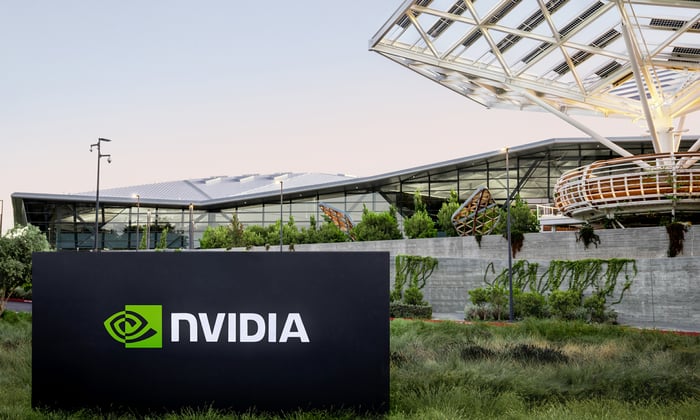
Image source: Nvidia.
What the market expects
The market always looks at analysts' estimates for a company before a quarterly earnings print. The estimates of those professionals covering a stock are averaged to produce "consensus" estimates on earnings and revenues, and if the company's results come in above these levels, the market often tags it as a strong quarter.
According to Visible Alpha, for Nvidia's fiscal 2027 first quarter (which ended April 26), the analysts' consensus expectations are (as of May 11):
- Revenue: $78.29 billion
- Diluted adjusted earnings per share (EPS): $1.74
- Gross margin: 75.04%
If those numbers prove accurate, revenue would have risen nearly 44% year over year and about 15% from the prior quarter. That also means diluted EPS would be up nearly 115% year over year, and up about 7.5% from the prior quarter. The expected gross margin is roughly even with the prior quarter.
As I mentioned, Nvidia has a strong track record of beating earnings estimates, having done so on adjusted EPS in 21 of its last 23 quarters. There's also reason to believe there have been strong underlying trends in the semiconductor space.
During its earnings reports, Nvidia also typically provides guidance for the quarter that is then underway, which in this case is the second quarter of its fiscal 2027. If the company provides guidance that is better than consensus estimates, the stock should benefit. Often, guidance proves more important in how the market responds than the most recent quarter's results.
For the second quarter of its fiscal 2027, analysts, according to Visible Alpha, expect:
- Revenue: $85.1 billion
- Diluted adjusted EPS: $1.91
- Gross margin: 75.01%
AI capex is climbing
While there have been many concerns this year about the artificial intelligence supercycle and whether it can maintain its momentum, there's no evidence that it's slowing.
The hyperscalers in the "Magnificent Seven" have recently reported earnings, and all have significantly increased their guidance for this year's capital expenditures -- and most of those outlays will be used to build and equip AI infrastructure.
Heading into the recent reports, the top of the estimated capex range for Microsoft, Amazon, Alphabet, and Meta Platforms totaled about $670 billion, according to Yahoo! Finance. Now, estimates are closer to $725 billion.
This is good for Nvidia because it likely means hyperscalers will spend more on chips or building data centers that require them, so it's a good indicator of where demand for its wares is headed.
Furthermore, Taiwan Semiconductor Manufacturing, the largest chip foundry in the world and the manufacturer of nearly all of Nvidia's most advanced chips, also reported a strong quarter recently, another good sign.
Expect a good quarter followed by a muted reaction
One thing retail investors should understand is that they are always at a disadvantage in the short term.
Not only has a ton of data shown how difficult near-term investing is, but most institutional investors in the market are investing based on 12-month to 18-month holding timelines, so they will be laser-focused on companies' near-term results. Given the resources and knowledge institutional investors have, they are likely to see a good quarter coming well before the report arrives.
Nvidia stock is at an all-time high and is up 15.4% this year, despite a big sell-off in April.
Investors should also look back at last quarter's report: The company beat consensus estimates and provided guidance that was more upbeat than the consensus, only to see its stock fall the next day. With a nearly $5.4 trillion market cap as of this writing, Nvidia is so big that it really has to exceed investor expectations by a wide margin on earnings to see its stock rise immediately after a report.
Retail investors should make sure they are not betting on Nvidia based on near-term events; if they own the stock, it should be because they believe in its long-term prospects.
It's hard to bet against Nvidia right now, given the underlying trends in AI and the company's recent impressive performances and upbeat guidance. While I, too, have some concerns about AI, I think investors can still comfortably buy and hold Nvidia for the long term.
Should you buy stock in Nvidia right now?
Before you buy stock in Nvidia, consider this:
The Motley Fool Stock Advisor analyst team just identified what they believe are the 10 best stocks for investors to buy now… and Nvidia wasn’t one of them. The 10 stocks that made the cut could produce monster returns in the coming years.
Consider when Netflix made this list on December 17, 2004... if you invested $1,000 at the time of our recommendation, you’d have $472,205!* Or when Nvidia made this list on April 15, 2005... if you invested $1,000 at the time of our recommendation, you’d have $1,384,459!*
Now, it’s worth noting Stock Advisor’s total average return is 999% — a market-crushing outperformance compared to 208% for the S&P 500. Don't miss the latest top 10 list, available with Stock Advisor, and join an investing community built by individual investors for individual investors.
See the 10 stocks »
*Stock Advisor returns as of May 15, 2026.
Bram Berkowitz has no position in any of the stocks mentioned. The Motley Fool has positions in and recommends Alphabet, Amazon, Meta Platforms, Microsoft, Nvidia, and Taiwan Semiconductor Manufacturing. The Motley Fool has a disclosure policy.
Recommended Articles


