


Prediction: XRP (Ripple) Will Be Worth $1 (or Less) in 12 Months. Here's Why.
Key Points
XRP experienced a historic rally during the first half of 2025 thanks to some regulatory wins.
The token ultimately sold off once investors realized its utility was disconnected from adoption rates.
XRP's issuer, Ripple, is witnessing robust transaction growth; however, this has not translated into wider usage of XRP.
- 10 stocks we like better than XRP ›
Sometimes, investing in popular assets has a way of turning hype into heartbreak. The cryptocurrency market might just be the most prominent example of this phenomenon.
Once hailed as the bridge to a faster, cheaper global payments system, XRP (CRYPTO: XRP) has ridden waves of euphoria only to crash back to earth in epic fashion. As of mid-May, the token trades at about $1.40 -- roughly 60% below its July 2025 peak.
Will AI create the world's first trillionaire? Our team just released a report on the one little-known company, called an "Indispensable Monopoly" providing the critical technology Nvidia and Intel both need. Continue »
Although some bulls still cling to visions of institutional dominance and regulatory tailwinds, I think XRP could plummet to $1 or lower within the next year.

Image source: Getty Images.
What is XRP and why does it matter?
XRP is the native digital asset of the XRP Ledger. Unlike Bitcoin's proof-of-work model or Ethereum's focus on smart contracts, the XRP ledger leverages a unique consensus protocol that settles transactions in seconds with minimal fees.
Ripple, the company behind this ecosystem, markets XRP as a bridge currency for cross-border payments. Traditional international transfers rely on intermediary banks and pre-funded accounts in foreign currencies. This structure inherently ties up capital, as it takes days for transactions to clear. XRP's utility is straightforward: The token acts as a neutral bridge currency.
Think of it this way: A bank in the U.S. can send dollars, convert them instantly to XRP, and have the recipient's bank convert back to local currency -- all within seconds and bypassing the need to hold idle balances overseas. In theory, denominating transactions in XRP could slash costs for treasury operations and become a much-needed disruptor to the $200 trillion annual cross-border payments market.
Analyzing XRP's sudden rally and epic crash
XRP opened 2025 with the final resolution of Ripple's long-running lawsuit with the Securities and Exchange Commission (SEC). A crypto-friendly Trump administration amplified optimism and paved the way for spot XRP exchange-traded funds (ETFs).
Per the chart below, XRP smashed through multiyear price resistance, riding broader crypto rallies to fresh highs between $3.50 and $3.60 by the summer. As is often the case with crypto investing, retail sentiment around XRP exploded. For a brief moment, it felt like XRP had arrived and was here to stay. As smart investors understand, though, rallies built on narrative almost always unravel once reality intrudes.
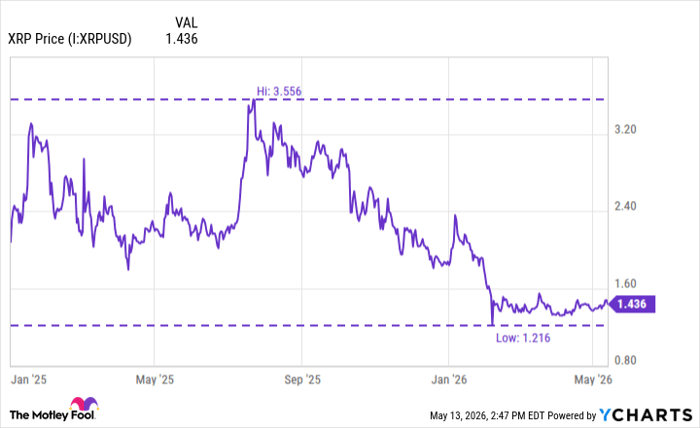
XRP Price data by YCharts
By late last year, meaningful profit-taking set in. The prolonged sell-off was driven by a combination of macro headwinds from tariff-driven trade tensions, broader crypto market volatility, and pullbacks in other major tokens. All told, XRP closed the year near $1.90 -- shedding roughly half its peak value.
Why could cause XRP to drop further?
During the next year, several forces could lead to further deterioration in XRP's price.
First, the altcoin's commercial traction remains limited. Although Ripple has entered meaningful partnerships with high-profile financial institutions, the volume of payments actually settling on the XRP Ledger has not increased very much. This means that on-demand liquidity has grown but still represents a minuscule portion relative to global capital flows.
In addition, much of the excitement around Ripple has started to shift toward stablecoin settlements via its RLUSD. Critically, some of these deals settle on Ethereum or other blockchains rather than exclusively on the XRP Ledger. In turn, adoption of Ripple's payments infrastructure does not automatically translate into demand for XRP. This decoupling underscores XRP's paradox: Ripple can thrive while its native token struggles.
From a macro perspective, keep in mind that cryptocurrency is highly correlated with risk sentiment. Any sluggish movements in larger coins or renewed economic shocks such as recession fears or tighter monetary policy will likely hit XRP harder as a smaller, less liquid asset.
A drop to $1 would represent roughly a 30% decline from XRP's current levels -- entirely plausible in a crypto winter environment. In my eyes, this price normalization would reflect XRP's fair value if utility fails to catch up to its already rich valuation represented by its market cap of $88 billion.
All told, XRP's story has always been one of immense potential met with continuous execution gaps. During the next year, I think these gaps could widen and push the price toward $1 as investors increasingly demand performance, not promises.
Should you buy stock in XRP right now?
Before you buy stock in XRP, consider this:
The Motley Fool Stock Advisor analyst team just identified what they believe are the 10 best stocks for investors to buy now… and XRP wasn’t one of them. The 10 stocks that made the cut could produce monster returns in the coming years.
Consider when Netflix made this list on December 17, 2004... if you invested $1,000 at the time of our recommendation, you’d have $472,205!* Or when Nvidia made this list on April 15, 2005... if you invested $1,000 at the time of our recommendation, you’d have $1,384,459!*
Now, it’s worth noting Stock Advisor’s total average return is 999% — a market-crushing outperformance compared to 208% for the S&P 500. Don't miss the latest top 10 list, available with Stock Advisor, and join an investing community built by individual investors for individual investors.
See the 10 stocks »
*Stock Advisor returns as of May 15, 2026.
Adam Spatacco has no position in any of the stocks mentioned. The Motley Fool has positions in and recommends Bitcoin, Ethereum, and XRP. The Motley Fool has a disclosure policy.
Recommended Articles


