


Fed report finds AI reshaping US workforce as adoption accelerates across industries
The Federal Reserve Board’s recently published annual Survey of Household Economics and Decisionmaking shows a rapid increase in workplace AI use.
Roughly one in four American workers use AI at work, according to the report’s findings on the economic well-being of U.S. households in 2025.
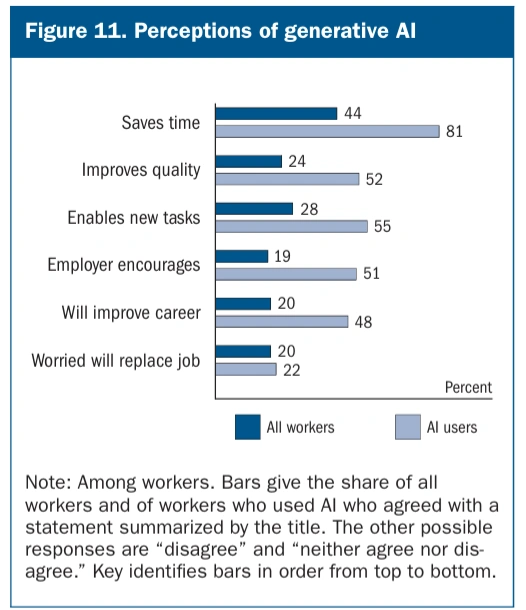
Are workers being upgraded or replaced by Gen AI?
The Federal Reserve Board has confirmed that generative AI has been rapidly adopted in the American workplace. The recently released “Economic Well-Being of U.S. Households in 2025” report states that one in four workers said they used generative AI on the job in the prior month. Among these users, 81% of them agreed that AI saves them time.
Survey data from the Census Bureau shows that approximately 18% of U.S. firms had adopted AI by the end of 2025. However, this number is much higher among large employers. The Federal Reserve Board estimates that 78% of the labor force works at firms that have adopted AI.
In the financial and professional services sector, generative AI adoption rates are near 33%, with over 60% of workers reporting they use it. Meanwhile, the healthcare and manufacturing sectors are slower on the uptake. Despite this, the manufacturing industry saw a 58% year-on-year growth in AI adoption.
The adoption of Gen AI is also affecting the job market. A Real-Time Population Survey showed that over half of the U.S. working-age population had used generative AI tools since ChatGPT launched in November 2022.
Researchers at the Federal Reserve Bank of New York examined whether the rapid spread of AI has started to reduce demand for workers in exposed occupations and found that while hiring has truly slowed since late 2022 when ChatGPT was launched, the data from job postings shows “little indication” that it is a decline specifically caused by AI.
Most notably, it appears that while white-collar jobs may be facing some headwinds from AI adoption, there is no question that blue-collar workers are the biggest beneficiaries.
AT&T (NYSE: T) CEO John Stankey told CNBC that the company is struggling to find blue-collar technicians to build AI infrastructure, even as fewer people are getting hired for white-collar jobs.
“We need people who know how to actually work with electricity,” Stankey said. “It’s not like we’re growing them on trees in the United States.”
AT&T has invested significantly in training to solve its problems, spending up to $80,000 per technician to fill gaps in fiber and data center construction.
Does retraining help employees?
A New York Fed staff report tracked over 1.6 million job-training spells and found that workers in occupations like finance and insurance who retrain earn roughly $1,470 more per quarter than those who only receive job-search assistance.
25 to 40% of occupations are considered “AI retrainable,” but researchers found that trainees who specifically targeted AI-intensive work faced a 29% earnings penalty compared to individuals who pursued more general training paths.
Fed Governor Christopher Waller, speaking at the Boston Fed’s Technology-Enabled Disruption Conference in February, revealed that every Federal Reserve employee now has access to an approved internal AI platform for drafting, summarizing, and analyzing information.
Waller added that the goal is to “reduce friction” in routine work to give individuals more time to spend on “higher-value activities.”
The smartest crypto minds already read our newsletter. Want in? Join them.
Recommended Articles


