


Prediction: The Nasdaq Could Soar to 30,000 by 2027. These Are the Best Artificial Intelligence (AI) Growth Stocks to Own Until Then.
Key Points
The artificial intelligence-fueled earnings growth of tech companies is going to be a tailwind for the Nasdaq Composite index, which has shown resilience in April after a poor start to the year.
Nvidia and TSMC enjoy solid pricing power.
Both chip giants are in a position to clock solid earnings growth over the next couple of years, and that could translate into solid upside for both of them.
- 10 stocks we like better than Nvidia ›
The Nasdaq Composite index has jumped 102% over the past three years, outpacing the 72% gains of the S&P 500 over the same period. The simple reason why the tech-focused index has outperformed the broad-market benchmark is that tech companies have delivered superior earnings growth, primarily fueled by the proliferation of artificial intelligence (AI) technology.
Of course, the Nasdaq Composite has been under stress at certain times over the past three years, mainly due to factors that are outside the control of companies, such as President Donald Trump's tariffs and the conflict in the Middle East. However, the strong earnings growth exhibited by AI stocks has ultimately been a tailwind for the index, which is around 24,400 as of this writing.
Will AI create the world's first trillionaire? Our team just released a report on the one little-known company, called an "Indispensable Monopoly" providing the critical technology Nvidia and Intel both need. Continue »
The good news for investors is that the tech sector's robust earnings growth looks to be here to stay. Last week, wealth management firm LPL Financial points out reported that earnings estimates for the tech sector had increased by more than 6% since the beginning of the Iran war. Analysts are expecting to see that tech earnings spiked by 44% in the first quarter of 2026.
That trend could continue as well, as the massive investments in AI data center infrastructure aren't slowing down. Also, AI adoption by businesses has been increasing at a steady pace, suggesting that AI hardware and software sales will continue to grow at a healthy clip. As a result, don't be surprised to see the Nasdaq Composite index hitting the 30,000 level by next year.
The index would need to rise by about 22% from its current level to hit that mark. It could easily do so in the next year or so, especially considering that the Nasdaq Composite has jumped almost 12% just this month.
Let's take a closer look at two companies with strong earnings power that could ride the Nasdaq's bull run and deliver solid upside to investors over the next year or so.
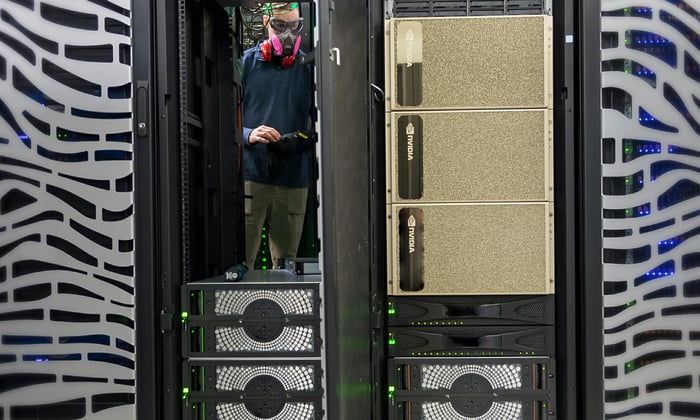
Image source: Nvidia.
The solid pricing power of these two semiconductor bellwethers can send their stocks soaring
Nvidia (NASDAQ: NVDA) and Taiwan Semiconductor Manufacturing (NYSE: TSM) are two of the most important semiconductor companies driving the AI revolution. They have a symbiotic relationship, with Nvidia designing AI data center chips and TSMC manufacturing them.
Importantly, both companies are dominant in their respective niches. Nvidia has an 81% share of the AI data center chip market, according to IDC. The company's dominance stems from its first-mover advantage in the AI chip market: It has been the leader in parallel processors for years, and OpenAI decided to use Nvidia's graphics processing units to train ChatGPT four years ago.
This relationship opened the gates to the AI gold rush for Nvidia, with major hyperscalers and AI companies making a beeline for its chips to power their AI training and inference applications. What's more, Nvidia has stayed ahead of its rivals on the technology curve, which explains why it is still the dominant company in this market.
Its latest generation Vera Rubin AI processors, for instance, promise major gains over its previous-generation Blackwell processors. Nvidia has said it expects to sell an impressive $1 trillion worth of its Vera Rubin and Blackwell processors in 2026 and 2027. Also, as Nvidia is the biggest AI chip designer out there and exercises solid control over the supply chain due to its relationship with TSMC, it can charge premium prices for its offerings.
This combination of strong AI chip sales volumes and Nvidia's robust pricing power explains why its non-GAAP (adjusted) earnings per share are expected to grow by 75% this year, following a 60% spike last year. Analysts are forecasting another 35% earnings increase in its next fiscal year to $11.24 per share, but it could do better than that due to its massive sales pipeline.
The solid earnings growth that it can clock could send Nvidia's stock soaring. Even if it achieves $11.24 per share in earnings and trades at 30 times earnings (a discount to the Nasdaq-100's average earnings multiple of 32.4), its stock could jump to $337. That would be an increase of 67% from current levels, making Nvidia a no-brainer buy, particularly given its forward earnings multiple of 25.
Analysts are boosting their earnings estimates for TSMC following its latest report
TSMC's advanced chip fabrication facilities have made it the foundry of choice for the major AI chip designers, including Nvidia. As a result, TSMC is the largest player in the third-party foundry market, controlling 72% of this space, according to Counterpoint Research -- up from 69% a year ago.
That massive market share explains TSMC's pricing power. The company is expected to increase the price of its chips by 5% to 10% this year, with the prices of its most advanced 2-nanometer (nm) chip node anticipated to jump the most. It is worth noting that TSMC has reportedly sold out its manufacturing capacity until 2028.
A shortage of manufacturing capacity for advanced chips, which are in high demand, puts the company in a position to raise prices further. This is precisely the reason why analysts are now expecting stronger earnings growth from the company.
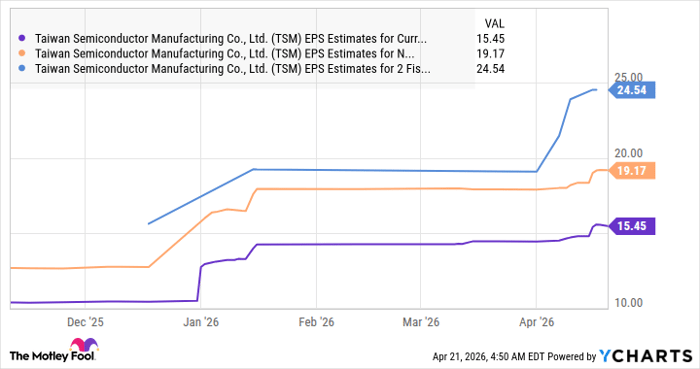
TSM EPS Estimates for Current Fiscal Year data by YCharts.
The chart above points to the view that TSMC's earnings in 2027 could reach $19.17 per share. There is a strong likelihood that TSMC will exceed that estimate, especially given that it expects sales of the AI accelerator chips it manufactures to clock compound annual growth at a percentage in the high-50s through 2029. But even if TSMC's earnings are only in line with analysts' consensus expectations over the next two years and it trades at 30 times earnings at the end of that period, its stock price could reach $575.
That's a potential upside of 57% within the next two years. However, the catalysts discussed above suggest that it could deliver bigger gains to investors, which makes this semiconductor stock a top buy while it's trading at 25 times forward earnings.
Should you buy stock in Nvidia right now?
Before you buy stock in Nvidia, consider this:
The Motley Fool Stock Advisor analyst team just identified what they believe are the 10 best stocks for investors to buy now… and Nvidia wasn’t one of them. The 10 stocks that made the cut could produce monster returns in the coming years.
Consider when Netflix made this list on December 17, 2004... if you invested $1,000 at the time of our recommendation, you’d have $502,837!* Or when Nvidia made this list on April 15, 2005... if you invested $1,000 at the time of our recommendation, you’d have $1,241,433!*
Now, it’s worth noting Stock Advisor’s total average return is 977% — a market-crushing outperformance compared to 200% for the S&P 500. Don't miss the latest top 10 list, available with Stock Advisor, and join an investing community built by individual investors for individual investors.
See the 10 stocks »
*Stock Advisor returns as of April 23, 2026.
Harsh Chauhan has no position in any of the stocks mentioned. The Motley Fool has positions in and recommends Nvidia and Taiwan Semiconductor Manufacturing. The Motley Fool has a disclosure policy.
Recommended Articles


