


Nike Is Now the Third Highest-Yielding Dividend Stock in the Dow Jones Industrial Average. Should You Follow Apple CEO Tim Cook's Lead and Buy Nike Near a 10-Year Low?
Key Points
Investor patience has reached a breaking point with Nike after years of disappointing results.
The company has addressed its most pressing challenges, but it still has a long way to go.
Nike still hasn't returned to growth, so it isn't cheap based on forward earnings estimates.
- 10 stocks we like better than Nike ›
Tim Cook made headlines on April 20 when Apple announced he would step down as CEO to become executive chairman, effective Sept. 1, 2026. Cook has been CEO since 2011.
Will AI create the world's first trillionaire? Our team just released a report on the one little-known company, called an "Indispensable Monopoly" providing the critical technology Nvidia and Intel both need. Continue »
But his tenure on the Nike (NYSE: NKE) board of directors dates all the way back to 2005. Cook has been making noteworthy purchases of Nike stock in recent months -- including 50,000 shares in December and another 25,000 shares in April.
Despite a broader market recovery in recent weeks, Nike is hovering around a 10-year low -- impacted by its 27% year-to-date decline and 62.7% collapse over the last three years.
The sell-off has pushed Nike's dividend yield to 3.5% -- making it the third-highest yielding stock among the 30 components of the Dow Jones Industrial Average, behind only Chevron and Verizon Communications.
Cook's purchase is a vote of confidence that the worst for Nike could be over, but it doesn't mean Nike will magically rebound overnight. Here's why Nike's investment thesis is shaken, why Nike has transformed from a growth stock to a high-yield dividend stock, and whether Nike is a buy now.
Image source: Getty Images.
Execution errors have come at a steep price for Nike shareholders
The COVID-19 pandemic proved to be a very misleading time for Nike, as was true for many companies. Nike invested heavily in its direct-to-consumer (DTC) Nike Direct strategy -- which consists of Nike Digital through its website and app, as well as Nike-owned retail stores.
The idea thrived during the pandemic, as consumers naturally pivoted to online shopping and Nike Digital provided a streamlined option. But Nike went way too far by reducing ties with many of its wholesale partners. The idea backfired as COVID-19 restrictions eased and Nike came under pressure from familiar competitors, as well as newer ones like Deckers Outdoor-owned Hoka and On Holding.
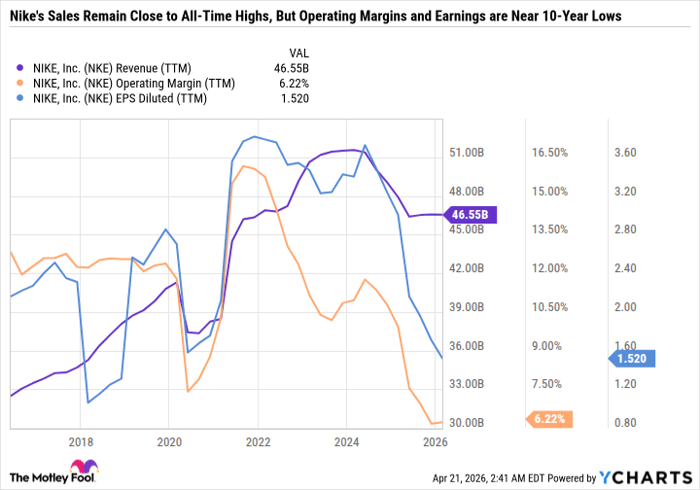
Nike's earnings and margins began ticking down. And it became painfully obvious that Nike was more dependent on its wholesale partnerships than it cared to admit.
NKE Revenue (TTM) data by YCharts
DTC gives Nike greater control over the buyer experience to make promotions more effective, cuts out the middleman nature of wholesale partners, and can theoretically boost margins by reducing operating costs. But it also makes Nike more responsible for aligning product quality and quantity with consumer interests.
If Nike overestimates demand or misses the mark on key design trends, it can be left holding a lot of unwanted inventory -- which forces discounts and losses. However, wholesale partners take some of that downside risk off Nike.
Nike's gradual road to recovery
Nike was caught flat-footed in the years following the pandemic, so it named Nike veteran Elliott Hill as CEO in October 2024 and tasked him with turning the business around. But the turnaround has taken far longer than some investors may have initially expected. Not only is Nike dealing with its own supply chain, marketing, and strategy issues, it is also facing a difficult operating environment for consumer discretionary spending in general, not to mention added tariff-related costs that are further straining its margins.
Nike's size, which used to be a core strength, is now one of its greatest weaknesses. The company is such a massive, diversified global business that it's difficult for a single market or theme to move the needle. So even though Nike is leaning more into sports -- especially running and football -- and its North American wholesale sales channels, it continues to be dragged down by Greater China, Converse, and its sportswear segment.
For the quarter, wholesale revenue increased 5%, but Nike Digital revenue fell 9%, and Nike-owned store sales dropped 5%. On the April earnings call, Nike said that it will return to providing full-year and long-term guidance at its Investor Day in the fall -- which is a red flag that Nike needs more time to chart a clear and attainable turnaround.
Nike isn't performing at the level needed to support its dividend
Nike's cash, cash equivalents, and short-term investments fell $2.3 billion to $8.1 billion in the third quarter of 2026 because cash dividends, share buybacks, bond repayments, and capital expenditures were higher than cash generated from operations. However, Nike did reduce its long-term debt by 12% year over year to $7.03 billion.
In November, Nike announced a 3% increase in its quarterly dividend, boosting the payout to $0.41 per share and marking the 24th consecutive annual dividend raise. However, it's difficult for investors to be confident in Nike's payout when its free cash flow can't cover its dividends and buybacks.
Given Nike's steep sell-off, you may think the stock would fetch a dirt cheap valuation. But analyst consensus earnings estimates of $1.50 per share in fiscal 2026 and $1.89 in fiscal 2027 point to a slow recovery. Nike's stock price at the time of this writing of $46.50 is still 24.6 times fiscal 2027 estimates, which isn't cheap at all.
Nike isn't a screaming buy
Nike is arguably one of the most difficult stocks to value in today's market. The company has overpromised and underdelivered for years, to the point where management isn't even providing full-year guidance. Its dividend yield is attractive, but it comes at the expense of depleting cash from the balance sheet. But to Nike's credit, cash, cash equivalents, and short-term investments are still higher than its long-term debt.
If Nike can recover to its pre-pandemic form, the stock will be too cheap to ignore. And there's reason to believe Nike is on the right path now that it has centered its focus on core product categories and is back to growing its wholesale business.
All told, it's probably best if most investors keep Nike on a watch list until it shows a clear path to dividend stability and earnings growth. However, those who are confident that its strategic shifts will pay off may want to step in and buy high stock now. Nike's dividend provides a worthwhile incentive to hold the stock through this period, though it means little if the stock's decline continues to outpace dividend income, as has been the case in recent years.
Should you buy stock in Nike right now?
Before you buy stock in Nike, consider this:
The Motley Fool Stock Advisor analyst team just identified what they believe are the 10 best stocks for investors to buy now… and Nike wasn’t one of them. The 10 stocks that made the cut could produce monster returns in the coming years.
Consider when Netflix made this list on December 17, 2004... if you invested $1,000 at the time of our recommendation, you’d have $502,837!* Or when Nvidia made this list on April 15, 2005... if you invested $1,000 at the time of our recommendation, you’d have $1,241,433!*
Now, it’s worth noting Stock Advisor’s total average return is 977% — a market-crushing outperformance compared to 200% for the S&P 500. Don't miss the latest top 10 list, available with Stock Advisor, and join an investing community built by individual investors for individual investors.
See the 10 stocks »
*Stock Advisor returns as of April 23, 2026.
Daniel Foelber has positions in Nike. The Motley Fool has positions in and recommends Apple, Chevron, Deckers Outdoor, Nike, and On Holding. The Motley Fool recommends Verizon Communications. The Motley Fool has a disclosure policy.
Recommended Articles


