


2 Slam-Dunk ETFs You Can Buy With Confidence Using Your 2026 Tax Refund
Key Points
President Trump's "Big, Beautiful Bill" has boosted the average tax refund by 11% to $3,462, as of April 3.
The first ETF tracks a benchmark index that hasn't had a negative total return over any rolling 20-year period dating back to 1900.
Meanwhile, the second ETF is packed with profitable, time-tested dividend stocks that are notably cheaper than Wall Street's major stock indexes.
- 10 stocks we like better than Vanguard S&P 500 ETF ›
Love it or hate it, today (April 15) is officially Tax Day! Following the passage of President Donald Trump's flagship tax and spending law, the "Big, Beautiful Bill," a variety of tax breaks have boosted the average refund in 2026 by 11% to $3,462 (as of April 3).
While the smartest maneuvers with federal tax refunds are to shore up your emergency fund and pay down/off high-interest debt, investing this capital in the stock market is a genius option for those who already have these bases covered. In particular, two slam-dunk exchange-traded funds (ETFs) -- the Vanguard S&P 500 ETF (NYSEMKT: VOO) and Schwab U.S. Dividend Equity ETF (NYSEMKT: SCHD) -- can confidently be bought by investors looking to put their tax refund to work.
Will AI create the world's first trillionaire? Our team just released a report on the one little-known company, called an "Indispensable Monopoly" providing the critical technology Nvidia and Intel both need. Continue »

Image source: Getty Images.
Vanguard S&P 500 ETF
Although nothing is guaranteed on Wall Street, the Vanguard S&P 500 ETF is about as close as you'll get to a guaranteed long-term moneymaker.
As its name implies, this is an index fund that attempts to mirror the total returns of the benchmark S&P 500 (SNPINDEX: ^GSPC), less fees and expenses. It's a fund that provides instant diversification and exposure to 500 of Wall Street's most influential businesses.
The beauty of holding an S&P 500-tracking ETF is that the stock market's benchmark index hasn't had a negative total return over any rolling 20-year period. A data set published by Crestmont Research examined the rolling 20-year total returns, including dividends, of the S&P 500 from 1900 through 2025 and found that all 107 timelines (1900-1919, 1901-1920, and so on, to 2006-2025) generated positive total annualized returns.
What's more, the Vanguard S&P 500 ETF has a microscopic net expense ratio of 0.03%. This means only $0.30 of every $1,000 invested is kept for management fees and marketing expenses.
Though the S&P 500 doesn't rise every year, Crestmont's more-than-century-long analysis offers a compelling reason to buy for long-term-minded investors.
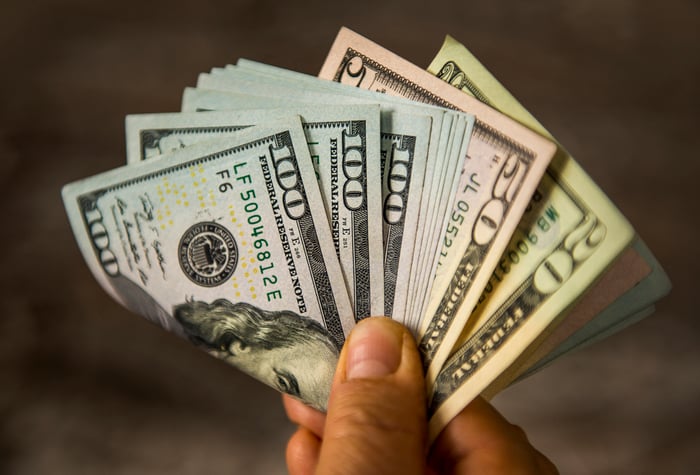
Image source: Getty Images.
Schwab U.S. Dividend Equity ETF
The second ETF that makes for a genius buy with your 2026 tax refund is the Schwab U.S. Dividend Equity ETF. This ETF closely tracks the total return of the Dow Jones U.S. Dividend 100 Index.
Why dividend stocks? The simple answer is that they historically outperform non-payers... by a lot! In "The Power of Dividends: Past, Present, and Future," analysts at Hartford Funds, in collaboration with Ned Davis Research, found that dividend stocks more than doubled the annualized return of non-payers over 51 years (1973-2024): 9.2% annualized vs. 4.31% annualized.
Companies that regularly pay a dividend to shareholders are typically profitable on a recurring basis, time-tested, and capable of providing transparent long-term growth outlooks. They're just the type of businesses we'd expect to increase in value over time.
Like the Vanguard S&P 500 ETF, the Schwab U.S. Dividend Equity ETF has a net expense ratio that's below its category average. Only $0.60 (0.06% net expense ratio) of every $1,000 invested goes toward fees and expenses.
To round things out, the price-to-earnings (P/E) ratio of the Schwab U.S. Dividend Equity ETF is notably lower than the P/E ratios of the S&P 500 and high-flying Nasdaq Composite. There's a value proposition with this ETF, to go along with its 3.3% dividend yield.
Should you buy stock in Vanguard S&P 500 ETF right now?
Before you buy stock in Vanguard S&P 500 ETF, consider this:
The Motley Fool Stock Advisor analyst team just identified what they believe are the 10 best stocks for investors to buy now… and Vanguard S&P 500 ETF wasn’t one of them. The 10 stocks that made the cut could produce monster returns in the coming years.
Consider when Netflix made this list on December 17, 2004... if you invested $1,000 at the time of our recommendation, you’d have $556,335!* Or when Nvidia made this list on April 15, 2005... if you invested $1,000 at the time of our recommendation, you’d have $1,160,572!*
Now, it’s worth noting Stock Advisor’s total average return is 975% — a market-crushing outperformance compared to 193% for the S&P 500. Don't miss the latest top 10 list, available with Stock Advisor, and join an investing community built by individual investors for individual investors.
See the 10 stocks »
*Stock Advisor returns as of April 15, 2026.
Sean Williams has no position in any of the stocks mentioned. The Motley Fool has positions in and recommends Vanguard S&P 500 ETF. The Motley Fool has a disclosure policy.
Recommended Articles


