


This Value Stock Yields 5.3% and Has Paid a Dividend for 92 Consecutive Years. Here's Why It's a Buy in April.
Key Points
Despite falling earnings, Kimberly-Clark can still support its dividend from its operations rather than relying on debt.
The company will likely close its acquisition of Kenvue later this year.
Kimberly-Clark's high-yield and valuation make it especially appealing to income-focused value investors.
- 10 stocks we like better than Kimberly-Clark ›
The S&P 500 (SNPINDEX: ^GSPC) has become far more concentrated in tech-focused growth companies, many of which have low yields or don't pay dividends. The changing composition of the index has compressed the S&P 500 dividend yield to just 1.2%, down from around 2% a decade ago.
Investors looking for stocks to boost their passive income have come to the right place. Kimberly-Clark (NASDAQ: KMB) -- a leading consumer staples company -- has raised its dividend for 54 consecutive years. That makes Kimberly-Clark one of 60 companies that have paid and raised their dividends for at least 50 consecutive years -- known as Dividend Kings. But Kimberly-Clark's dividend track record extends far beyond that time frame, as the company has paid a dividend for 92 consecutive years -- a streak that predates the first FM radio broadcast and the invention of the microwave oven.
Will AI create the world's first trillionaire? Our team just released a report on the one little-known company, called an "Indispensable Monopoly" providing the critical technology Nvidia and Intel both need. Continue »
Here's why Kimberly-Clark is one of the best value stocks for income investors to buy in April.

Image source: Getty Images.
Navigating a multiyear downturn
Kimberly-Clark's yield has soared to 5.3% due to a combination of consistent dividend raises and its falling stock price. The sell-off has gone from bad to worse, and Kimberly-Clark is now hovering around a 12-year low.
Sales growth and profit margins are under pressure due to rising costs and weak consumer spending. But unlike some high-yield stocks with falling earnings that must use debt to fund their payouts, Kimberly-Clark continues to generate plenty of operating cash flow to support its long-term capital spending plans, dividend, and share repurchases.
Kimberly-Clark's payout ratio is elevated, but its earnings still exceed its dividend payment. Free cash flow (FCF) is barely below the dividend expense, and that's even when factoring in a substantial decrease in FCF in recent years, amplified by a roughly $200 million increase in input costs in fiscal 2025, mainly due to tariff-related headwinds.
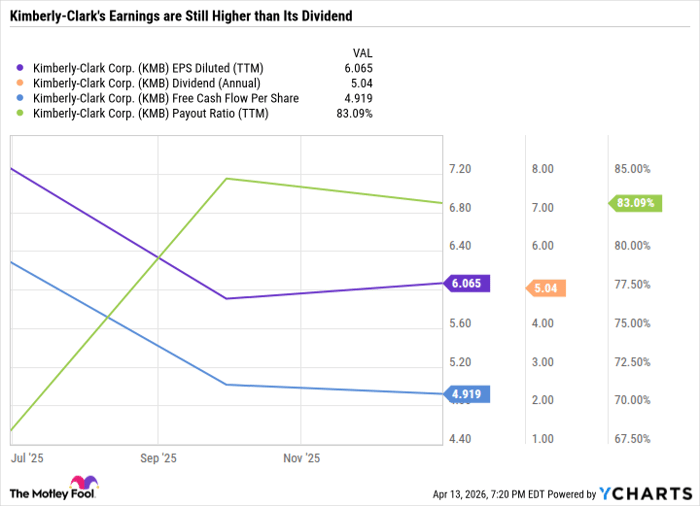
KMB EPS Diluted (TTM) data by YCharts
The good news is that Kimberly-Clark expects margins to improve, with organic growth accelerating in the second half of 2026. Management also set its goal to reach at least 40% gross margins by the end of the decade.
What's more, the stock is dirt cheap, trading at just 16 times trailing-12-month earnings and 12.9 times forward earnings.
A household products and personal care powerhouse
Kimberly-Clark is a textbook example of how great companies can go from cheap to bargain-bin territory when multiple factors magnify investor uncertainty. In Kimberly-Clark's case, the sectorwide sell-off in consumer staples, inflationary cost pressures due in part to high oil prices, weak consumer spending due to cost-of-living increases, and uncertainty around Kimberly-Clark's Kenvue acquisition (expected to close in the second half of 2026) give short-term-minded investors multiple excuses to sell the stock.
Long-term investors who believe in the staying power of Kimberly Clark's top brands -- like Huggies, Kleenex, and Scott -- as well as the brands it will get from its acquisition of Kenvue -- like Neutrogena, Aveeno, Listerine, Band-Aid, and Tylenol -- are getting a phenomenal opportunity to scoop up shares of Kimberly-Clark on sale.
Should you buy stock in Kimberly-Clark right now?
Before you buy stock in Kimberly-Clark, consider this:
The Motley Fool Stock Advisor analyst team just identified what they believe are the 10 best stocks for investors to buy now… and Kimberly-Clark wasn’t one of them. The 10 stocks that made the cut could produce monster returns in the coming years.
Consider when Netflix made this list on December 17, 2004... if you invested $1,000 at the time of our recommendation, you’d have $556,335!* Or when Nvidia made this list on April 15, 2005... if you invested $1,000 at the time of our recommendation, you’d have $1,160,572!*
Now, it’s worth noting Stock Advisor’s total average return is 975% — a market-crushing outperformance compared to 193% for the S&P 500. Don't miss the latest top 10 list, available with Stock Advisor, and join an investing community built by individual investors for individual investors.
See the 10 stocks »
*Stock Advisor returns as of April 15, 2026.
Daniel Foelber has positions in Kenvue and Kimberly Clark. The Motley Fool has positions in and recommends Kenvue. The Motley Fool has a disclosure policy.
Recommended Articles


