

TradingKey Today’s Market Recap: U.S. Stocks Gain on Iran Peace Oververtures; Oracle Jumps 12% Marking Best Day Since Sept; Software Sector Sees Across-the-Board Gains

Source Tradingkey

TradingKey - The three major U.S. stock indices closed higher on Monday, ET, fueled by expectations of easing tensions in the Middle East. The S&P 500 rose 1.02% to close at 6,886, recovering all losses since the start of the U.S.-Iran war; the Nasdaq Composite gained 1.23% to end at 23,184, marking its ninth consecutive session of gains; the Dow Jones Industrial Average rose 0.63% to close at 48,218.

On the news front, as the U.S. military began blockading Iranian ports, President Trump stated that Iran had initiated contact seeking a deal. Rising market expectations for a U.S.-Iran agreement pushed market sentiment toward optimism.

In terms of individual stocks, storage chip maker SanDisk (SNDK) will be added to the Nasdaq 100 Index. It closed up 11.83% on Monday, bringing its year-to-date gains to 246%. Oracle (ORCL) shares surged 12%, marking their best single-day performance since last September and leading software stocks to recover some of their year-to-date losses, Adobe (ADBE) Salesforce (CRM) ServiceNow (NOW) each rose more than 5%. Software stocks have been under broad pressure this year due to the impact of AI.

On Monday, Goldman Sachs (GS) kicked off the Q2 earnings season, reporting record equities revenue, though its fixed income (FICC) business remained under pressure, with the stock closing down nearly 2%. The largest U.S. banks will release their financial reports throughout this week, and the performance of bank stocks is considered a barometer for the economy.

Market Headlines

The U.S. 'blockade order' on Iranian ports has taken effect. Trump stated that Iran called the U.S. side expressing a desire to reach an agreement, while threatening to destroy Iranian fast-attack craft. Iran warned that if the U.S. blockades the Strait of Hormuz, it will lose the Bab-el-Mandeb Strait. The Iranian military stated it would implement a "permanent mechanism for controlling the Strait of Hormuz," asserting that enemy vessels have no right to pass through the strait now or in the future. More than 15 U.S. warships are in position to support the blockade. On Monday, Trump stated that Iran will not be allowed to possess nuclear weapons and that there will never be a deal if the Iranian side does not agree. According to U.S. media reports, U.S. government officials are discussing potential dates and locations for face-to-face talks, with Geneva and Islamabad under consideration; the next round of direct negotiations could take place in Islamabad on the 16th.

Crude oil production recorded its largest single-month decline in history, as OPEC's March crude output plummeted by 7.88 million barrels per day (bpd), a drop exceeding the peak levels seen during the COVID-19 pandemic. Impacted by the blockade of the Strait of Hormuz, OPEC's daily crude oil production fell sharply by 7.88 million barrels in March, surpassing the record drop of 6.28 million barrels during the 2020 COVID-19 pandemic. Iraq saw the most drastic reduction, with daily output plunging by 2.56 million barrels to 1.63 million barrels. OPEC lowered its global oil demand forecast for the second quarter of this year by 500,000 bpd to 105.07 million bpd, while maintaining its full-year growth outlook.

Elon Musk's version of WeChat—the encrypted messaging app XChat—is set to officially launch on April 17. Four years in the making, XChat—the encrypted messaging app under the X platform and a "Western version of the Super App" designed to rival WeChat—is about to launch. The app features end-to-end encryption, no phone number requirement, built-in Grok AI, and support for Simplified Chinese, aiming to allow Western users to integrate social networking, communications, AI assistance, and even payments into a single gateway.

Goldman Sachs saw steady growth in Q1 revenue and net profit, with equity trading revenue breaking Wall Street records for two consecutive quarters, yet its shares declined. Goldman Sachs Group's equity trading desk broke Wall Street records for the second consecutive quarter, with intense market volatility triggered by the Iranian war serving as a key driver. Revenue for the equities division reached $5.33 billion in the first quarter, more than $1 billion higher than the previous record of $4.31 billion set in the fourth quarter of last year. However, revenue from other segments, such as fixed income, came in below expectations for the first quarter.

Top 10 Most Active Stocks

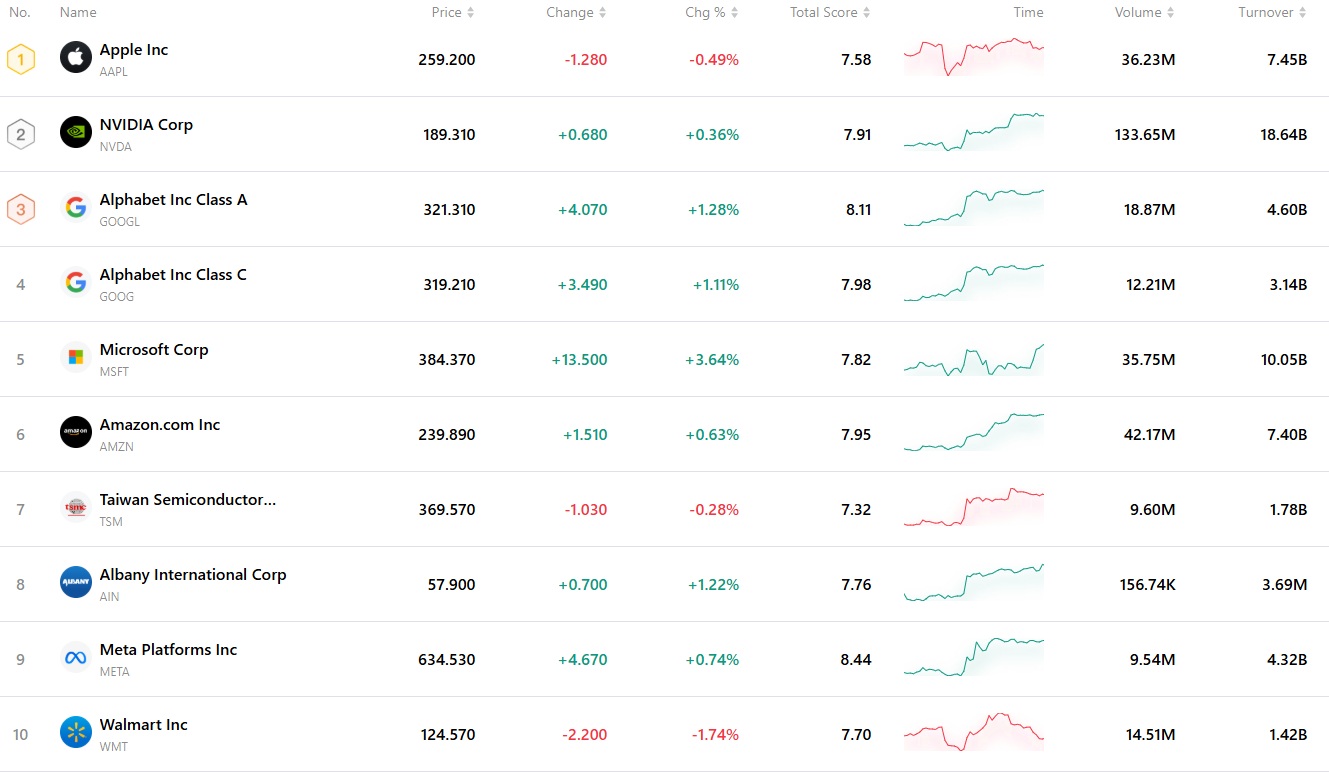
The following chart lists the ten most actively traded stocks in the market on Monday. With massive trading volumes and high liquidity, these assets have become key benchmarks for tracking global market dynamics.
10-stock-7c3785e4c46947bdae65eea7c376662c

Disclaimer: For information purposes only. Past performance is not indicative of future results.
placeholder
Bitcoin CME gaps at $35,000, $27,000 and $21,000, which one gets filled first?Prioritize filling the $27,000 gap and even try higher.
Author  FXStreet
Aug 22, 2023
Prioritize filling the $27,000 gap and even try higher.
placeholder
Pinduoduo Earnings Incoming: Morgan Stanley Sees Long-Term Profit Potential​Insights – On November 21, Chinese e-commerce giant Pinduoduo (PDD) will release its Q3 2024 earnings.
Author  Mitrade
Nov 20, 2024
​Insights – On November 21, Chinese e-commerce giant Pinduoduo (PDD) will release its Q3 2024 earnings.
placeholder
Elon Musk’s xAI and Neuralink Launch New Funding Rounds​Billionaire Elon Musk recently raised funds for his two high-profile tech companies, xAI and Neuralink.
Author  Insights
Jun 03, 2025
​Billionaire Elon Musk recently raised funds for his two high-profile tech companies, xAI and Neuralink.
placeholder
Bitcoin briefly loses 2025 gains as crypto plunges over the weekend.Bitcoin experienced a sharp decline this weekend, briefly erasing its 2025 gains and dipping below its year-opening value of $93,507. The cryptocurrency fell to a low of $93,029 on Sunday, representing a 25% drop from its all-time high in October. Although it has rebounded slightly to around $94,209, the pressures on the market remain significant. The downturn occurred despite the reopening of the U.S. government on Thursday, which many had hoped would provide essential support for crypto markets. This year initially appeared promising for cryptocurrencies, particularly after the inauguration of President Donald Trump, who has established the most pro-crypto administration thus far. However, ongoing political tensions—including Trump's tariff strategies and the recent government shutdown, lasting a historic 43 days—have contributed to several rapid price pullbacks for Bitcoin throughout the year. Market dynamics are also being influenced by Bitcoin whales—investors holding large amounts of Bitcoin—who have been offloading portions of their assets, consequently stalling price rallies even as positive regulatory developments emerge. Despite these sell-offs, analysts from Glassnode argue that this behavior aligns with typical patterns seen among long-term investors during the concluding stages of bull markets, suggesting it is not indicative of a mass exodus. Notably, Bitcoin is not alone in its struggles, as Ethereum and Solana have also recorded declines of 7.95% and 28.3%, respectively, since the start of the year, while numerous altcoins have faced even steeper losses. Looking ahead, questions linger regarding the viability of the four-year cycle thesis, particularly given the increasing institutional support and regulatory frameworks now in place in the crypto landscape. Matt Hougan, chief investment officer at Bitwise, remains optimistic, suggesting a potential Bitcoin resurgence in 2026 driven by the “debasement trade” thesis and a broader trend toward increased adoption of stablecoins, tokenization, and decentralized finance. Hougan emphasized the soundness of the underlying fundamentals, pointing to a positive outlook for the sector in the longer term.
Author  Mitrade
Nov 17, 2025
Bitcoin experienced a sharp decline this weekend, briefly erasing its 2025 gains and dipping below its year-opening value of $93,507. The cryptocurrency fell to a low of $93,029 on Sunday, representing a 25% drop from its all-time high in October. Although it has rebounded slightly to around $94,209, the pressures on the market remain significant. The downturn occurred despite the reopening of the U.S. government on Thursday, which many had hoped would provide essential support for crypto markets. This year initially appeared promising for cryptocurrencies, particularly after the inauguration of President Donald Trump, who has established the most pro-crypto administration thus far. However, ongoing political tensions—including Trump's tariff strategies and the recent government shutdown, lasting a historic 43 days—have contributed to several rapid price pullbacks for Bitcoin throughout the year. Market dynamics are also being influenced by Bitcoin whales—investors holding large amounts of Bitcoin—who have been offloading portions of their assets, consequently stalling price rallies even as positive regulatory developments emerge. Despite these sell-offs, analysts from Glassnode argue that this behavior aligns with typical patterns seen among long-term investors during the concluding stages of bull markets, suggesting it is not indicative of a mass exodus. Notably, Bitcoin is not alone in its struggles, as Ethereum and Solana have also recorded declines of 7.95% and 28.3%, respectively, since the start of the year, while numerous altcoins have faced even steeper losses. Looking ahead, questions linger regarding the viability of the four-year cycle thesis, particularly given the increasing institutional support and regulatory frameworks now in place in the crypto landscape. Matt Hougan, chief investment officer at Bitwise, remains optimistic, suggesting a potential Bitcoin resurgence in 2026 driven by the “debasement trade” thesis and a broader trend toward increased adoption of stablecoins, tokenization, and decentralized finance. Hougan emphasized the soundness of the underlying fundamentals, pointing to a positive outlook for the sector in the longer term.
placeholder
WTI jumps roughly 8% toward $100 as US blockades Strait of HormuzWest Texas Intermediate (WTI) – the US oil benchmark – has opened the week with a bullish gap, climbing roughly 8%, looking to retarget the $100 threshold.
Author  Mitrade
Yesterday 01: 37
West Texas Intermediate (WTI) – the US oil benchmark – has opened the week with a bullish gap, climbing roughly 8%, looking to retarget the $100 threshold.
goTop
quote