


Should You Buy Microsoft Stock Before April 29?
Key Points
Microsoft's past two earnings reports have resulted in sharp declines for its stock.
A slowing growth rate in its Azure business was the reason for its most recent sell-off.
The stock trades at a low earnings multiple, and a lot of bearishness may already be priced in.
- 10 stocks we like better than Microsoft ›
If you were to look at Microsoft (NASDAQ: MSFT)'s share price, you might think that the business is struggling. It has fallen 21% this year, and over the past 12 months, the stock has declined by 1%. That's not the type of performance you might expect from a company that's as robust and diversified as Microsoft, particularly as it's investing in new opportunities in artificial intelligence (AI).
The tech stock needs a positive catalyst, and investors may be hopeful that when it reports its latest earnings on April 29, it could finally get one. Should you buy the stock before then?
Will AI create the world's first trillionaire? Our team just released a report on the one little-known company, called an "Indispensable Monopoly" providing the critical technology Nvidia and Intel both need. Continue »

Image source: Getty Images.
Recent earnings reports haven't been kind to the stock
A big concern for investors recently has been that Microsoft's cloud business, Azure, has been growing at a slower pace of late. And that could be a key number that yet again dictates how the stock does after it reports earnings. Back in January, the stock fell heavily, as you'll see in the chart below, as Azure's growth rate came in at 39% -- down from 40% a quarter earlier.
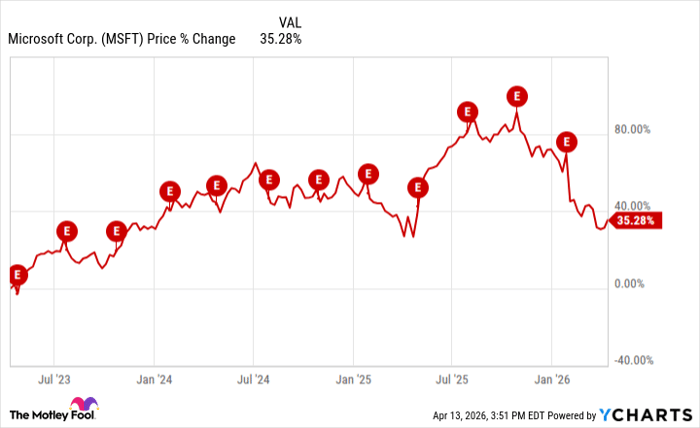
MSFT data by YCharts
The past two earnings reports have resulted in significant declines for Microsoft's stock. Back in October, it was an increase in capex spending that spooked investors, calling into question whether its AI strategy was worth the price.
At this stage, however, unless there's a troubling new development, much of the negativity around the stock may already be priced in.
Microsoft's stock might be too cheap to pass up
Shares of Microsoft have dipped so low that the stock is now trading at just 23 times its trailing earnings, and 19 times forward earnings (which are based on analyst expectations). By comparison, the average S&P 500 stock trades at a trailing earnings multiple of more than 24 and an expected future profit multiple of 21. Microsoft's stock is cheaper against both metrics.
There's some good value with Microsoft's stock today, which may make it too tempting an investment to pass up. This is one of the safest tech stocks you can own. It generates margins of around 40%, and even if its growth rate in one area of its business is slowing down, I don't think that justifies it trading at a discount to the S&P 500. This is still a company that has some fantastic long-term growth prospects, and buying it ahead of earnings, regardless of what happens, may prove to be a great move for patient investors.
Should you buy stock in Microsoft right now?
Before you buy stock in Microsoft, consider this:
The Motley Fool Stock Advisor analyst team just identified what they believe are the 10 best stocks for investors to buy now… and Microsoft wasn’t one of them. The 10 stocks that made the cut could produce monster returns in the coming years.
Consider when Netflix made this list on December 17, 2004... if you invested $1,000 at the time of our recommendation, you’d have $555,526!* Or when Nvidia made this list on April 15, 2005... if you invested $1,000 at the time of our recommendation, you’d have $1,156,403!*
Now, it’s worth noting Stock Advisor’s total average return is 968% — a market-crushing outperformance compared to 191% for the S&P 500. Don't miss the latest top 10 list, available with Stock Advisor, and join an investing community built by individual investors for individual investors.
See the 10 stocks »
*Stock Advisor returns as of April 13, 2026.
David Jagielski, CPA has no position in any of the stocks mentioned. The Motley Fool has positions in and recommends Microsoft. The Motley Fool has a disclosure policy.
Recommended Articles


