


5 Low-Cost Vanguard ETFs Are Undergoing Stock Splits. But Which Is the Best Buy Before the Split Takes Effect on April 21?
Key Points
Chip stocks have contributed to the Vanguard Information Technology ETF’s long-term outperformance.
Three of the ETFs offer an inexpensive way to get exposure to a diversified basket of leading growth stocks.
The mid-cap ETF, while it has underperformed, still has a solid return and may appeal to value investors.
- 10 stocks we like better than Vanguard Information Technology ETF ›
Will AI create the world's first trillionaire? Our team just released a report on the one little-known company, called an "Indispensable Monopoly" providing the critical technology Nvidia and Intel both need. Continue »
Mutual fund giant Vanguard Group has announced stock splits on five well-known exchange-traded funds (ETFs) that have been long-term winners. According to the ETF provider, a lower share price could boost trading volume, narrow the bid-ask spread, and benefit investor outcomes.
Here's a brief breakdown of each ETF to help you decide which one is the best buy for you.

Image source: Getty Images.
Stock splits for 5 low-cost ETFs
As of market close on April 7, the ETFs range from $290.93 per share to $718.63 per share. Effective April 21, the splits will bring each ETF below $100 a share.
|
ETF Name |
Net Assets |
Expense Ratio |
Split Ratio |
Current Price |
Split-Adjusted Price |
|---|---|---|---|---|---|
|
Vanguard Mid-Cap ETF (NYSEMKT: VO) |
$210.3 billion |
0.03% |
4-for-1 |
$290.93 |
$72.73 |
|
Vanguard Mega Cap Growth ETF (NYSEMKT: MGK) |
$29.3 billion |
0.05% |
5-for-1 |
$374.19 |
$74.84 |
|
Vanguard S&P 500 Growth ETF (NYSEMKT: VOOG) |
$21.9 billion |
0.07% |
6-for-1 |
$416.69 |
$69.45 |
|
Vanguard Growth ETF (NYSEMKT: VUG) |
$335.9 billion |
0.03% |
6-for-1 |
$445.08 |
$74.18 |
|
Vanguard Information Technology ETF (NYSEMKT: VGT) |
$126.5 billion |
0.09% |
8-for-1 |
$718.63 |
$89.83 |
Data as of market close on April 7, 2026. Data sources: Vanguard, YCharts.
As you can see in the table, each ETF is low cost, with expense ratios below 0.1%, or less than $10 for every $10,000 invested.
Among the ETFs undergoing splits are some of Vanguard's largest funds by net assets -- most notably its Growth ETF and Mid-Cap ETF. The Vanguard Information Technology ETF is the largest U.S. stock market sector ETF by net assets -- even bigger than the State Street Technology Select Sector SPDR ETF.
The Vanguard Tech ETF, along with the three growth-stock ETFs, have all outperformed the S&P 500 over the last decade. And although the Mid-Cap ETF has underperformed, it has still produced a solid return.
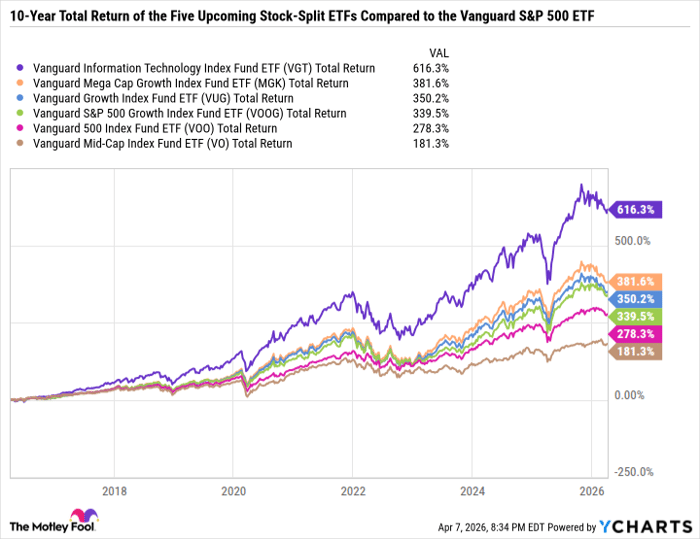
VGT Total Return Level data by YCharts.
Betting on big tech
The Vanguard Tech ETF is the best buy for investors seeking exposure to a handful of leading growth stocks and the semiconductor industry. This sector fund has crushed the S&P 500 and the Nasdaq Composite over the long term due to its outsize exposure to legacy tech giants like Microsoft and Apple. But the real winners in recent years have been semiconductor stocks.
Six of the Tech ETF's ten largest holdings are semiconductor stocks, including Nvidia, Broadcom, Micron Technology, Advanced Micro Devices, Applied Materials, and Lam Research. In fact, semiconductor, semiconductor materials, and semiconductor equipment companies now make up over 40% of the Vanguard Tech ETF.
Or put another way, roughly two-thirds of the ETF is invested in Apple, Microsoft, and semiconductors. That makes the fund a great buy for investors who believe these themes will continue to drive the broader market to new heights.
Three low-cost growth ETFs to buy now
Among the three growth-focused ETFs that are undergoing splits, the Vanguard Mega Cap Growth ETF is the best buy for folks who want outsize exposure to leading megacap growth stocks, but don't want to limit their holdings to the tech sector -- as megacap growth stocks like Alphabet, Meta Platforms, Amazon, Tesla, Eli Lilly, Visa, and Mastercard are not in the tech sector and therefore not included in the Vanguard Tech ETF.
The Mega Cap Growth ETF has outperformed the S&P 500 Growth ETF and the Growth ETF because it has higher weightings in the largest growth stocks. Less diversification has been a winning formula, but it's not well suited for all investors -- especially those who already have sizable dividend holdings in "Magnificent Seven" stocks.
The Vanguard Growth ETF and S&P 500 Growth ETF are good buys for investors looking for even more diversification -- although both funds still allocate over 30% of their holdings to Nvidia, Apple, and Microsoft. The S&P 500 Growth ETF has significantly less exposure to Apple than the Growth ETF and includes more financial stocks, like Berkshire Hathaway and JPMorgan Chase.
All three funds are good buys for the same core reason. And although their differences may seem subtle at first glance, investors should still take time to choose the fund that best complements their existing holdings and aligns with their risk tolerance.
A role player in a diversified portfolio
The Vanguard Tech ETF, Growth ETF, S&P 500 Growth ETF, and Mega Cap Growth ETF have similar top holdings and are all bets on the sustained outperformance of megacap growth stocks.
The Vanguard Mid-Cap ETF offers an entirely different investment objective. It includes 287 holdings, with no single stock accounting for more than 1.5% of the fund. It is far less top-heavy than the other ETFs that are undergoing splits. And its sector breakdown is well diversified across the market, with just 13.1% exposure to the tech sector.
You may have never heard of many of the top companies in the Vanguard Mid-Cap ETF. And that's by design, as most of the holdings aren't S&P 500 components. In this vein, the Mid-Cap ETF is a perfect fit for investors who already own S&P 500 stocks -- either individually or through other ETFs -- and are looking for true diversification that doesn't duplicate existing holdings.
The Mid-Cap ETF has a price-to-earnings ratio (P/E) of 23 and a 1.5% dividend yield compared to a 26.2 P/E and 1.2% yield for the Vanguard S&P 500 ETF (NYSEMKT: VOO) -- making it a good buy for value- and income-focused investors.
Should you buy stock in Vanguard Information Technology ETF right now?
Before you buy stock in Vanguard Information Technology ETF, consider this:
The Motley Fool Stock Advisor analyst team just identified what they believe are the 10 best stocks for investors to buy now… and Vanguard Information Technology ETF wasn’t one of them. The 10 stocks that made the cut could produce monster returns in the coming years.
Consider when Netflix made this list on December 17, 2004... if you invested $1,000 at the time of our recommendation, you’d have $555,526!* Or when Nvidia made this list on April 15, 2005... if you invested $1,000 at the time of our recommendation, you’d have $1,156,403!*
Now, it’s worth noting Stock Advisor’s total average return is 968% — a market-crushing outperformance compared to 191% for the S&P 500. Don't miss the latest top 10 list, available with Stock Advisor, and join an investing community built by individual investors for individual investors.
See the 10 stocks »
*Stock Advisor returns as of April 13, 2026.
JPMorgan Chase is an advertising partner of Motley Fool Money. Daniel Foelber has positions in Nvidia. The Motley Fool has positions in and recommends Advanced Micro Devices, Alphabet, Amazon, Apple, Applied Materials, Berkshire Hathaway, JPMorgan Chase, Lam Research, Mastercard, Meta Platforms, Micron Technology, Microsoft, Nvidia, Tesla, Vanguard Growth ETF, Vanguard Mid-Cap ETF, and Visa and is short shares of Apple. The Motley Fool recommends Broadcom. The Motley Fool has a disclosure policy.
Recommended Articles


