


Is the SpaceX IPO Destined to Flop? This Historical Indicator Has a (Thus Far) 100% Success Rate and Offers a Clear Answer.
Key Points
Space infrastructure and artificial intelligence (AI) conglomerate SpaceX recently put the wheels in motion to become a public company.
SpaceX may fetch a valuation of up to $1.75 trillion and raise in the neighborhood of $75 billion from its initial public offering (IPO).
However, the historically accurate price-to-sales ratio has a stark warning for prospective SpaceX investors.
- These 10 stocks could mint the next wave of millionaires ›
This may very well be the year of the mega-initial public offering (IPO). Artificial intelligence (AI) large language model developers OpenAI and Anthropic are both exploring the idea of going public before the end of 2026. However, the kingpin of all expected IPOs is space infrastructure and AI conglomerate, SpaceX.
SpaceX, whose CEO, Elon Musk, also runs trillion-dollar electric-vehicle (EV) maker Tesla (NASDAQ: TSLA), confidentially filed to go public on April 1. Initial reports suggest it could fetch a valuation of up to $1.75 trillion and raise in the neighborhood of $75 billion. For context, Saudi Aramco currently holds the title of largest IPO, with $29.4 billion raised in December 2019.
Will AI create the world's first trillionaire? Our team just released a report on the one little-known company, called an "Indispensable Monopoly" providing the critical technology Nvidia and Intel both need. Continue »

Image source: Getty Images.
Investors have a laundry list of reasons to be excited about SpaceX's debut. It has its fingers in two of the largest addressable markets on the planet, artificial intelligence and space infrastructure, is already turning a profit (from SpaceX), and is led by Musk, who turned Tesla into one of America's largest public companies.
But what if success was far from guaranteed for SpaceX and its soon-to-be public shareholders?
This time-tested indicator has a flawless track record of forecasting stock market bubbles
To preface the following discussion, there isn't a data point or historical correlation that can guarantee a short-term directional move in any stock or broad-based index. If there were, we'd all be using it by now.
However, there is one time-tested valuation tool that has an immaculate track record of alerting investors to stock market bubbles over several decades: the price-to-sales (P/S) ratio.
For more than three decades, companies on the leading edge of game-changing technologies and innovations have commonly topped out at trailing 12-month (TTM) P/S ratios ranging from 30 to 45, with some wiggle room at each end. For example, we witnessed Cisco Systems and Microsoft reach their respective P/S ratio peaks within this range prior to the dot-com bubble bursting.
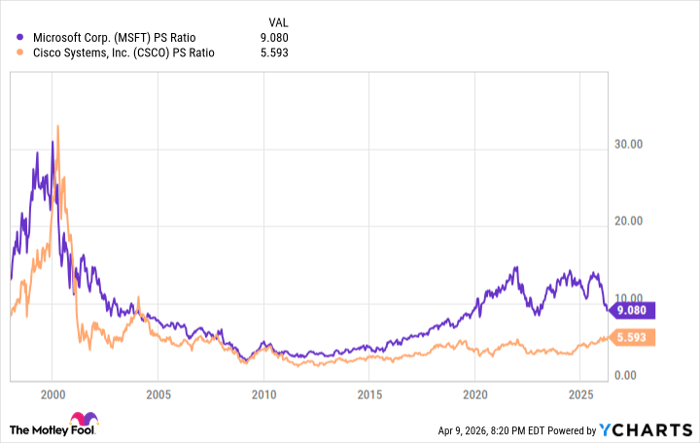
MSFT PS Ratio data by YCharts.
Including the proliferation of the internet and the several next-big-thing trends that have followed, no public company has been able to maintain a TTM P/S ratio above 30 for an extended period.
According to Reuters, SpaceX generated $15 billion to $16 billion in sales last year. Although an S-1 prospectus hasn't been filed (i.e., investors can't comb through the company's operating performance just yet), SpaceX itself is expected to account for $1 trillion (or more) of the company's market cap. Even though SpaceX is profitable, it means the company is valued at 63 times sales, at a minimum, ahead of its IPO. If P/S ratios of 30 have proven unsustainable since the mid-1990s, imagine what a P/S ratio of over 60 suggests.
SPACEX HAS OFFICIALLY FILED FOR AN IPO.
-- amit (@amitisinvesting) April 1, 2026
SpaceX Revenue -- $15B, targeting a $1.75T valuation$META Revenue -- $200B, currently at a $1.45T valuation
Are you buying the SpaceX IPO?
SpaceX's valuation implies perfection from high-growth industries that we simply know are imperfect. Space infrastructure is capital-intensive, prone to production delays, and can be adversely impacted by inflation. Meanwhile, AI is likely on a path to its own bubble-bursting event.
We observed the same dynamic play out with Tesla. Although EVs looked like a no-brainer investment opportunity on paper, a lack of EV infrastructure, coupled with tepid consumer demand for electric transportation, has stymied Tesla's sales growth.
Based on the time-tested P/S ratio, the SpaceX IPO appears destined to flop.
Don’t miss this second chance at a potentially lucrative opportunity
Ever feel like you missed the boat in buying the most successful stocks? Then you’ll want to hear this.
On rare occasions, our expert team of analysts issues a “Double Down” stock recommendation for companies that they think are about to pop. If you’re worried you’ve already missed your chance to invest, now is the best time to buy before it’s too late. And the numbers speak for themselves:
- Nvidia: if you invested $1,000 when we doubled down in 2009, you’d have $489,281!*
- Apple: if you invested $1,000 when we doubled down in 2008, you’d have $49,600!*
- Netflix: if you invested $1,000 when we doubled down in 2004, you’d have $555,526!*
Right now, we’re issuing “Double Down” alerts for three incredible companies, available when you join Stock Advisor, and there may not be another chance like this anytime soon.
See the 3 stocks »
*Stock Advisor returns as of April 13, 2026.
Sean Williams has no position in any of the stocks mentioned. The Motley Fool has positions in and recommends Cisco Systems, Microsoft, and Tesla. The Motley Fool has a disclosure policy.
Recommended Articles


