

If I Could Tell Investors 1 Thing About the Stock Market Right Now, It Would Be This

Source The Motley Fool

Key Points

  • Market chaos is more common than you might think.

  • It's easy to find several reasons for long-term optimism amid the general doom and gloom.

  • The long-term case for stocks is stronger than the short-term noise.

  • These 10 stocks could mint the next wave of millionaires ›

Volatility is the name of the game with the stock market right now. Uncertainty reigns amid concerns about the Middle East and resurgent inflation. The odds of a U.S. recession have increased sharply in betting markets.

All of this could easily become overwhelming, especially to new investors and those hoping to retire soon. Some are probably tempted to sell everything and only hold cash. Others check their portfolios frequently, fearful of what they might see. Neither approach is ideal.

Will AI create the world's first trillionaire? Our team just released a report on the one little-known company, called an "Indispensable Monopoly" providing the critical technology Nvidia and Intel both need. Continue »

I have been an investor for over 30 years. I've written about investing for 14 years. After watching multiple market cycles, if I could tell investors one thing about the stock market right now, it would be this: The biggest mistake you can make is to focus on short-term uncertainty instead of the long-term opportunity.

A person balancing a scale with a moneybag on one side and blocks spelling "fear" on the other, with an umbrella in the center.

Image source: Getty Images.

Market chaos is more common than you might think

Morgan Housel said it best, "Volatility is the price of admission... You have to pay the price to get the returns." He's exactly right.

The reality is that market chaos is more common than you might think. The stock market has always been volatile. Corrections occur around once every one to two years, on average. Not coincidentally, the Dow Jones Industrial Average (DJINDICES: ^DJI) and the Nasdaq Composite Index (NASDAQINDEX: ^IXIC) entered correction territory in 2025 and 2026.

Bear markets happen every three to five years, on average. The last one was in 2022.

I have seen the Dow plunge 22.6% in a single day. I lived through the dot-com bubble bursting. I watched the market meltdown in 2008. I vividly recall the panic selling during the early days of the COVID-19 pandemic. Every single one of those steep market downturns presented tremendous buying opportunities. However, many investors were so focused on the short-term that they missed out.

Reasons for long-term optimism

Is today's volatility somehow different from that in the past? I don't think so. We don't have to look hard to find several reasons for long-term optimism amid the general doom and gloom.

For one thing, corporate earnings have proven to be more resilient than many expected. Despite the highest tariffs in decades and significant geopolitical uncertainty, most companies continue to generate more money. Of the 503 stocks in the S&P 500 (SNPINDEX: ^GSPC) (there are more than 500 because some companies have multiple share classes), 424 (over 84%) have grown their earnings per share year over year.

Concerns that the market is overly dependent on the so-called "Magnificent Seven" stocks have proven to be overblown. The S&P 500 has held up much better than those seven mega-cap members have so far in 2026.

Although some are worried about AI, the opportunities it will likely create for businesses remain staggering. And AI is just one example of how innovation is accelerating. Companies are making major advances in biotech, energy storage, quantum computing, robotics, and more that could pay off handsomely for forward-looking investors.

Zoom out

I'm not saying that the stock market won't decline sharply; it might. However, I think the smartest thing that investors can do right now is to zoom out -- way out. Look at the S&P 500's performance since 1950. Despite multiple bear markets and global crises, the index has skyrocketed.
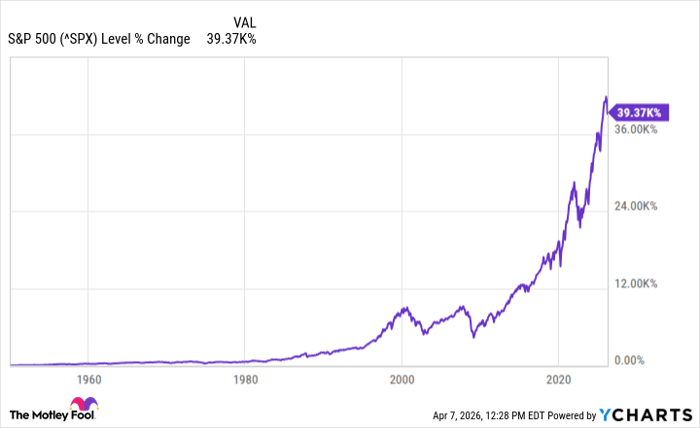
^SPX Chart

^SPX data by YCharts

The long-term case for stocks is stronger than the short-term noise. You don't have to predict what will happen over the next three months or the next three years. If you hold a diversified basket of stocks long enough, you should be fine.

Warren Buffett once said, "The stock market is a device for transferring money from the impatient to the patient." Patience has paid off during past periods of volatility. It will again.

Where to invest $1,000 right now

When our analyst team has a stock tip, it can pay to listen. After all, Stock Advisor’s total average return is 968%* — a market-crushing outperformance compared to 191% for the S&P 500.

They just revealed what they believe are the 10 best stocks for investors to buy right now, available when you join Stock Advisor.

See the stocks »

*Stock Advisor returns as of April 13, 2026.

Keith Speights has no position in any of the stocks mentioned. The Motley Fool has no position in any of the stocks mentioned. The Motley Fool has a disclosure policy.

Disclaimer: For information purposes only. Past performance is not indicative of future results.
placeholder
Bitcoin CME gaps at $35,000, $27,000 and $21,000, which one gets filled first?Prioritize filling the $27,000 gap and even try higher.
Author  FXStreet
Aug 22, 2023
Prioritize filling the $27,000 gap and even try higher.
placeholder
Pinduoduo Earnings Incoming: Morgan Stanley Sees Long-Term Profit Potential​Insights – On November 21, Chinese e-commerce giant Pinduoduo (PDD) will release its Q3 2024 earnings.
Author  Mitrade
Nov 20, 2024
​Insights – On November 21, Chinese e-commerce giant Pinduoduo (PDD) will release its Q3 2024 earnings.
placeholder
Elon Musk’s xAI and Neuralink Launch New Funding Rounds​Billionaire Elon Musk recently raised funds for his two high-profile tech companies, xAI and Neuralink.
Author  Insights
Jun 03, 2025
​Billionaire Elon Musk recently raised funds for his two high-profile tech companies, xAI and Neuralink.
placeholder
Bitcoin briefly loses 2025 gains as crypto plunges over the weekend.Bitcoin experienced a sharp decline this weekend, briefly erasing its 2025 gains and dipping below its year-opening value of $93,507. The cryptocurrency fell to a low of $93,029 on Sunday, representing a 25% drop from its all-time high in October. Although it has rebounded slightly to around $94,209, the pressures on the market remain significant. The downturn occurred despite the reopening of the U.S. government on Thursday, which many had hoped would provide essential support for crypto markets. This year initially appeared promising for cryptocurrencies, particularly after the inauguration of President Donald Trump, who has established the most pro-crypto administration thus far. However, ongoing political tensions—including Trump's tariff strategies and the recent government shutdown, lasting a historic 43 days—have contributed to several rapid price pullbacks for Bitcoin throughout the year. Market dynamics are also being influenced by Bitcoin whales—investors holding large amounts of Bitcoin—who have been offloading portions of their assets, consequently stalling price rallies even as positive regulatory developments emerge. Despite these sell-offs, analysts from Glassnode argue that this behavior aligns with typical patterns seen among long-term investors during the concluding stages of bull markets, suggesting it is not indicative of a mass exodus. Notably, Bitcoin is not alone in its struggles, as Ethereum and Solana have also recorded declines of 7.95% and 28.3%, respectively, since the start of the year, while numerous altcoins have faced even steeper losses. Looking ahead, questions linger regarding the viability of the four-year cycle thesis, particularly given the increasing institutional support and regulatory frameworks now in place in the crypto landscape. Matt Hougan, chief investment officer at Bitwise, remains optimistic, suggesting a potential Bitcoin resurgence in 2026 driven by the “debasement trade” thesis and a broader trend toward increased adoption of stablecoins, tokenization, and decentralized finance. Hougan emphasized the soundness of the underlying fundamentals, pointing to a positive outlook for the sector in the longer term.
Author  Mitrade
Nov 17, 2025
Bitcoin experienced a sharp decline this weekend, briefly erasing its 2025 gains and dipping below its year-opening value of $93,507. The cryptocurrency fell to a low of $93,029 on Sunday, representing a 25% drop from its all-time high in October. Although it has rebounded slightly to around $94,209, the pressures on the market remain significant. The downturn occurred despite the reopening of the U.S. government on Thursday, which many had hoped would provide essential support for crypto markets. This year initially appeared promising for cryptocurrencies, particularly after the inauguration of President Donald Trump, who has established the most pro-crypto administration thus far. However, ongoing political tensions—including Trump's tariff strategies and the recent government shutdown, lasting a historic 43 days—have contributed to several rapid price pullbacks for Bitcoin throughout the year. Market dynamics are also being influenced by Bitcoin whales—investors holding large amounts of Bitcoin—who have been offloading portions of their assets, consequently stalling price rallies even as positive regulatory developments emerge. Despite these sell-offs, analysts from Glassnode argue that this behavior aligns with typical patterns seen among long-term investors during the concluding stages of bull markets, suggesting it is not indicative of a mass exodus. Notably, Bitcoin is not alone in its struggles, as Ethereum and Solana have also recorded declines of 7.95% and 28.3%, respectively, since the start of the year, while numerous altcoins have faced even steeper losses. Looking ahead, questions linger regarding the viability of the four-year cycle thesis, particularly given the increasing institutional support and regulatory frameworks now in place in the crypto landscape. Matt Hougan, chief investment officer at Bitwise, remains optimistic, suggesting a potential Bitcoin resurgence in 2026 driven by the “debasement trade” thesis and a broader trend toward increased adoption of stablecoins, tokenization, and decentralized finance. Hougan emphasized the soundness of the underlying fundamentals, pointing to a positive outlook for the sector in the longer term.
placeholder
Gold edges lower below $4,750 amid fragile Middle East ceasefire Gold price (XAU/USD) trades in negative territory around $4,705 during the early Asian session on Thursday. The precious metal edges lower amid a temporary two-week ceasefire between the US and Iran.   
Author  FXStreet
Apr 09, Thu
Gold price (XAU/USD) trades in negative territory around $4,705 during the early Asian session on Thursday. The precious metal edges lower amid a temporary two-week ceasefire between the US and Iran.   
goTop
quote