


Prediction: This Beaten-Down Tech Stock Will Outperform the S&P 500 by 2027
Key Points
Not every microchip was completely designed by the company selling that silicon.
The developers of each aspect, component, or piece of a processor are compensated one way or another.
The advent of artificial intelligence requires power-efficient semiconductors that aren’t always easy to design in-house.
- 10 stocks we like better than Arm Holdings ›
Last week, Amazon CEO Andy Jassy somewhat shocked investors. Extending the technological developmental work the company's already done to serve its cloud computing customers, in his recent annual letter to shareholders, Jassy floated the prospect of outright selling its home-grown artificial intelligence (AI) processor chips to third parties, potentially pitting it against industry-leading Nvidia.
It's just an idea, of course. It's not happened yet. And maybe it never will.
Will AI create the world's first trillionaire? Our team just released a report on the one little-known company, called an "Indispensable Monopoly" providing the critical technology Nvidia and Intel both need. Continue »
If it does end up happening, though, there's an indirect and often-overlooked beneficiary of Amazon's new opportunity. That's Arm Holdings (NASDAQ: ARM), which largely designed several of Amazon's processing chips.
What's Arm?
It's often categorized as a semiconductor company, and understandably so. Arm isn't a chipmaker, however (except, it now technically is -- more on that in a moment). Rather, Arm Holdings designs microchip architecture, then licenses this know-how out to third-party developers or users, and collects licensing fees and/or royalties on this intellectual property.
Amazon is one of these licensees. Although its Trainium and Nitro processing chips were designed entirely in-house by Amazon's wholly owned Annapurna Labs, Amazon's Graviton processors are Arm-based. Amazon pays to utilize this know-how, and if it sells this silicon, it would almost certainly owe Arm a cut of this revenue.
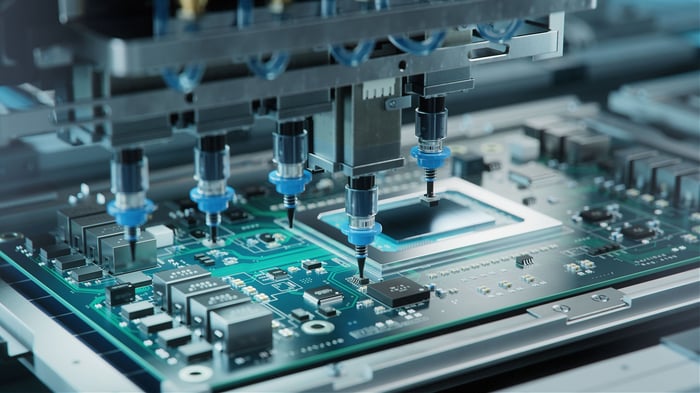
Image source: Getty Images.
It's not just Amazon. Alphabet's flagship Google's Axiom processors are Arm-based as well, as are Qualcomm's Snapdragon chips and others, including Apple's iPhone processors.
All of these companies are looking for the same thing: That's plenty of computing power with a minimal amount of power consumption. Arm's tech offers exactly that.
Huge growth ahead
It's not the only processing chip architecture out there, to be clear. Amazon's impressive Trainium chips, as a reminder, were designed by Annapurna Labs. Google's Tensor Processors are largely custom built from the ground up in-house as well.
Broadly speaking, demand for licenses of Arm's intellectual property is heating up far more than most investors appreciate. Analysts expect the company's revenue to nearly double over the course of the coming three years and then nearly double again by 2030, more than tripling its net income as a result as players like Amazon turn into hardware sellers.
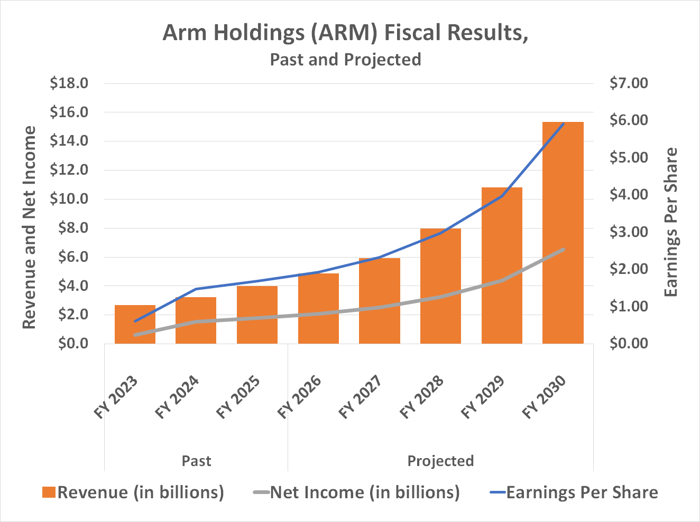
Data source: Morningstar. Chart by author.
See, margins in the IP licensing business are very high.
Of course, just as Amazon and Alphabet are maneuvering away from reliance on Arm's chip architecture, just last month Arm Holdings confirmed that it's expanding its business from beyond mere licensing to include manufacturing and directly selling its own silicon. Although it's probably not quite ready to stand toe-to-toe with Nvidia on this front, it has already inked a deal with Facebook parent Meta Platforms, while several other prospects are showing interest in this new processing option.
There's still time to get in
It does appear some investors are starting to connect the dots. What at one point was more than a 40% pullback from October's peak price has since been pared back to only a 16% setback.
Yet there's still lots of room for this stock to keep running. Even if artificial intelligence isn't quite the panacea it was supposed to be, it's clear that the world's still going to need plenty of Arm's power-efficient processing chips well into the foreseeable future.
Should you buy stock in Arm Holdings right now?
Before you buy stock in Arm Holdings, consider this:
The Motley Fool Stock Advisor analyst team just identified what they believe are the 10 best stocks for investors to buy now… and Arm Holdings wasn’t one of them. The 10 stocks that made the cut could produce monster returns in the coming years.
Consider when Netflix made this list on December 17, 2004... if you invested $1,000 at the time of our recommendation, you’d have $555,526!* Or when Nvidia made this list on April 15, 2005... if you invested $1,000 at the time of our recommendation, you’d have $1,156,403!*
Now, it’s worth noting Stock Advisor’s total average return is 968% — a market-crushing outperformance compared to 191% for the S&P 500. Don't miss the latest top 10 list, available with Stock Advisor, and join an investing community built by individual investors for individual investors.
See the 10 stocks »
*Stock Advisor returns as of April 12, 2026.
James Brumley has positions in Alphabet. The Motley Fool has positions in and recommends Alphabet, Amazon, Apple, Meta Platforms, Nvidia, and Qualcomm and is short shares of Apple. The Motley Fool has a disclosure policy.
Recommended Articles


