


Want to Play the Reshoring Theme? You Might Want to Buy These Stocks South of the Border.
Key Points
Airports in Mexico are likely to see increased traffic from tourism and industrial development.
Grupo Aeroportuario del Pacifico has a mix of tourist and manufacturing hubs.
Grupo Centro Norte is focused on Monterrey, Mexico's premier manufacturing city.
- 10 stocks we like better than Grupo Aeroportuario Del Centro NorteB. De C.v. ›
Reshoring is the macroeconomic theme of the United States, bringing industrial capacity from Asia (specifically China) back home to North and South America. Some manufacturing will be done in the United States (e.g., semiconductors), while some will flow to other nations.
No country is better positioned to benefit from reshoring than Mexico. But how does one invest to take advantage of the potential economic boom south of the border? The answer may lie in the aviation sector and the publicly traded airport stocks in Mexico.
Will AI create the world's first trillionaire? Our team just released a report on the one little-known company, called an "Indispensable Monopoly" providing the critical technology Nvidia and Intel both need. Continue »

Image source: Getty Images.
Grupo Aeroportuario del Pacífico: Betting on Mexican tourism
Unlike in the United States, the operators of Mexican airports are publicly traded companies, of which there are three. They don't own the airport but have long-term (generally 50-year) contracts that allow them to manage these assets for the government while splitting the profits.
Grupo Aeroportuario del Pacífico (NYSE: PAC) is one of Mexico's airport operators, focused on the Pacific region, with its largest airports being in Guadalajara, Los Cabos, Tijuana, and Puerto Vallarta. These cities have a mix of international tourism and industrial capacity, with Tijuana benefiting from a land bridge connecting to San Diego that allows residents to easily get on cheaper flights when visiting Mexico.
The stock is trading down 15% from its highs due to fears over recent cartel violence in Mexico, which seems to have subsided for the time being, as well as global concerns about rising oil prices and their potential impact on air travel demand.
Airport operators such as Grupo Pacifico make money as more passengers flow through their airports, along with government-allowed price increases. Over the long term, air traffic to Mexico has exploded because of international tourism, general economic growth in Mexico, and growing industrial capacity in places such as Guadalajara, which drives business travel.
Right now, the stock trades at a dividend yield of 3.5% and at 13 times its trailing EBITDA (earnings before interest, taxes, depreciation, and amortization). This is for a business that has grown its revenue by 286% over the past 10 years in U.S. dollar terms, despite a global pandemic in between. Unless you think Mexican tourism is going to fall apart overnight, now could be a great time to buy Grupo Pacifico stock.
Grupo Aeroportuario del Centro Norte: The reshoring focus
The airport operator most focused on the reshoring theme is Grupo Aeroportuario del Centro Norte (NASDAQ: OMAB), which operates the Monterrey airport and a number of smaller regional airports across Mexico's North and Western regions.
Monterrey is the wealthiest large city in Mexico and is closest to the United States. It has become wealthier than the average Mexican metro area because of its industrial might, with many companies around the world setting up shop there to ship goods to the United States. It even offers direct flights to Tokyo and Seoul to serve electronic manufacturing companies in the area.
It lacks the tourist charm, but Monterrey will benefit if the reshoring trend continues through the rest of this decade. Total passenger traffic grew 8.5% year over year in 2025, with Monterrey growing 15% and making up around half of passenger volume. Right now, the stock trades at a dividend yield of 4.2% and 11.5 times EBITDA, making it even cheaper than Grupo Pacifico.
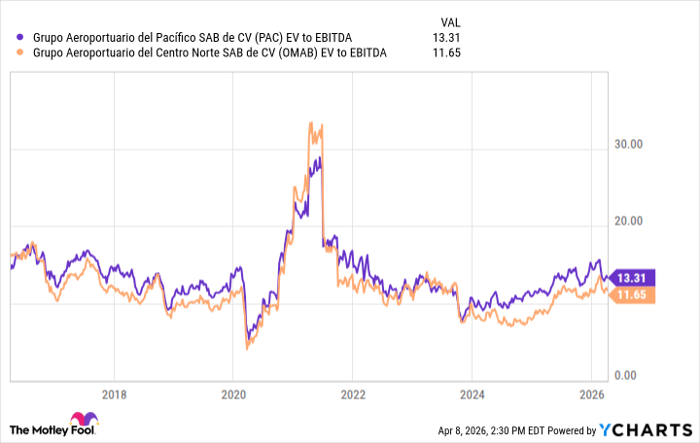
Data by YCharts.
Should you buy Mexican airport stocks?
If you have only invested in your home market, it might feel scary to buy a stock from a country like Mexico, where you have less understanding of the local culture and economy. This fear may be warranted for consumer goods, but airports are very similar, no matter which country you go to.
Currency risks are another factor that pops up, but they can be mitigated by increasing per-passenger fees and by international traffic and commercial revenue from tourism shops. As a monopoly, the Mexican government regulates airports and determines the prices inbound flights can charge, with Grupo Norte granted the right to increase prices by 38% over the next five years. That sounds like a good business to me.
Mexican airport stocks are well-positioned to deliver strong returns for shareholders over the next decade.
Should you buy stock in Grupo Aeroportuario Del Centro NorteB. De C.v. right now?
Before you buy stock in Grupo Aeroportuario Del Centro NorteB. De C.v., consider this:
The Motley Fool Stock Advisor analyst team just identified what they believe are the 10 best stocks for investors to buy now… and Grupo Aeroportuario Del Centro NorteB. De C.v. wasn’t one of them. The 10 stocks that made the cut could produce monster returns in the coming years.
Consider when Netflix made this list on December 17, 2004... if you invested $1,000 at the time of our recommendation, you’d have $555,526!* Or when Nvidia made this list on April 15, 2005... if you invested $1,000 at the time of our recommendation, you’d have $1,156,403!*
Now, it’s worth noting Stock Advisor’s total average return is 968% — a market-crushing outperformance compared to 191% for the S&P 500. Don't miss the latest top 10 list, available with Stock Advisor, and join an investing community built by individual investors for individual investors.
See the 10 stocks »
*Stock Advisor returns as of April 12, 2026.
Brett Schafer has positions in Grupo Aeroportuario Del Centro NorteB. De C.v. The Motley Fool recommends Grupo Aeroportuario Del PacíficoB. De C.v. The Motley Fool has a disclosure policy.
Recommended Articles


