


Tesla's Big Rig Could Be a Big Success and Still Disappoint
Key Points
After being unveiled in 2017, Tesla is finally accelerating production of its Semi in the first-half of 2026.
Tesla has improved the truck, and it now offers comparable payload capacity to diesel trucks.
Even if successful, initial sales volume won't blow investors away. But that's not important right now.
- These 10 stocks could mint the next wave of millionaires ›
If at first you don't succeed, try, try again. While Tesla's (NASDAQ: TSLA) first foray into trucks was its polarizing, entirely unsuccessful Cybertruck, its second attempt is likely to be something very different. Tesla's electric Semi, the Class 8 truck, aims to disrupt an entirely new market for the company and, hopefully, be much more successful than the Cybertruck's effort to disrupt Detroit truckmakers.
Here's the problem: Expectations might be too high. In fact, even if Tesla's Semi is a big success, it might still disappoint investors in the near term.
Will AI create the world's first trillionaire? Our team just released a report on the one little-known company, called an "Indispensable Monopoly" providing the critical technology Nvidia and Intel both need. Continue »
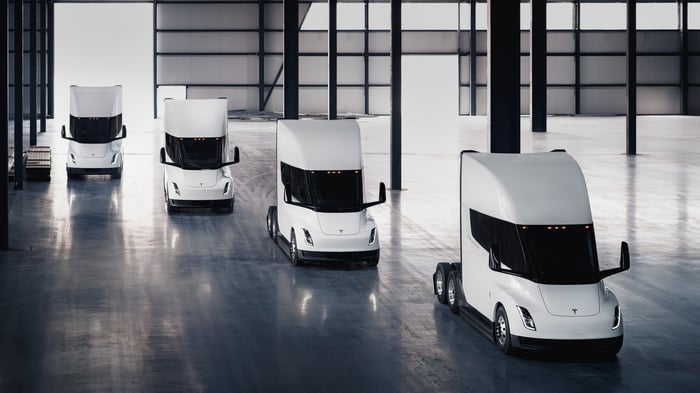
Image source: Tesla.
Tesla's Semi is coming to a road near you
Long-term Tesla investors can brush aside the Cybertruck's shortcomings and focus on the next frontier, as its Semi truck has an opportunity to do what Tesla already did for the passenger-vehicle battery-electric industry: create a real, compelling electric option. Tesla's electric Semi has what it takes to be a game-changer for the industry by rivaling combustion competitors on cost, maintenance, and performance.
Investors might be frustrated with the Semi's slow start, considering it was presented in 2017, with production promised two years later. After delays, the electric vehicle (EV) maker is only now accelerating Semi production, with a 2026 goal of between 5,000 and 15,000 units.
Here's the semi-bad news: Tesla's Semi begins pricing at roughly $300,000, which is almost double the price of a comparable diesel truck. That's a sizable distance to close between fuel savings, maintenance, and uptime. Here's the good news: Pilot testing appears to be going well.
"This truck is a really, really good performer," said Paul Gioupis, founder and CEO of Zeem Solutions, an electric fleet infrastructure and truck-leasing company, according to Automotive News. "We've been getting over 400 miles on every single one of the runs that these fleets have been doing."
Although Tesla's semi-truck is off to a slow start, considering when it was presented, the automaker has been busy solving problems. One big knock against Tesla's Semi was weight, because an electric truck carrying a giant battery back would theoretically sacrifice payload. Tesla has since cut about 1,000 pounds from earlier Semi iterations, and when combined with a 2,000-pound federal weight exemption for EVs, the 500-mile Long Range version achieves payload parity -- essentially maximum hauling capacity -- with comparable diesel Class 8 trucks.
What it all means for Tesla investors
While Tesla's Semi production at its Nevada factory will boast annual production capacity of 50,000 trucks, investors would be wise to largely ignore that number at the moment. If Tesla's Semi even gets its foot in the door initially, that will be a big success, but its sales volume would still probably disappoint investors.
According to the American Truck Dealers Association, the entire Class 8 market of trucks totaled 208,000 in 2025, and capturing a small market share would be a solid first step. In fact, if Tesla Semi sales approach 10,000 annually by the end of the decade, that would be a pretty big win, all things considered.
Tesla's Semi has incredible potential, is turning some skeptics into believers, and has intriguing potential for fleet operators when considering simpler long-haul highway routes for driverless vehicle technology. Ultimately, investors would be wise to temper expectations and sales figures. Tesla's Semi success shouldn't be determined by near-term volume.
Don’t miss this second chance at a potentially lucrative opportunity
Ever feel like you missed the boat in buying the most successful stocks? Then you’ll want to hear this.
On rare occasions, our expert team of analysts issues a “Double Down” stock recommendation for companies that they think are about to pop. If you’re worried you’ve already missed your chance to invest, now is the best time to buy before it’s too late. And the numbers speak for themselves:
- Nvidia: if you invested $1,000 when we doubled down in 2009, you’d have $489,281!*
- Apple: if you invested $1,000 when we doubled down in 2008, you’d have $49,600!*
- Netflix: if you invested $1,000 when we doubled down in 2004, you’d have $555,526!*
Right now, we’re issuing “Double Down” alerts for three incredible companies, available when you join Stock Advisor, and there may not be another chance like this anytime soon.
See the 3 stocks »
*Stock Advisor returns as of April 12, 2026.
Daniel Miller has no position in any of the stocks mentioned. The Motley Fool has positions in and recommends Tesla. The Motley Fool has a disclosure policy.
Recommended Articles


