


Here's the Real Reason SpaceX Is Teaming Up With Intel on Terafab
Key Points
Two weeks ago, Elon Musk announced his Terafab project.
Last week, Intel also announced it would be joining the effort, though details were scarce.
A blog post from Intel research on the same day may have illuminated what the partnership is really about.
- 10 stocks we like better than Intel ›
Two weeks ago, Elon Musk introduced Terafab. The Terafab venture is Musk's ambition to produce semiconductors for his companies Tesla (NASDAQ: TSLA) and SpaceX, which recently merged with xAI before its upcoming initial public offering (IPO).
Musk believes he's going to need lots of chips, and by "lots of chips," he means lots of chips -- as in, a terawatt of compute per year. To keep that in perspective, the current output of all leading-edge artificial intelligence (AI) chips from all fabs today is just 20 GW per year, or 2% of what Musk thinks he'll need!
Will AI create the world's first trillionaire? Our team just released a report on the one little-known company, called an "Indispensable Monopoly" providing the critical technology Nvidia and Intel both need. Continue »
Last week, things got more interesting when Intel (NASDAQ: INTC) announced it was "joining" the Terafab effort. In a tweet, Intel disclosed:
Intel is proud to join the Terafab project with @SpaceX, @xAI, and @Tesla to help refactor silicon fab technology.
-- Intel (@intel) April 7, 2026
Our ability to design, fabricate, and package ultra-high-performance chips at scale will help accelerate Terafab's aim to produce 1 TW/year of compute to power... pic.twitter.com/2vUmXn0YhH
The language around the partnership was general and somewhat confusing. After all, Intel is also expanding its own foundry services. So, is Intel Foundry going to become part of Terafab? Will it operate Terafab? Are they even two separate entities?
On the same day of the partnership announcement, Intel made a technology announcement that shed light on the likely reason for the tie-up... and it could be pretty exciting.
A breakthrough GaN chiplet
On April 7, the same day Intel announced its participation in Terafab, Intel Foundry researchers also published a blog post outlining a new technological breakthrough.
The breakthrough in question is a new ultrathin gallium nitride (GaN) chiplet.
Gallium nitride is a compound semiconductor that is more resilient than silicon in high-voltage environments. In the blog post, the researchers disclosed that Intel had found a way to grow GaN directly on a standard 300mm wafer with standard semiconductor production equipment, enabling low-cost production. The researchers also implemented a novel thinning process called stealth dicing before grinding (SDBG), which enabled Intel to create a GaN chiplet with a silicon base just 19 microns thick. For perspective, a micron is one millionth of a meter, and 19 microns is just one-fifth the width of a human hair.
What's more, Intel was able to combine GaN power electronics and silicon logic on the same chiplet. In traditional power electronics, power transistors have to be kept separate from logic transistors, because power chips' large transistors aren't small enough to perform complex calculations, and they generate significant heat and electrical noise that can affect nearby logic that controls them. Therefore, power transistors are often placed away from their controlling logic, which often requires a separate chip. Separating the two increases the space needed for the system and also leads to a loss of electrical current.
But Intel has managed to place both GaN power electronics and the control logic on the same chiplet. According to the blog post, Intel was able to mix traditional silicon into the GaN wafer using a process called layer transfer. After doing so, Intel was able to place high-voltage power-electronics transistors next to smaller logic transistors on the same chiplet, bringing all of the transistors -- power and logic alike -- into a more compact space. Subsequent testing showed these chiplets were able to function and retain their resilience under high-stress conditions.
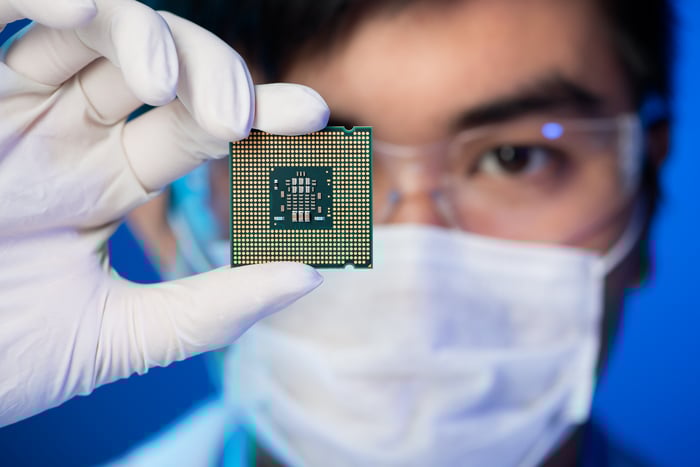
Image source: Getty Images.
Why SpaceX may be especially interested in this technology
In the Terafab presentation, Musk stressed that the majority of the chip output would go to SpaceX, both for a space-oriented industrial economy as well as AI data centers on satellites. However, semiconductors used in space need to be ruggedized to withstand the harsh environment.
GaN-based chips are especially useful in space applications, because GaN is more radiation-tolerant than silicon, and solar radiation is prevalent in space. So Intel's ability to make thinner, lighter, and more compact GaN chips would be especially useful, since every little bit of weight reduction on a rocket can mean millions of dollars. The heavier the rocket is, the more expensive it is to launch due to the fuel and power required. Today, launch costs can range from $1,000 to $10,000 per pound, depending on the type of payload.
The financial impact won't be known for years
Given that Terafab will likely cost literally trillions of dollars and take a long time to build, the financial impact of the SpaceX-Intel partnership won't be felt for years, in all likelihood. Moreover, it's still unclear whether Intel will just license this IP, or whether it will operate or co-invest with SpaceX and Tesla in Terafab.
Still, if more positive details on the partnership emerge between now and then, it could continue to benefit Intel's stock, given the sheer volume of chips Musk envisions producing.
Should you buy stock in Intel right now?
Before you buy stock in Intel, consider this:
The Motley Fool Stock Advisor analyst team just identified what they believe are the 10 best stocks for investors to buy now… and Intel wasn’t one of them. The 10 stocks that made the cut could produce monster returns in the coming years.
Consider when Netflix made this list on December 17, 2004... if you invested $1,000 at the time of our recommendation, you’d have $555,526!* Or when Nvidia made this list on April 15, 2005... if you invested $1,000 at the time of our recommendation, you’d have $1,156,403!*
Now, it’s worth noting Stock Advisor’s total average return is 968% — a market-crushing outperformance compared to 191% for the S&P 500. Don't miss the latest top 10 list, available with Stock Advisor, and join an investing community built by individual investors for individual investors.
See the 10 stocks »
*Stock Advisor returns as of April 12, 2026.
Billy Duberstein and/or his clients have positions in Intel and has the following options: short April 2026 $34 puts on Intel. The Motley Fool has positions in and recommends Intel and Tesla. The Motley Fool has a disclosure policy.
Recommended Articles


