


Here's Why I Bought This Glorious Growth Stock After Its 83% Plunge
Key Points
Duolingo operates the world's largest digital language-education platform, serving over 52 million users every day.
The company plans to nearly double its user base by 2028, but that could result in slower growth of revenue and earnings in the short term.
Though investors sold the stock when the plan was revealed, it now looks so attractive that I decided to swoop in and buy.
- 10 stocks we like better than Duolingo ›
Duolingo (NASDAQ: DUOL) operates the world's largest digital language-education platform. I've followed the company for several years, but its stock was consistently more expensive than the broader market, so I waited on the sidelines for an opportunity to buy. Last month, that chance finally arrived.
Duolingo has lost 83% of its peak value over the past year. Investors are worried that artificial intelligence (AI) will disrupt its business. But they're also concerned about management's plan to target faster user growth, which is expected to be a headwind for the platform's revenue and profits in the short term.
Will AI create the world's first trillionaire? Our team just released a report on the one little-known company, called an "Indispensable Monopoly" providing the critical technology Nvidia and Intel both need. Continue »
As I'll explain, I think those concerns are overblown. And since Duolingo stock has never been this cheap (as measured by two widely used valuation metrics), I decided this is a no-brainer buying opportunity.

Image source: Getty Images.
AI is actually benefiting Duolingo's business
Duolingo makes money in two ways. It shows advertisements to its free users, and it also offers paid subscription options for users who want to unlock additional features to accelerate their learning. The platform ended 2025 with 52.7 million daily active users (DAUs), for growth of 30% year over year. A record 12.2 million users were paid subscribers, a number that was up 28%.
AI has become a big part of the company's strategy. Users who pay for either Super Duolingo or Duolingo Max subscriptions are granted exclusive access to a feature called Video Call, which allows them to practice their foreign-language speaking skills with an AI-powered digital avatar named Lily. She adapts to each user's fluency level and offers supportive guidance, but in keeping with Duolingo's fun and lighthearted approach to education, she does so with a sarcastic and playful tone.
Users who opt for the more expensive Duolingo Max subscription can also access other AI-powered features like Roleplay, which guides them to improve their foreign-language conversational skills through a chatbot-style interface.
Investors might be concerned about users potentially abandoning Duolingo in favor of AI-powered chatbots and other new tools. However, based on the strong growth in the platform's user base, its gamified approach to education is clearly resonating. And based on subscriber growth, AI appears to be a valuable asset, not a threat.
Faster user growth could pay off significantly in the long run
Duolingo generated a record $1.04 billion in total revenue during 2025, for 39% growth from the previous year. The company also delivered a record $414.1 million in generally accepted accounting principles (GAAP) net income, soaring by a whopping 367% year over year.
Those glowing growth rates might be under threat with the recent shift in Duolingo's business strategy, so I can sympathize with investors who are concerned. Management believes investing more aggressively in acquiring new users will lead to much better financial results over the long term, so monetization is going to take a back seat for now.
Simply put, having more users will give the platform more prospects to convert into paying subscribers. Plus, in an increasingly competitive and AI-driven landscape, having a larger user base will make Duolingo much harder to disrupt.
Management will aim to have 100 million daily active users on the platform by 2028, which would be nearly double the 52.7 million it served at the end of 2025. In my opinion, Duolingo will be generating much higher revenue and earnings two years from now if that goal is achieved.
Duolingo stock has never been this cheap
Based on Duolingo's 2025 earnings of $8.31 per share, its stock is trading at a price-to-earnings (P/E) ratio of just 10.2. This is the cheapest it has ever been since the company went public in 2021; it's also a 56% discount to the S&P 500 (SNPINDEX: ^GSPC) index, which trades at a P/E of 23.5. In other words, Duolingo stock looks like a bargain following its 83% decline.
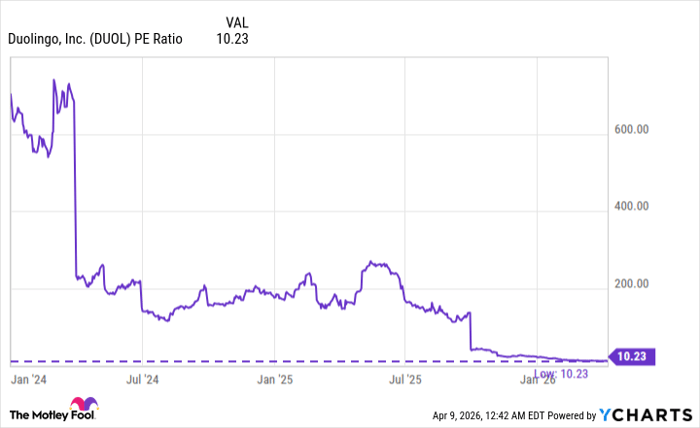
DUOL PE Ratio data by YCharts.
There is a catch. Wall Street expects Duolingo's annual earnings to decline to $7.07 per share during 2026 (according to Yahoo! Finance) because of management's focus on user growth. However, that means its shares are still trading at an attractive forward P/E ratio of just 12.9.
Moreover, based on Duolingo's 2025 revenue of $1.04 billion, the stock trades at a price-to-sales (P/S) ratio of just 4.1, which is also its cheapest level since going public. Plus, that's a 74% discount to its long-term average of 16.1.
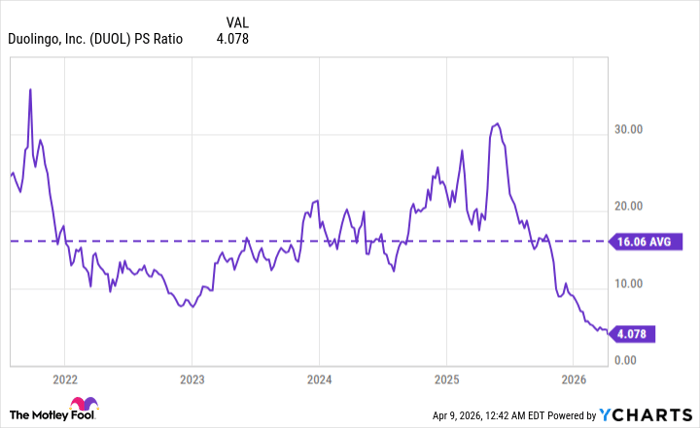
DUOL PS Ratio data by YCharts.
In summary, Duolingo stock looks very attractive no matter which way you slice it, which is why I decided to buy. I think investors who are willing to hold onto their shares until 2028 (and beyond) are likely to do extremely well.
Should you buy stock in Duolingo right now?
Before you buy stock in Duolingo, consider this:
The Motley Fool Stock Advisor analyst team just identified what they believe are the 10 best stocks for investors to buy now… and Duolingo wasn’t one of them. The 10 stocks that made the cut could produce monster returns in the coming years.
Consider when Netflix made this list on December 17, 2004... if you invested $1,000 at the time of our recommendation, you’d have $555,526!* Or when Nvidia made this list on April 15, 2005... if you invested $1,000 at the time of our recommendation, you’d have $1,156,403!*
Now, it’s worth noting Stock Advisor’s total average return is 968% — a market-crushing outperformance compared to 191% for the S&P 500. Don't miss the latest top 10 list, available with Stock Advisor, and join an investing community built by individual investors for individual investors.
See the 10 stocks »
*Stock Advisor returns as of April 12, 2026.
Anthony Di Pizio has positions in Duolingo. The Motley Fool has positions in and recommends Duolingo. The Motley Fool has a disclosure policy.
Recommended Articles


