


Stop Chasing the S&P 500. This Vanguard ETF Has Beaten It Over the Last Decade.
Key Points
Investing in the S&P 500 has served investors well over the past few years.
People investing for the longer term can achieve better returns if they're willing to take on a little more risk.
The Vanguard Growth ETF (VUG) has a stellar record of beating the S&P 500 over the past two decades.
- 10 stocks we like better than Vanguard Growth ETF ›
From 2023 to 2025, investors didn't really need a complex strategy to make money. By simply putting their money in an S&P 500-mirroring exchange-traded fund (ETF), such as the Vanguard S&P 500 ETF (NYSEMKT: VOO), they could achieve returns that beat most sector and thematic strategies.
But the index didn't beat all of them. Tech, of course, generated some of the biggest returns. By extension, growth stocks also performed very well. If your time horizon is short, say the next couple of years, tech and growth could do very well or not well at all, as we've seen in 2026.
Will AI create the world's first trillionaire? Our team just released a report on the one little-known company, called an "Indispensable Monopoly" providing the critical technology Nvidia and Intel both need. Continue »
Over the long term, however, the case for growth stocks relative to the S&P 500 remains compelling.
Image source: Getty Images.
Some points to consider when making the argument
- Over the past 10 years, the Vanguard Growth ETF (NYSEMKT: VUG) has had an average annual return of 16%, compared to roughly 14% for the S&P 500.
- Tech accounts for approximately 65% of the portfolio. The "Magnificent Seven" stocks plus Broadcom account for all but one of the top 10 holdings.
- The Vanguard Growth ETF is about 15% more volatile than the S&P 500, but it offers higher growth potential.
- Because of its heavy megacap tech exposure, the fund is essentially an investment in the belief that artificial intelligence (AI) will be the dominant theme for years to come.
Growth stocks have the advantage
The S&P 500 is a broad index that includes everything from fast-growing tech companies to slow-and-stodgy utilities. That works great as a core portfolio holding for diversification. But it can also dampen long-term returns where growth often outperforms value.
The Vanguard Growth ETF tracks the CRSP U.S. Large Cap Growth Index. It selects stocks based on the following six factors:
- Expected long-term growth in earnings per share (EPS).
- Expected short-term growth in earnings per share.
- Three-year historical growth in earnings per share.
- Three-year historical growth in sales per share.
- Current investment-to-assets ratio.
- Return on assets.
The stocks with the best combination of these factors make the cut for the final portfolio. Holdings are market cap-weighted.
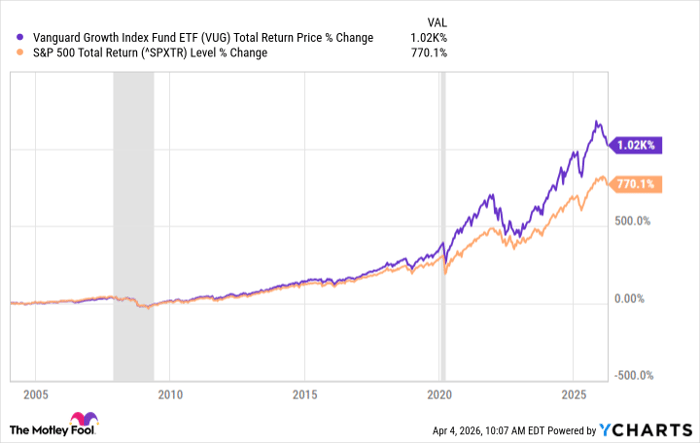
This strategy has worked incredibly well since the fund's launch in January 2004.
Data by YCharts.
The drawback is that there is a higher risk involved if you want to capture these returns. Growth stocks often experience deeper drawdowns in market declines, something we saw in 2018, 2020, and 2022. But as the table demonstrates, if you're willing to ride out the added volatility, long-term returns can outperform the S&P 500.
Vanguard Growth ETF vs. S&P 500
| Metric | VUG | VOO |
|---|---|---|
| 10-year annualized return | 16% | 14% |
| Expense ratio | 0.03% | 0.03% |
| Dividend yield | 0.4% | 1.2% |
| Number of holdings | 151 | 504 |
| Top sector | Technology (65%) | Technology (32%) |
| 10-year beta | 1.19 | 1.00 |
| Best for: | Long-term growth investors | Broad market exposure |
Data source: Vanguard.
You don't necessarily want to put all your eggs in the growth-stock basket. The Vanguard Growth ETF is very tech-heavy and produces an imbalanced portfolio on its own. But it does pair well with the Vanguard S&P 500 ETF if you're looking for added long-term growth potential.
If you're looking for a solid opportunity to beat the S&P long term, growth stocks are worth adding to your portfolio.
Should you buy stock in Vanguard Growth ETF right now?
Before you buy stock in Vanguard Growth ETF, consider this:
The Motley Fool Stock Advisor analyst team just identified what they believe are the 10 best stocks for investors to buy now… and Vanguard Growth ETF wasn’t one of them. The 10 stocks that made the cut could produce monster returns in the coming years.
Consider when Netflix made this list on December 17, 2004... if you invested $1,000 at the time of our recommendation, you’d have $536,003!* Or when Nvidia made this list on April 15, 2005... if you invested $1,000 at the time of our recommendation, you’d have $1,116,248!*
Now, it’s worth noting Stock Advisor’s total average return is 946% — a market-crushing outperformance compared to 190% for the S&P 500. Don't miss the latest top 10 list, available with Stock Advisor, and join an investing community built by individual investors for individual investors.
See the 10 stocks »
*Stock Advisor returns as of April 10, 2026.
David Dierking has no position in any of the stocks mentioned. The Motley Fool has positions in and recommends Vanguard Growth ETF and Vanguard S&P 500 ETF. The Motley Fool recommends Broadcom. The Motley Fool has a disclosure policy.
Recommended Articles


