


Netflix vs. Walt Disney: Consistency vs. Volatility in Revenue
Key Points
Netflix generates consistently growing revenue, while Walt Disney produces a much higher but more volatile revenue total.
Both companies increased their revenue over the last eight quarters, with Netflix showing steady quarter-over-quarter gains and Walt Disney experiencing more quarter-over-quarter fluctuation.
Investors should watch whether the revenue gap between the two companies starts to narrow or if the current distance remains stable in upcoming quarters.
- 10 stocks we like better than Netflix ›
Netflix (NASDAQ:NFLX) and Walt Disney (NYSE:DIS) are two widely recognized entertainment brands. But one makes money from subscriptions, while the other earns revenue from multiple business lines. Both of these companies are essentially in the same business: creating content that entertains people, but how they go about it paints two completely different financial profiles.
Netflix: Consistent Revenue Gains
Netflix provides entertainment services to members worldwide by offering streaming television series, documentaries, feature films, and mobile games.
Recently, it withdrew its cash offer to acquire Warner Bros. Discovery after a competing bid emerged, and it reported an approximately 20% net income margin for the quarter ended Dec. 31, 2025.
Walt Disney: Fluctuating Revenue on a Larger Scale
Walt Disney operates as an entertainment business by producing television content, running broadcast networks, offering direct-to-consumer streaming services, and managing global theme parks and resorts.
It appointed Josh D'Amaro as Chief Executive Officer in February 2026, and it recorded an approximately 9% net income margin for the quarter ended Dec. 27, 2025.
Why Revenue Matters for Retail Investors
Revenue is a fundamental measure of how much money a company takes in from selling products. It shows investors the total amount of money a company brings in from its operations before any expenses are deducted.
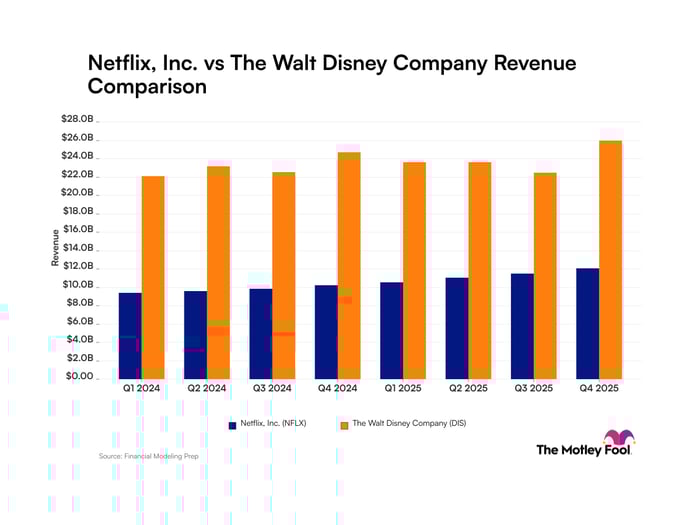
Image source: The Motley Fool.
Quarterly Revenue for Netflix and Walt Disney
| Quarter (Period End) | Netflix Revenue | Walt Disney Revenue |
|---|---|---|
| Q1 2024 | $9.4 billion (period ended March 2024) | $22.1 billion (period ended March 2024) |
| Q2 2024 | $9.6 billion (period ended June 2024) | $23.2 billion (period ended June 2024) |
| Q3 2024 | $9.8 billion (period ended Sept. 2024) | $22.6 billion (period ended Sept. 2024) |
| Q4 2024 | $10.2 billion (period ended Dec. 2024) | $24.7 billion (period ended Dec. 2024) |
| Q1 2025 | $10.5 billion (period ended March 2025) | $23.6 billion (period ended March 2025) |
| Q2 2025 | $11.1 billion (period ended June 2025) | $23.6 billion (period ended June 2025) |
| Q3 2025 | $11.5 billion (period ended Sept. 2025) | $22.5 billion (period ended Sept. 2025) |
| Q4 2025 | $12.1 billion (period ended Dec. 2025) | $25.9 billion (period ended Dec. 2025) |
Data source: Company filings. Data as of April 8, 2026.
Foolish Take
Consistency is an important factor to consider when investing in a company. It can not only influence the stock’s valuation and share price performance, but also reflect how easy or difficult it is for a given company to generate profits from its services.
Netflix has reported double-digit revenue growth every quarter over the past few years. It’s doing that while earning a much higher profit margin than Disney. Disney has seen its quarterly year-over-year revenue growth range from down 0.5% to up 7% in the last four quarters.
The gap in revenue performance reflects the difference in how these entertainment companies make money. Netflix is a simpler business that earns revenue from monthly subscriptions, with a small, but fast-growing, share from advertising.
Disney makes money from multiple businesses, including cyclical media advertising, subscriptions, toys and merchandise, film releases, and theme park ticket sales.
For Netflix, investors will want to see whether new releases can continue to power its revenue and membership growth over the next few years.
For Disney, accelerating revenue growth might be challenging. But a catalyst for the stock could come from expanding margins in streaming, where management expects operating margin to double to 10% this year.
Should you buy stock in Netflix right now?
Before you buy stock in Netflix, consider this:
The Motley Fool Stock Advisor analyst team just identified what they believe are the 10 best stocks for investors to buy now… and Netflix wasn’t one of them. The 10 stocks that made the cut could produce monster returns in the coming years.
Consider when Netflix made this list on December 17, 2004... if you invested $1,000 at the time of our recommendation, you’d have $536,003!* Or when Nvidia made this list on April 15, 2005... if you invested $1,000 at the time of our recommendation, you’d have $1,116,248!*
Now, it’s worth noting Stock Advisor’s total average return is 946% — a market-crushing outperformance compared to 190% for the S&P 500. Don't miss the latest top 10 list, available with Stock Advisor, and join an investing community built by individual investors for individual investors.
See the 10 stocks »
*Stock Advisor returns as of April 9, 2026.
John Ballard has no position in any of the stocks mentioned. The Motley Fool has positions in and recommends Netflix and Walt Disney. The Motley Fool has a disclosure policy.
Recommended Articles


