


2 Monster EV Stocks Worth Owning While the Sector Is Still Out of Favor
Key Points
EV stocks have the potential to lead the autonomous driving revolution.
Two stocks in particular are poised to benefit despite recent pullbacks.
- 10 stocks we like better than Rivian Automotive ›
By the end of the decade, we should see huge numbers of robotaxis roaming the streets of America, as well as other major countries. At least that's the consensus opinion among experts, whose opinions were compiled in a recent research report from global consultancy firm McKinsey & Co.
"[T]he global rollout of robo-taxis is now expected to become reality at a large scale in 2030," the report concludes. "Overall, experts expect that robo-taxis will be the first commercial application for L4 in mobility -- not privately owned cars."
Will AI create the world's first trillionaire? Our team just released a report on the one little-known company, called an "Indispensable Monopoly" providing the critical technology Nvidia and Intel both need. Continue »
It's likely that electric vehicle (EV) companies will be the leaders when it comes to the self-driving car revolution. Electric vehicles are already software heavy, often designed with autonomy at their core. And yet the EV sector largely remains out of favor, allowing investors to find surprising bargains. The two stocks below are your best bets for betting on the coming autonomous driving future.
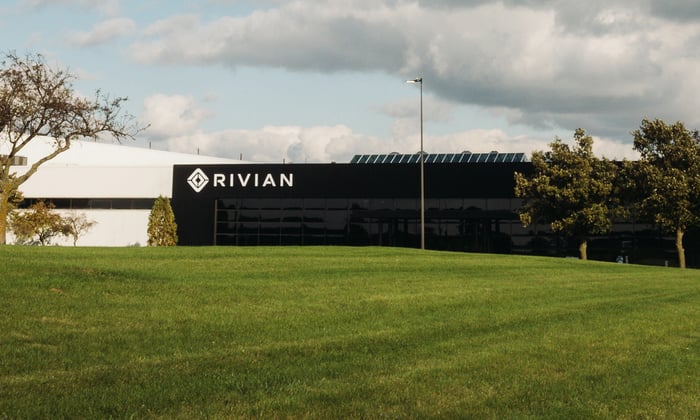
Image source: Rivian.
1. Rivian stock is now surprisingly cheap
Earlier this year, I named Rivian (NASDAQ: RIVN) my top growth stock for 2026. There are two primary factors spurring my optimism.
First, Rivian expects to begin shipping its R2 SUV this month. This will be the company's first vehicle priced under $50,000. Roughly 70% of prospective car buyers want their next vehicle to cost less than $50,000. And yet the average price of a new vehicle recently surpassed $50,000. Automakers that can offer new models -- especially within high-demand categories like SUVs and crossovers -- will have better odds of achieving mass volumes.
Rivian's price-to-sales ratio still hovers near the bottom of its trailing range over the past three years. Yet analysts expect sales to jump in 2026 and 2027 due to the R2 launch. Investors willing to jump in before sales traction numbers go public now have the opportunity to buy low.
The second reason for my optimism is Rivian's heavy bets on artificial intelligence (AI). These bets are so heavy, in fact, that the company recently pushed out its timeline for achieving profitability. That's a hard pill to swallow, but the company already proved in recent quarters that it can achieve positive gross margins. By investing more heavily in AI, Rivian can stay in the race for achieving fully autonomous vehicles. As we'll see next, Tesla's management team clearly believes this is the future of EVs.
2. Tesla's AI capabilities may be unmatched
Compared to Rivian, Tesla (NASDAQ: TSLA) isn't obviously out of favor. Shares trade above 13 times sales compared to a valuation of around 3 times sales for Rivian. But since December, Tesla shares have lost more than 25% of their value. And compared to the company's growth opportunities, the current "pricey" valuation could ultimately prove to be a bargain.
The first growth opportunity is Tesla's ability to sell fully autonomous vehicles. The difference between a semi-autonomous vehicle and a fully self-driving vehicle cannot be overstated. According to one study, "car buyers are willing to spend twice as much on self-driving tech than on any other category, even additional safety features." Achieving full autonomy would undoubtedly help Tesla's flagging sales growth.
The biggest growth opportunity, however, likely lies with robotaxis. Some experts believe this market could be worth $10 trillion globally. A new report from Boston Consulting Group predicts a global robotaxi fleet of up to 3 million vehicles by 2035. "To win in this increasingly competitive market, operators will need patience and years of substantial investment," the firm's report concludes.
Compared to any other automaker, Tesla arguably has the most financial firepower to dedicate toward achieving full autonomy through repeated multibillion-dollar investments. It also has scaled manufacturing capabilities that can produce huge numbers of vehicles internally -- an advantage almost none of its big tech competitors have.
Tesla stock is expensive. But if it can dominate the autonomous driving market over the next decade, that premium will be warranted.
Should you buy stock in Rivian Automotive right now?
Before you buy stock in Rivian Automotive, consider this:
The Motley Fool Stock Advisor analyst team just identified what they believe are the 10 best stocks for investors to buy now… and Rivian Automotive wasn’t one of them. The 10 stocks that made the cut could produce monster returns in the coming years.
Consider when Netflix made this list on December 17, 2004... if you invested $1,000 at the time of our recommendation, you’d have $532,929!* Or when Nvidia made this list on April 15, 2005... if you invested $1,000 at the time of our recommendation, you’d have $1,091,848!*
Now, it’s worth noting Stock Advisor’s total average return is 928% — a market-crushing outperformance compared to 186% for the S&P 500. Don't miss the latest top 10 list, available with Stock Advisor, and join an investing community built by individual investors for individual investors.
See the 10 stocks »
*Stock Advisor returns as of April 8, 2026.
Ryan Vanzo has no position in any of the stocks mentioned. The Motley Fool has positions in and recommends Tesla. The Motley Fool has a disclosure policy.
Recommended Articles


