


1 Unstoppable Cryptocurrency to Buy Before It Soars 31,243%, According to Strategy's Michael Saylor
Key Points
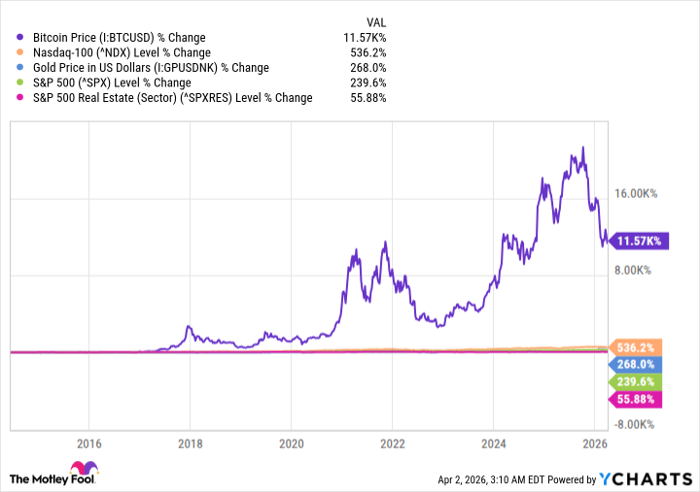
Bitcoin, the world's largest cryptocurrency, has outperformed every other major asset since it was launched in 2009.
The cryptocurrency market is in the throes of a sell-off, but Strategy's Michael Saylor is betting on significant long-term upside for the crypto.
His price target might be too ambitious, but Bitcoin could still deliver strong returns from here.
- 10 stocks we like better than Bitcoin ›
Bitcoin (CRYPTO: BTC) was officially launched in 2009, and since then, it has significantly outperformed the stock market, the real estate market, and even gold.
Will AI create the world's first trillionaire? Our team just released a report on the one little-known company, called an "Indispensable Monopoly" providing the critical technology Nvidia and Intel both need. Continue »
Bitcoin price data by YCharts.
Despite suffering a 45% decline over the last six months, a single bitcoin still trades for over $67,000. However, the co-founder of Strategy (NASDAQ: MSTR), Michael Saylor, thinks it could skyrocket to $21 million per coin by the year 2046, which implies a potential upside of 31,243% over the next two decades.
Saylor is putting his money where his mouth is. Strategy was primarily a software provider until he converted it into a Bitcoin treasury company in 2020, and it now owns 762,099 coins, worth $51 billion, representing almost 4% of all the circulating supply. But how realistic is his long-term price target?

Image source: Getty Images.
Could Bitcoin transform the financial system?
Bitcoin is fully decentralized, which means it isn't controlled by any person, company, or government. It's built on a secure and transparent system of record called the blockchain, and every transaction is verified by network participants who compete with one another for the right to add new blocks in exchange for financial rewards.
Saylor believes every real asset will eventually be tokenized on the blockchain, resulting in more transparency and higher economic efficiency than existing systems of record. For example, there is no centralized register of U.S. real estate holdings, which is why buying a house often involves costly due diligence and legal processes. Placing every real estate transaction on the blockchain would give buyers instant access to the appropriate records, eliminating costs and speeding up settlement periods.
Saylor says Bitcoin would be the ideal reserve currency for the tokenization process, because it's decentralized. That means the cryptocurrency would be used to buy, sell, or transfer every tokenized asset, so any person who wants to participate in the financial system would have to own it.
That would fuel incredible demand for the digital coin. At the time of Saylor's predictions last year, the total value of all global assets stood at around $500 trillion, hence his lofty $21 million price target for the crypto by 2046.
Saylor's vision faces hurdles
Bitcoin wouldn't necessarily rise in value if it were only used for asset transfers on the blockchain. A person would buy it to acquire a desired asset, but the receiving parties would then be equal sellers when they convert their coins back into fiat currency. As a result, this transaction would create a net value of zero.
The crypto would significantly increase in value if it became the world's sole currency, but that is very unlikely. It would require global cooperation on a scale we have never seen, because every government in the world would have to pass legislation mandating its adoption.
Countries with small economies would be very hesitant to go along with this plan. They have weaker floating-rate currencies than countries with large economies, which helps them compete on the global stage by making their exports cheaper for foreign buyers. Adopting Bitcoin would thrust them onto a level playing field with economic powerhouses like the U.S. and China, which would decimate their exports and erode the living standards of their citizens.
Bitcoin could rise, but maybe by a more modest amount
If the coin reached Saylor's $21 million target, it would have a fully diluted market capitalization of $441 trillion. For some perspective, the output of the entire U.S. economy was $30.6 trillion last year, and the world's largest company, Nvidia, is currently worth $4.2 trillion.
Therefore, I personally don't think Saylor's target is realistic, but Bitcoin could deliver strong returns from here nonetheless. Many investors buy it because they consider it to be a legitimate store of value, like a digital version of gold. The value of all above-ground reserves of the precious metal is $32 trillion as I write this, which might be a more achievable target for Bitcoin's market cap over the long term.
It would translate to $1,523,000 per coin, representing a potential upside of 2,170% from the current price. There is no guarantee it will get there, because it is a highly speculative asset, after all, but I would assign this outcome much better chances than Saylor's prediction that it will be 14 times more valuable than the annual output of the entire U.S. economy.
Should you buy stock in Bitcoin right now?
Before you buy stock in Bitcoin, consider this:
The Motley Fool Stock Advisor analyst team just identified what they believe are the 10 best stocks for investors to buy now… and Bitcoin wasn’t one of them. The 10 stocks that made the cut could produce monster returns in the coming years.
Consider when Netflix made this list on December 17, 2004... if you invested $1,000 at the time of our recommendation, you’d have $533,522!* Or when Nvidia made this list on April 15, 2005... if you invested $1,000 at the time of our recommendation, you’d have $1,089,028!*
Now, it’s worth noting Stock Advisor’s total average return is 930% — a market-crushing outperformance compared to 185% for the S&P 500. Don't miss the latest top 10 list, available with Stock Advisor, and join an investing community built by individual investors for individual investors.
See the 10 stocks »
*Stock Advisor returns as of April 8, 2026.
Anthony Di Pizio has no position in any of the stocks mentioned. The Motley Fool has positions in and recommends Bitcoin and Nvidia. The Motley Fool has a disclosure policy.
Recommended Articles


