


Macroeconomic Factors Are Dragging Down Carvana's Stock. Should You Buy the Dip?
Key Points
Carvana’s stock has dropped more than 30% from its record highs.
It still looks surprisingly cheap relative to its long-term growth potential.
- 10 stocks we like better than Carvana ›
Carvana (NYSE: CVNA), the online marketplace for used cars, went public nearly nine years ago at $15 per share. Its stock sank to an all-time low of $3.72 on Dec. 27, 2022, as investors fretted over its slowing sales, rising debt, and steep losses.
However, Carvana's subsequent recovery, soaring profits, and inclusion in the S&P 500 propelled its stock to a record high of $478.45 on Jan. 22, 2026. A $10,000 investment in the stock at its lowest point would have blossomed into $1.29 million in just over three years. Today, Carvana's stock trades at about $310. Does that pullback represent a good buying opportunity?
Will AI create the world's first trillionaire? Our team just released a report on the one little-known company, called an "Indispensable Monopoly" providing the critical technology Nvidia and Intel both need. Continue »
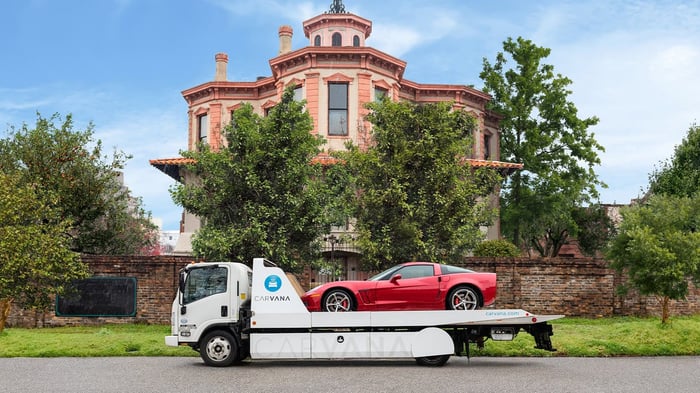
Image source: Carvana.
What happened to Carvana over the past five years?
Carvana's online marketplace simplifies the byzantine process of buying and selling used cars by setting firm prices, streamlining financing, and offering convenient pickup and delivery. It aims to help shoppers "get the car without the car salesman", and the bulls believe it will eventually become the "Amazon of cars." Its "vending machine" towers, which let buyers pick up their vehicles with big tokens, are also attracting a lot of attention.
From 2020 to 2025, Carvana's total units sold more than doubled from 244,111 to 596,641, its revenue surged from $5.6 billion to $20.3 billion, while its adjusted earnings before interest, taxes, depreciation, and amortization (EBITDA) margins expanded from negative 4.6% to positive 11%. It's also stayed profitable on a full-year basis since 2023.
|
Metric |
2020 |
2021 |
2022 |
2023 |
2024 |
2025 |
|---|---|---|---|---|---|---|
|
Units Sold Growth |
37% |
74% |
(3%) |
(24%) |
33% |
43% |
|
Revenue Growth |
42% |
129% |
6% |
(21%) |
27% |
49% |
|
Adjusted EBITDA Margin |
(4%) |
0.5% |
(7.7%) |
3.1% |
10.1% |
11% |
Data source: Carvana.
In 2022 and 2023, rising interest rates and a surplus of used vehicles throttled Carvana's growth. But in 2024 and 2025, its growth accelerated again as interest rates declined, the used-car market grew, and it integrated its 2022 acquisition of ADESA's U.S. auction network. It also restructured its debt and cut costs to stabilize its margins.
Is Carvana's stock still worth buying?
The recent macro headwinds for consumer spending and oil prices have been driving investors away from Carvana and compressing its valuations. But from 2025 to 2028, analysts still expect its revenue and adjusted EBITDA to grow at CAGRs of 26% and 28%, respectively.
Carvana claims that by 2030 to 2035, it will be selling at least 3 million cars per year at adjusted EBITDA margins of about 13.5% as economies of scale kick in. With an enterprise value of $47 billion, its stock still looks surprisingly cheap at 16 times this year's adjusted EBITDA. Therefore, I think Carvana's pullback is a great buying opportunity for long-term investors right now.
Should you buy stock in Carvana right now?
Before you buy stock in Carvana, consider this:
The Motley Fool Stock Advisor analyst team just identified what they believe are the 10 best stocks for investors to buy now… and Carvana wasn’t one of them. The 10 stocks that made the cut could produce monster returns in the coming years.
Consider when Netflix made this list on December 17, 2004... if you invested $1,000 at the time of our recommendation, you’d have $533,522!* Or when Nvidia made this list on April 15, 2005... if you invested $1,000 at the time of our recommendation, you’d have $1,089,028!*
Now, it’s worth noting Stock Advisor’s total average return is 930% — a market-crushing outperformance compared to 185% for the S&P 500. Don't miss the latest top 10 list, available with Stock Advisor, and join an investing community built by individual investors for individual investors.
See the 10 stocks »
*Stock Advisor returns as of April 7, 2026.
Leo Sun has positions in Amazon. The Motley Fool has positions in and recommends Amazon. The Motley Fool has a disclosure policy.
Recommended Articles


