


3 Powerful Nuclear Energy Stocks to Buy in April
Key Points
The U.S. government is racing to rebuild the nuclear energy industry amid booming power demand.
Government backing and explosive demand are a rare combination for nuclear energy stocks.
Now's the best time to catch this wave and buy top nuclear stocks.
- 10 stocks we like better than Constellation Energy ›
Despite all the conflict and chaos happening around the world right now, one thing in Washington hasn't changed: the U.S. government's support for nuclear energy. With artificial intelligence and data center buildout driving energy demand to unprecedented levels, President Trump is reviving America's nuclear energy industry and plans to quadruple America's nuclear energy capacity to 400 gigawatts (GW) by 2050
Nuclear energy is clean and reliable and is finally getting the massive government backing it needs. With the nuclear comeback becoming official, here are three top nuclear energy stocks to buy in April and hold.
Will AI create the world's first trillionaire? Our team just released a report on the one little-known company, called an "Indispensable Monopoly" providing the critical technology Nvidia and Intel both need. Continue »

Image source: Getty Images.
This nuclear giant is signing 20-year deals with hyperscalers
Constellation Energy (NASDAQ: CEG) is the largest operator of nuclear plants in the U.S. and the nation's largest producer producer of clean energy. With the acquisition of Calpine in a $16.4 billion stock-and-cash deal in early 2026, Constellation grown even bigger in size, with a combined capacity of nearly 60 GW from zero- and low-emission energy sources, including nuclear, natural gas, geothermal, solar, wind, hydro, and battery storage.
Constellation has become the go-to partner for hyperscalers and data center operators. The company is working to restart Unit 1 of the Three Mile Island nuclear power plant, rebranded as the Crane Clean Energy Center, as part of a landmark 20-year power supply agreement with Microsoft. During its March 31 business update call, CEO Joe Dominguez said it plans to restart the plant by the end of 2027. The U.S. Department of Energy has also issued a $1 billion loan guarantee to fund the restart.
Constellation also signed a 20-year power deal with Meta Platforms last year, as well as a deal with data center operator CyrusOne in early 2026.
Constellation is not your sleepy power producer. Its unmatched scale in clean energy, especially nuclear, positions it perfectly to capitalize on a potential nuclear resurgence under the Trump administration. The company also raised its dividend by 10% last year and is targeting another 10% raise this year, all while consistently buying back shares. With Constellation stock down over 20% so far this year and trading nearly 35% below its 52-week high, April is a perfect time to buy some shares.
An unstoppable nuclear energy stock
While Constellation Energy operates nuclear reactors to generate and sell nuclear energy, those reactors can't run without nuclear fuel. That's where Cameco's (NYSE: CCJ) expertise comes into the picture. With the U.S. actively trying to cut reliance on uranium imports, Cameco's high-grade mines have become strategic national security assets.
Cameco is one of the world's largest uranium mining companies, with a 15% market share in global uranium supply. Beyond the nuclear fuel, it also provides mission-critical nuclear technology and services through a 49% stake in Westinghouse Electric.
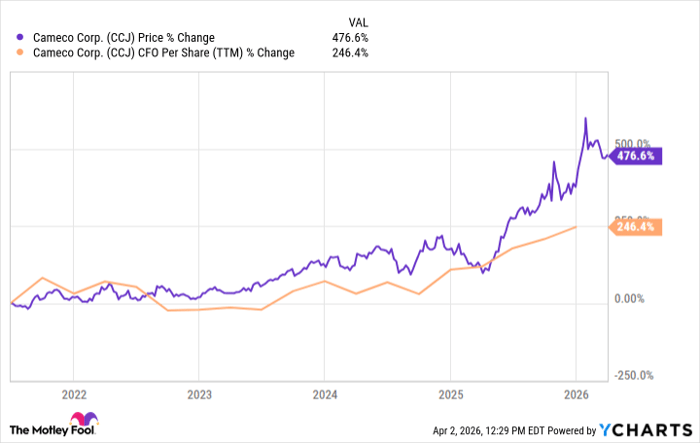
Cameco typically sells uranium under long-term contracts to utilities, reducing its exposure to spot uranium prices. And, Cameco is a global play. For instance, it recently signed a $2.6 billion, nine-year uranium supply deal with the government of India. Its stake in Westinghouse, meanwhile, is one of the biggest comparative advantages today. Last year, Westinghouse struck a partnership with the U.S. government to build new nuclear reactors. The deal is worth at least $80 billion.
CCJ data by YCharts
Cameco is also in excellent financial shape for a commodity company. Its cash flows have grown steadily through uranium cycles, and it has paid a dividend every year since going public in 1991, even raising it steadily in recent years. With Cameco's contracted uranium commitments already stretching beyond the next decade, it is a no-brainer nuclear energy stock to buy now and hold.
Buy the best nuclear stocks with just one ETF
While stocks like Constellation Energy and Cameco are surefire ways to play the nuclear energy boom, there's another way to buy these, and more nuclear energy stocks, at one go without actually buying them. That's the power of exchange-traded funds, and one of the top nuclear ETFs to buy now is the VanEck Uranium and Nuclear ETF (NYSEMKT: NLR).
This ETF owns 30 stocks from the global nuclear energy industry, including uranium miners, nuclear power producers, developers of reactors and plants, and nuclear technology and service providers. As of April, 1, its top holdings include Cameco (8.04% of net assets), Constellation Energy (7.82%), and BWX Technologies (NYSE: BWXT) (6.86%). BWX builds reactors and supplies nuclear fuel and components that power the U.S. Navy's fleet of aircraft carriers and submarines. It has a near-monopoly in the naval nuclear space.
Although the VanEck Uranium and Nuclear ETF has surged almost 80% in one year, as of this writing, its 10% pullback in one month is an opportunity to buy because nuclear is a secular tailwind, and demand for the energy source should only rise amid the global shift toward decarbonization and the massive energy requirements of AI data centers. A net expense ratio of 0.56% and a dividend isn't a bad deal to gain exposure to the world's top nuclear stocks.
Should you buy stock in Constellation Energy right now?
Before you buy stock in Constellation Energy, consider this:
The Motley Fool Stock Advisor analyst team just identified what they believe are the 10 best stocks for investors to buy now… and Constellation Energy wasn’t one of them. The 10 stocks that made the cut could produce monster returns in the coming years.
Consider when Netflix made this list on December 17, 2004... if you invested $1,000 at the time of our recommendation, you’d have $532,066!* Or when Nvidia made this list on April 15, 2005... if you invested $1,000 at the time of our recommendation, you’d have $1,087,496!*
Now, it’s worth noting Stock Advisor’s total average return is 926% — a market-crushing outperformance compared to 185% for the S&P 500. Don't miss the latest top 10 list, available with Stock Advisor, and join an investing community built by individual investors for individual investors.
See the 10 stocks »
*Stock Advisor returns as of April 6, 2026.
Neha Chamaria has no position in any of the stocks mentioned. The Motley Fool has positions in and recommends BWX Technologies, Cameco, Constellation Energy, Meta Platforms, and Microsoft. The Motley Fool has a disclosure policy.
Recommended Articles


