


The Federal Reserve's March and April Inflation Forecast Is In -- and Things Just Keep Getting Uglier for Wall Street
Key Points
Uncertainties surrounding the Iran war briefly dropped the Dow Jones Industrial Average and Nasdaq Composite into correction territory.
The Federal Reserve Bank of Cleveland's proprietary Inflation Nowcasting tool predicts a mammoth jump in the prevailing U.S. inflation rate for March and April.
Rapidly rising inflation and a historically expensive stock market are a dangerous combination.
- 10 stocks we like better than S&P 500 Index ›
For much of the last three years, Wall Street's bull market rally has been virtually unstoppable. Over the last six months, we've observed the benchmark S&P 500 (SNPINDEX: ^GSPC), growth-driven Nasdaq Composite (NASDAQINDEX: ^IXIC), and iconic Dow Jones Industrial Average (DJINDICES: ^DJI) touch psychologically important milestones of 7,000, 24,000, and 50,000, respectively.
But things have been far more challenging for investors over the last six weeks. The Dow and Nasdaq Composite both briefly dipped into correction territory, while the S&P 500 flirted with a double-digit decline. Although the immediate blame lies with uncertainties tied to the Iran war, it's the longer-term implications for U.S. inflation that should have Wall Street on edge.
Will AI create the world's first trillionaire? Our team just released a report on the one little-known company, called an "Indispensable Monopoly" providing the critical technology Nvidia and Intel both need. Continue »
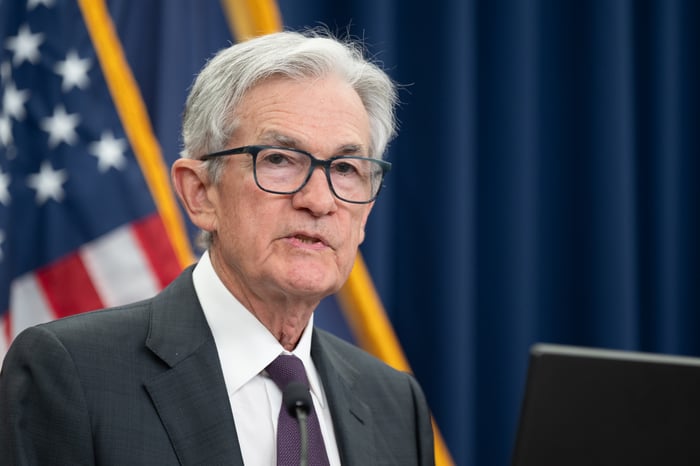
Fed Chair Jerome Powell and the Federal Open Market Committee have a challenging road ahead. Image source: Official Federal Reserve Photo.
The Iran war is roiling Wall Street -- and with good reason
On Feb. 28, U.S. and Israeli forces kicked off military operations against Iran. Shortly after this conflict began, Iran closed the Strait of Hormuz to most oil exports. This is a problem, given that approximately 20% of the world's liquid petroleum travels through the Strait of Hormuz each day, according to the Energy Information Administration.
The law of supply and demand states that when demand for a good outpaces its supply, the price of that good will rise until demand tapers off. The reaction in the oil market has been swift, with crude oil prices skyrocketing in the wake of this virtual closure.
Gas prices in the US have moved up to $4.08 per gallon, their highest level since August 2022. The 36% spike over the last month ($3.00/gallon to $4.08/gallon) is the biggest we've seen in the past 30 years. pic.twitter.com/wWDEg2e38u
-- Charlie Bilello (@charliebilello) April 2, 2026
Most consumers have felt the impact of higher oil prices at the gas pump. Over the last month, as of April 2, the national average price of a gallon of regular gas has surged by 36% to $4.08, per AAA. It's been an even steeper climb for diesel, which has soared 46% to $5.51 per gallon.
While higher gas prices are known to pinch consumers' pocketbooks, it's the inflationary impact of this historic energy supply shock that could upend the stock market.
Image source: Getty Images.
The Fed's newest inflation forecast for March and April is unsightly
In mid-March, the U.S. Bureau of Labor Statistics (BLS) reported a trailing 12-month inflation rate of 2.4% -- the 59th consecutive month above the central bank's long-term inflation target of 2%.
When the BLS publishes the March inflation report on April 10, things are going to look markedly worse. The million-dollar question is: How much worse?
The Federal Reserve Bank of Cleveland's proprietary Inflation Nowcasting tool offers a glimpse of what to expect. A few weeks ago, this tool was projecting a trailing 12-month inflation rate of 3.02%. But as of April 2, the March inflation estimate is up to 3.25%.
Additionally, the Inflation Nowcasting tool predicts that the U.S. inflation rate will edge higher to 3.28% for April.
A projected 85-basis-point jump in trailing 12-month inflation from the previous month is massive. More importantly, it almost certainly halts the Federal Reserve's rate-easing cycle in its tracks and realistically puts the prospect of interest rate hikes on the table.
The stock market began 2026 at its second-priciest valuation over 155 years, according to the S&P 500's Shiller Price-to-Earnings Ratio. The expectation of additional rate cuts is one of the reasons premium valuations have been sustained. A potential shift in monetary policy by Fed Chair Jerome Powell and other members of the Federal Open Market Committee could pull the rug out from under a historically expensive stock market.
Should you buy stock in S&P 500 Index right now?
Before you buy stock in S&P 500 Index, consider this:
The Motley Fool Stock Advisor analyst team just identified what they believe are the 10 best stocks for investors to buy now… and S&P 500 Index wasn’t one of them. The 10 stocks that made the cut could produce monster returns in the coming years.
Consider when Netflix made this list on December 17, 2004... if you invested $1,000 at the time of our recommendation, you’d have $532,066!* Or when Nvidia made this list on April 15, 2005... if you invested $1,000 at the time of our recommendation, you’d have $1,087,496!*
Now, it’s worth noting Stock Advisor’s total average return is 926% — a market-crushing outperformance compared to 185% for the S&P 500. Don't miss the latest top 10 list, available with Stock Advisor, and join an investing community built by individual investors for individual investors.
See the 10 stocks »
*Stock Advisor returns as of April 6, 2026.
Sean Williams has no position in any of the stocks mentioned. The Motley Fool has no position in any of the stocks mentioned. The Motley Fool has a disclosure policy.
Recommended Articles


