


Does SpaceX's 1-Million-Satellite Vision Offer Bold Upside or Regulatory and Environmental Risk for Investors?
Key Points
SpaceX will likely soon become the biggest IPO in history.
The company aims to launch 1 million satellites for orbital AI data centers.
Investors should take this news with a grain of salt and focus on a more pressing concern instead.
- These 10 stocks could mint the next wave of millionaires ›
The space economy technically isn't anything new. It's been a thing since governments and companies began launching rockets and satellites into space. Still, it's an exciting time for investors because of the immense upside of the next frontier.
Elon Musk has been central to the space industry for years as CEO of SpaceX since 2002. SpaceX has become the world's most prominent space company as a leader in rocket launch services and satellite internet technology.
Will AI create the world's first trillionaire? Our team just released a report on the one little-known company, called an "Indispensable Monopoly" providing the critical technology Nvidia and Intel both need. Continue »
An IPO filing appears imminent, making SpaceX stock a hot topic. SpaceX has filed a regulatory application to launch 1 million satellites into space for use with orbital artificial intelligence (AI) data centers, a far step up from the roughly 10,140 currently in orbit. What does this mean for investors with a potential IPO looming?
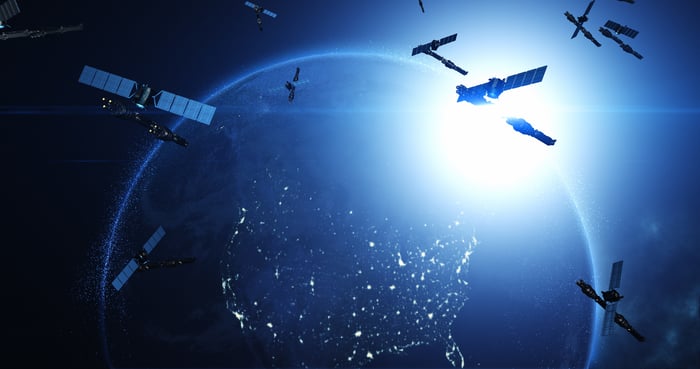
Image source: Getty Images.
A million satellites? Why concerns are likely way overblown
Experts have raised environmental and regulatory concerns over SpaceX's ambitious satellite plans. To be fair, though, Elon Musk, despite his success, has an extensive track record of setting bold goals, such as Tesla's autonomous driving and humanoid robotics programs. Investors are still largely waiting for Tesla to deliver, so having some perspective is crucial here.
A million satellites is such a large step up from 10,140 that investors probably don't need to look so far ahead. SpaceX doesn't need to launch anywhere near a million satellites into orbit to enjoy a massive growth runway moving forward.
However, SpaceX could attract regulatory scrutiny as the de facto leader in launch services. It has conducted more launch missions each year for the past six years, averaging nearly one launch every two days in 2025. It also dominates the market, conducting approximately 80% of launch missions in the United States.
Rocket Lab is preparing to enter SpaceX's core market with its own reusable Neutron rocket. That could actually alleviate regulatory threats by adding some healthy competition to the fray. That would arguably be ideal, as SpaceX is so entrenched at this point that the risk of actually losing industry leadership is probably nil.
With an IPO looming, investors should probably focus on this instead
The more pressing concern for investors about SpaceX stock is simply the hype it will likely generate as it begins trading. Elon Musk is one of the world's most influential people, and he has a massive investor following.
SpaceX is reportedly seeking a valuation of up to $1.75 trillion, making it one of the world's most valuable companies from the moment it begins trading. Consider that SpaceX reportedly generated an estimated $15.5 billion in revenue in 2025. A $1.75 trillion valuation is about 113 times sales. It would take very aggressive and sustainable growth to justify that valuation any time in the near future.
It wouldn't be shocking to see the stock generate poor returns once the hype fades, punishing early buyers. Unfortunately, given all the buzz SpaceX will likely generate, it's hard to see a realistic scenario in which investors can buy shares at a reasonable price.
Where to invest $1,000 right now
When our analyst team has a stock tip, it can pay to listen. After all, Stock Advisor’s total average return is 915%* — a market-crushing outperformance compared to 183% for the S&P 500.
They just revealed what they believe are the 10 best stocks for investors to buy right now, available when you join Stock Advisor.
See the stocks »
*Stock Advisor returns as of April 1, 2026.
Justin Pope has no position in any of the stocks mentioned. The Motley Fool has positions in and recommends Rocket Lab and Tesla. The Motley Fool has a disclosure policy.
Recommended Articles


