


Meet Bab el-Mandeb: How This Oil Chokepoint Could Send Crude Prices Even Higher.
Key Points
Bab el-Mandeb is another key oil market chokepoint.
The Houthis have disrupted oil tanker traffic in the region before.
Prolonged closers of two crucial chokepoints could send oil prices even higher and severely impact the global economy.
- 10 stocks we like better than ConocoPhillips ›
Most investors had probably never heard about the Strait of Hormuz until earlier this month. However, they've quickly learned of its importance to oil markets and the global economy after Iran effectively blocked ships from leaving the Persian Gulf through this narrow waterway. This blockage has already sent crude prices soaring above $100 a barrel and could cause a severe oil supply shortage the longer it remains blocked.
Unfortunately, it's not the only oil chokepoint that could roil the global energy markets. Bab el-Mandeb, a strait between Yemen on the Arabian Peninsula and the Horn of Africa, could be the next flashpoint that sparks a further surge in crude prices.
Will AI create the world's first trillionaire? Our team just released a report on the one little-known company, called an "Indispensable Monopoly" providing the critical technology Nvidia and Intel both need. Continue »
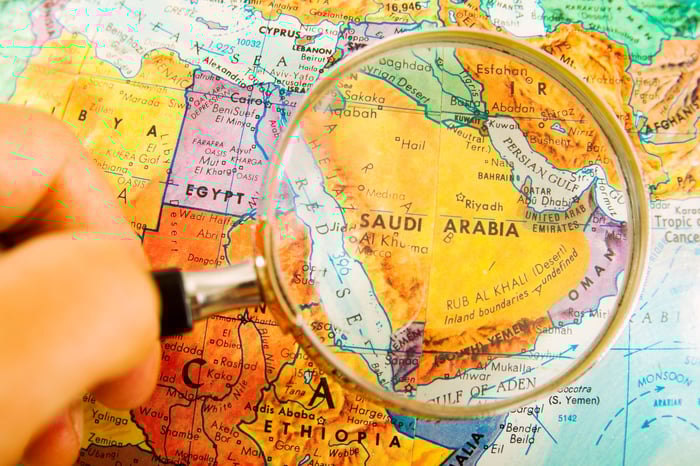
Image source: Getty Images.
What is Bab el-Mandeb?
Tankers are crucial to the global oil markets. They transport more than 75% of global oil supplies. Some of these oil shipping lanes are quite narrow. For example, the Strait of Hormuz is only about 29 miles wide at its narrowest point and consists of dual two-milewide channels of outbound and inbound shipping lanes. That has made it an easy target for Iran to attack ships, effectively choking off the Strait, which handled 20% of global oil and liquefied natural gas (LNG) supplies before the war.
Bab el-Mandeb is another important oil market chokepoint. It connects the Red Sea to the Gulf of Aden and the Arabian Sea. Last year, about 4.2 million barrels of oil flowed through this strait, often oil heading to Europe via the Suez Canal or the SUMED Pipeline, saving it a trip around Africa.
However, Bab el-Mandeb has become even more important to the oil market following the effective closure of the Strait of Hormuz. Saudi Arabia has partially bypassed that route by ramping up oil volumes on the East-West Pipeline to its full capacity of 7 million barrels per day (330% above the pre-war level). This oil can flow out through the Suez Canal, the SUMED Pipeline, or the Bab el-Mandeb to global markets.
The Houthis join the war
While Bab el-Mandeb is a long way from Iran, it influences the area, having backed the Houthis in Yemen. They've caused issues at Bab el-Mandeb in the past by attacking commercial ships. For example, oil shipments through this chokepoint plunged more than 50% in early 2024 due to the attacks.
The Houthis recently joined the war, launching a missile attack on Israel. They could start attacking vessels in Bab el-Mandeb. That would further disrupt the oil market by limiting Saudi Arabia's ability to export oil via the East-West Pipeline. Analysts fear oil prices could surge to $150-$200+ a barrel if both chokepoints close for prolonged periods.
How this could impact oil stocks
Higher oil prices would benefit oil companies that primarily produce in regions unimpacted by those two major chokepoints. For example, leading U.S. oil and gas producers ConocoPhillips (NYSE: COP) and Occidental Petroleum (NYSE: OXY) have limited exposure to the Persian Gulf.
ConocoPhillips combines its leading low-cost U.S. resource position with operations in Libya, Canada, Norway, and the Asia Pacific region. While the company is a partner with Qatar on three LNG projects, two are still under construction. Meanwhile, the company's other LNG assets in Australia and Equatorial Guinea will benefit from the disruption to global LNG supplies from Qatar. ConocoPhillips estimates that a $1 increase in oil prices will affect its annual cash flows by $20 million to $150 million, depending on the region where it produces oil.
Meanwhile, Occidental Petroleum combines its robust U.S. operations with assets in Algeria, Oman, and the UAE. While the war could affect its operations in the UAE, they're a small part of its global portfolio, as 84% of the company's production is domestic. Occidental also has the potential to ramp up its U.S. drilling activities this year to capitalize on higher oil prices.
Another potential catalyst for crude
While Bab el-Mandeb might not handle as much oil as the Strait of Hormuz, it's another key chokepoint for the oil market. If it also closes to tanker traffic, it will upend Saudi Arabia's partial workaround, further exacerbating the oil supply shock and undoubtedly sending oil prices much higher. That would benefit oil companies that primarily operate outside these key chokepoints, like ConocoPhillips and Occidental. However, it would likely inflict significant damage to the global economy. These factors make Bab el-Mandeb an important area to monitor.
Should you buy stock in ConocoPhillips right now?
Before you buy stock in ConocoPhillips, consider this:
The Motley Fool Stock Advisor analyst team just identified what they believe are the 10 best stocks for investors to buy now… and ConocoPhillips wasn’t one of them. The 10 stocks that made the cut could produce monster returns in the coming years.
Consider when Netflix made this list on December 17, 2004... if you invested $1,000 at the time of our recommendation, you’d have $501,381!* Or when Nvidia made this list on April 15, 2005... if you invested $1,000 at the time of our recommendation, you’d have $1,012,581!*
Now, it’s worth noting Stock Advisor’s total average return is 880% — a market-crushing outperformance compared to 178% for the S&P 500. Don't miss the latest top 10 list, available with Stock Advisor, and join an investing community built by individual investors for individual investors.
See the 10 stocks »
*Stock Advisor returns as of April 1, 2026.
Matt DiLallo has positions in ConocoPhillips. The Motley Fool recommends ConocoPhillips and Occidental Petroleum. The Motley Fool has a disclosure policy.
Recommended Articles


