


Prediction: Netflix's Latest Price Increase Will Be the Ultimate Stress Test on the U.S. Economy
Key Points
Netflix has raised prices amid consumer spending weakness before.
But this time may yield different results, given the extent of inflation pressures.
The streamer's ad-supported tier provides a way to retain subscribers seeking a lower monthly expense.
- 10 stocks we like better than Netflix ›
Higher oil prices are escalating inflationary pressures on already strained consumers. So you would think that most companies would ease up on price hikes and focus mainly on sales volumes to grow earnings.
Not Netflix (NASDAQ: NFLX). The streaming giant just announced price increases across all plans, boosting premium to $26.99 per month, standard to $19.99 per month, and its ad-supported tier to $8.99 per month. The company also raised prices in January 2025 and October 2023. For context, it was charging just $19.99 for premium before the October 2023 hike.
Will AI create the world's first trillionaire? Our team just released a report on the one little-known company, called an "Indispensable Monopoly" providing the critical technology Nvidia and Intel both need. Continue »
Here's why the price hikes provide a litmus test of the U.S. economy, with ripple effects on the stock market.
Image source: Netflix.
A bellwether for the consumer economy
Netflix blocks password-sharing and charges for adding a non-household user, which now costs $9.99 per ad-free user and $6.99 per ad-supported user. So, when factoring in the added revenue from non-household users, the cost of Netflix has increased even more than the tier-specific increases would indicate.
The price hike is a vote of confidence that Netflix's platform will continue to resonate with its customers. And that even if some users bail out of its standard and premium tiers, they can still scale down to an ad-supported service to remain in the system. To management's credit, it has every right to be confident.
The company has enjoyed mostly uninterrupted subscriber growth. Its margins and profitability have soared -- shifting the investment thesis from a sales growth story to a profitability narrative.
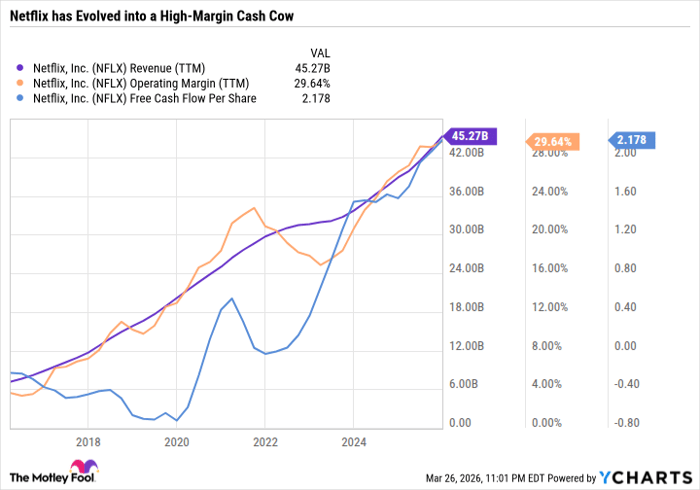
NFLX Revenue (TTM) data by YCharts; TTM = trailing 12 months.
The strategy has worked: Its shares command a premium valuation relative to the market and other growth stocks and is up 184.3% in the last three years -- even though Netflix is down 30.3% from its all-time high achieved in June.
Investors are now focused less on subscriber totals and more on bottom-line results. And price increases from a loyal subscriber base are one of the easiest ways to accelerate earnings growth.
Netflix could provide a crucial recession indicator
If Netflix's ad-free subscriber count remains relatively unchanged after this latest price increase takes effect, that would reinforce the narrative that it is viewed by many households as a consumer staple, on par with an Apple iPhone or an Amazon Prime membership. It's not as essential as toothpaste and toilet paper -- but still a priority over restaurant spending and vacations.
However, if subscriber losses exceed the revenue gains from remaining subscribers, that could be a sign that the U.S. economy is reaching a tipping point. And because consumer spending drives 70% of U.S. gross domestic product, cracks in household spending could foreshadow a recession.
The key for long-term investors isn't to jump in and out of stocks based on recession risk, but rather to ensure they are invested in companies that have what it takes to endure economic cycles. Netflix has so far given investors every reason to believe it is one of those companies, but it's understandable if some folks may want to wait and see how this latest price increase is received before buying the stock.
Should you buy stock in Netflix right now?
Before you buy stock in Netflix, consider this:
The Motley Fool Stock Advisor analyst team just identified what they believe are the 10 best stocks for investors to buy now… and Netflix wasn’t one of them. The 10 stocks that made the cut could produce monster returns in the coming years.
Consider when Netflix made this list on December 17, 2004... if you invested $1,000 at the time of our recommendation, you’d have $503,861!* Or when Nvidia made this list on April 15, 2005... if you invested $1,000 at the time of our recommendation, you’d have $1,026,987!*
Now, it’s worth noting Stock Advisor’s total average return is 884% — a market-crushing outperformance compared to 179% for the S&P 500. Don't miss the latest top 10 list, available with Stock Advisor, and join an investing community built by individual investors for individual investors.
See the 10 stocks »
*Stock Advisor returns as of March 31, 2026.
Daniel Foelber has positions in Netflix and has the following options: short April 2026 $85 calls on Netflix. The Motley Fool has positions in and recommends Amazon, Apple, and Netflix and is short shares of Apple. The Motley Fool has a disclosure policy.
Recommended Articles


