


The Best Quantum Computing Stock to Buy Now: D-Wave Quantum vs. Rigetti Computing
Key Points
D-Wave Quantum is taking a more specialized approach to this industry.
Rigetti Computing failed to capture an early-stage government contract.
- 10 stocks we like better than D-Wave Quantum ›
Quantum computing is closer to reality than many investors realize. While it still may be a few years away, the contracts and relationships that are forged now will shape how the industry grows.
And for investors to capture maximum upside in the quantum computing investing realm, they need to take a position today before all of the early gains, which tend to be outsize, are complete.
Will AI create the world's first trillionaire? Our team just released a report on the one little-known company, called an "Indispensable Monopoly" providing the critical technology Nvidia and Intel both need. Continue »
Two of the most popular quantum computing stocks are Rigetti Computing (NASDAQ: RGTI) and D-Wave Quantum (NYSE: QBTS). Both of these companies are vying for market share, but which is the better buy right now? Let's take a look.
Image source: Getty Images.
Each is taking a different approach to quantum computing
There isn't an established technique or process for quantum computing. While the general idea is to use quantum mechanics to act as a processor, how each company controls particles is completely different.
The most common technique is known as superconducting, which is done by cooling the particles to near absolute zero so their quantum motion is so slow that it can be harnessed for computing. This technology is being used by many of the legacy tech companies, as well as Rigetti Computing.
D-Wave Quantum isn't using superconducting; instead, it's deploying a completely different technology: quantum annealing. This technology specializes in searching for numerous solutions simultaneously, looking for the lowest energy state in the system to identify the optimal answer.
Quantum annealing has many uses, including artificial intelligence (AI) training and inference, weather modeling, and logistics networks, but it won't be able to be adapted to general-purpose computing situations like superconducting products will.
This makes Rigetti's potential market opportunity greater, so I'll give it the win in this category.
Winner: Rigetti Computing
D-Wave's financials look healthier
Switching to financials, it's difficult to assess each company. Right now, the only revenue each is generating comes from research contracts or early-stage system sales.
None of these can perpetually fund the companies. Still, the market and its clients are willing to fund these companies because they believe that there is something to quantum computing, even if it will be a few years before we see this technology become more mainstream.
D-Wave is clearly in the better spot and announced several early-stage system sales, including a $20 million system to Florida Atlantic University and a booking worth 10 million euros ($11.5 million) in Italy. Rigetti's flagship system sale in the fourth quarter was for $8.4 million to a client in India.
From the chart, you can see that Rigetti's business is trending in the wrong direction, while D-Wave's is picking up.
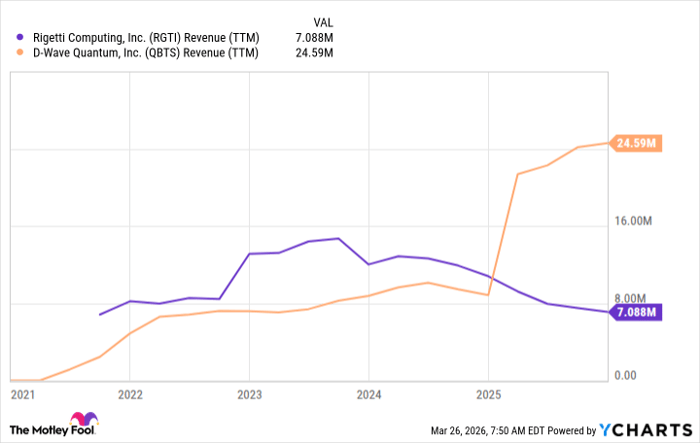
RGTI Revenue (TTM) data by YCharts; TTM = trailing 12 months.
I think this tells you all you need to know on the financial side of things, and D-Wave Quantum gets the nod here.
Winner: D-Wave Quantum
Rigetti has failed to establish key partnerships
The last category I want to look at is lasting partnerships. These companies must forge a relationship with clients long before the technology is available, so that they can deliver huge growth once the technology becomes optimal for commercial use.
Rigetti has a few research partnerships, but lost out on one of the most important contracts of all: the contract for the Defense Advanced Research Projects Agency (DARPA). The DARPA contract puts whichever company wins it on the fast track to becoming the go-to partner with U.S. defense agencies, which would be a huge win.
Rigetti started the trial but was eliminated in the first phase. This is a big red flag for me because it showed Rigetti's technology was behind that of its peers.
D-Wave Quantum didn't enter this contract bid because its optimization technology isn't suited for the work DARPA wanted. However, it has already partnered with several companies in the manufacturing sector to deliver early-stage success, such as schedule creation. I'm a lot more confident that D-Wave already has the partnerships needed to succeed, giving it the final win in this analysis.
Winner: D-Wave Quantum
Although the final score is 2-to-1 in favor of D-Wave Quantum, I think it's a runaway winner. Its only drawback is that it isn't pursuing a wide-scale approach; instead, it's opting to specialize. I think that's actually a smart strategy in quantum computing, making it the better stock to buy now.
Should you buy stock in D-Wave Quantum right now?
Before you buy stock in D-Wave Quantum, consider this:
The Motley Fool Stock Advisor analyst team just identified what they believe are the 10 best stocks for investors to buy now… and D-Wave Quantum wasn’t one of them. The 10 stocks that made the cut could produce monster returns in the coming years.
Consider when Netflix made this list on December 17, 2004... if you invested $1,000 at the time of our recommendation, you’d have $503,861!* Or when Nvidia made this list on April 15, 2005... if you invested $1,000 at the time of our recommendation, you’d have $1,026,987!*
Now, it’s worth noting Stock Advisor’s total average return is 884% — a market-crushing outperformance compared to 179% for the S&P 500. Don't miss the latest top 10 list, available with Stock Advisor, and join an investing community built by individual investors for individual investors.
See the 10 stocks »
*Stock Advisor returns as of March 30, 2026.
Keithen Drury has no position in any of the stocks mentioned. The Motley Fool has no position in any of the stocks mentioned. The Motley Fool has a disclosure policy.
Recommended Articles


