


Don't Look Now, but the Federal Reserve's March Inflation Forecast Just Worsened
Key Points
Inflation-based uncertainty is threatening to pull the rug out from beneath the Dow Jones Industrial Average, S&P 500, and Nasdaq Composite.
Crude oil prices have soared in the wake of the Iran war, resulting in respective increases of 34% and 43% per gallon for regular gas and diesel over the last month.
The Federal Reserve Bank of Cleveland's inflation forecasting tool estimates that price increases will be even worse than previously projected for March.
- 10 stocks we like better than S&P 500 Index ›
Until late February, the widely followed Dow Jones Industrial Average (DJINDICES: ^DJI), broad-based S&P 500 (SNPINDEX: ^GSPC), and growth-stock-dominated Nasdaq Composite (NASDAQINDEX: ^IXIC) had been virtually unstoppable. A bull market that's extended into its fourth year (for the Dow and S&P 500) has seen the S&P 500 briefly top 7,000, the Nasdaq eclipse 24,000, and the Dow touch 50,000.
But Wall Street's bull market rally may be more precarious than investors realize. Although headwinds are always threatening to drag down equities, there's arguably no greater risk for stocks right now than inflation-based uncertainty caused by the Iran war.
Will AI create the world's first trillionaire? Our team just released a report on the one little-known company, called an "Indispensable Monopoly" providing the critical technology Nvidia and Intel both need. Continue »
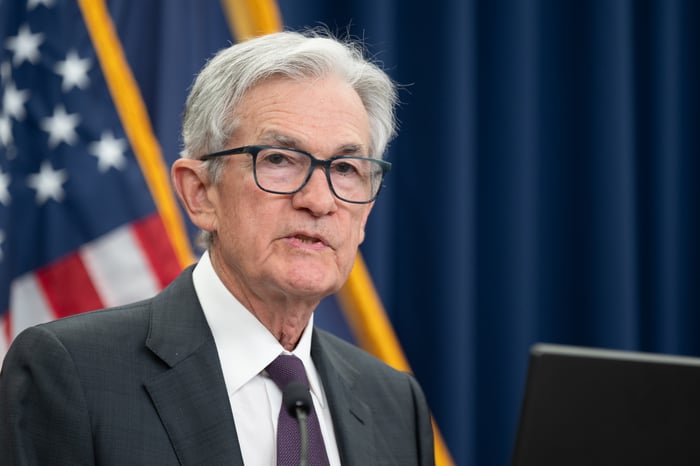
Fed Chair Jerome Powell and members of the Federal Open Market Committee are in a precarious position regarding inflation. Image source: Official Federal Reserve Photo.
The effects of war are felt well beyond the battlefield
A little over one month ago, on Feb. 28, U.S. and Israeli forces commenced military actions against Iran. Around this same time, Iran announced a virtual closure of oil exports through the Strait of Hormuz. This narrow channel between Iran and Oman sees approximately 20 million barrels of liquid petroleum traverse it daily.
This shutdown has disrupted roughly 20% of the world's liquid petroleum, and the effects are being felt at home.
According to data from AAA, the nationwide price of a gallon of regular gas has jumped 34% to $3.98 over the last month, as of March 25. The 43% increase in diesel over the trailing month is even more staggering.
Soaring crude oil prices are hitting consumers' pocketbooks and directly impacting transportation costs for businesses. Higher transportation and production costs often mean consumers will pay more for goods and services beyond the gas pump. The million-dollar question is: How much more?

Image source: Getty Images.
The Federal Reserve's March inflation forecast just got worse
When the U.S. Bureau of Labor Statistics (BLS) reported the February inflation data on March 11, it showed a 2.4% increase in prices over the trailing year. It was also the 59th consecutive month that the prevailing inflation rate has been above the Federal Reserve's long-term target of 2%.
On April 10, the BLS will unveil the March inflation report, and things are expected to look a lot different.
With the understanding that goods sector inflation tied to President Donald Trump's tariff and trade policy has proven stickier than expected, the Federal Reserve Bank of Cleveland's Inflation Nowcasting tool predicts that the trailing 12-month inflation rate will jump from a reported 2.4% in February to 3.16% in March. That's up another 14 basis points from where the projection stood on March 19.
S&P 500 Shiller PE Ratio hits 2nd highest level in history 🚨 The highest was the Dot Com Bubble 🤯 pic.twitter.com/Lx634H7xKa
-- Barchart (@Barchart) December 28, 2025
Rapidly rising inflation could be a death knell for the current bull market. The stock market entered 2026 at its second-priciest valuation in history. One of the main reasons investors have tolerated premium valuations has been the expectation of further interest rate cuts in 2026.
According to projections from the Federal Reserve Bank of Atlanta, there's less than 14% chance of a rate cut by the Federal Open Market Committee (FOMC) -- the 12-person body, including Fed Chair Jerome Powell, responsible for setting the nation's monetary policy -- by June 17. Conversely, there's a greater than 41% probability of a rate hike by mid-June.
Though the Inflation Nowcasting tool updates regularly, the message is clear that rate cuts may be off the table. This could lead to a valuation reset for pricey equities and a tough road ahead for the Dow Jones Industrial Average, S&P 500, and Nasdaq Composite.
Should you buy stock in S&P 500 Index right now?
Before you buy stock in S&P 500 Index, consider this:
The Motley Fool Stock Advisor analyst team just identified what they believe are the 10 best stocks for investors to buy now… and S&P 500 Index wasn’t one of them. The 10 stocks that made the cut could produce monster returns in the coming years.
Consider when Netflix made this list on December 17, 2004... if you invested $1,000 at the time of our recommendation, you’d have $503,861!* Or when Nvidia made this list on April 15, 2005... if you invested $1,000 at the time of our recommendation, you’d have $1,026,987!*
Now, it’s worth noting Stock Advisor’s total average return is 884% — a market-crushing outperformance compared to 179% for the S&P 500. Don't miss the latest top 10 list, available with Stock Advisor, and join an investing community built by individual investors for individual investors.
See the 10 stocks »
*Stock Advisor returns as of March 30, 2026.
Sean Williams has no position in any of the stocks mentioned. The Motley Fool has no position in any of the stocks mentioned. The Motley Fool has a disclosure policy.
Recommended Articles


