


Are Any of These Tesla Competitors Buys in 2026?
Key Points
Rivian is partnering with Uber in a deal worth $1.25 billion.
BYD surpassed Tesla in global sales last year.
Ford and GM have long-term plans to build their EV market share.
- These 10 stocks could mint the next wave of millionaires ›
Tesla (NASDAQ: TSLA) is navigating a complex electric vehicle landscape amid increasingly fierce competition. Pure-play EV makers such as Rivian (NASDAQ: RIVN) and BYD (OTC: BYDDY) are gaining global traction and brand recognition, while legacy automakers like Ford Motor Company (NYSE: F) and General Motors (NYSE: GM) continue their pivot into electric options.
Which of the biggest Tesla competitors are buys, though? Let's take a look at what's happening among the main EV manufacturers.
Will AI create the world's first trillionaire? Our team just released a report on the one little-known company, called an "Indispensable Monopoly" providing the critical technology Nvidia and Intel both need. Continue »
Rivian's inflection point is here
Rivian has garnered some positive headlines recently as the innovative EV maker prepares to release its high-tech, yet affordable, R2 fleet this spring. Rivian is also partnering with Uber to provide 50,000 self-driving taxis. The deal means Uber will invest $1.25 billion into the company over the next five years.
Rivian's automotive division is still not profitable, but a joint venture with Volkswagen is providing the business with a meaningful cash cushion. Because of the technology services Rivian provides to Volkswagen, the company has a positive overall gross profit.
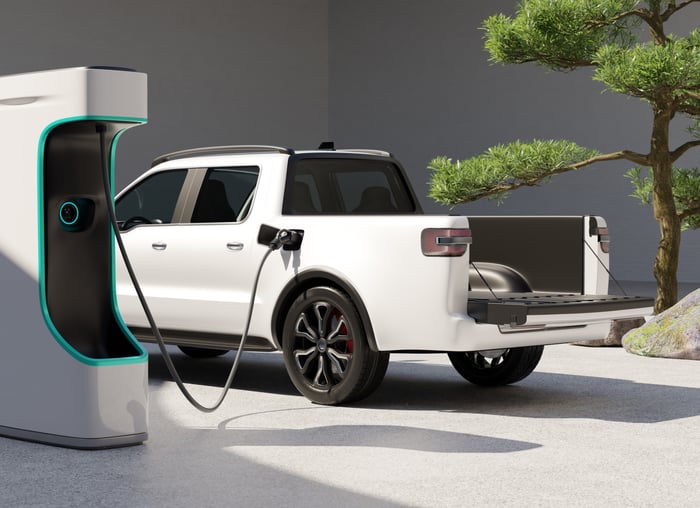
Image source: Getty Images.
Rivian needs the R2 launch and Uber partnership to succeed and create a real path to profitability that isn't solely dependent on its engineering and technology services. Rivian is still speculative, but definitely trending in the right direction. The upcoming launch of its mid-size mass-market SUVs is an important milestone.
Rivian remains a high-risk, high-reward speculative buy for investors willing to tolerate volatility.
BYD overtakes Tesla
The Chinese-based automaker BYD surpassed Tesla last year as the world's best-selling EV maker. The company is almost fully vertically integrated, building its own batteries, semiconductors, and most components. This structure gives it a very real competitive advantage.
BYD is rapidly expanding globally, opening factories in Southeast Asia, Europe, and Latin America. The biggest issue BYD is facing right now is back home in China. The EV maker's sales in its homeland have declined steadily as formidable competition erodes its market share.
Because BYD is based in China, for U.S. investors, this does pose a geopolitical risk. The company needs to prove it can be sustainably profitable overseas while also clawing back market share in China. The stock has fallen nearly 27% over the past year, so for patient investors, BYD is fairly priced.
Ford's successful pivot
Ford is obviously not a pure-play EV manufacturer. The legacy automaker's push into EVs has been far more successful than those of other combustion-engine manufacturers. Still, the company's line of EVs is struggling to build strong momentum in the U.S.
Ford's EV models are affordable and competitive with other brands such as Tesla. The Michigan-based company also has a diverse blend of vehicles, including hybrids, which creates a more reliable cash flow. The company's EV roadmap isn't as exciting as Tesla's or Rivian's, but its track record is solid.
Because Ford's fleet is a mix of combustion, hybrid, and EV models, it has a larger moat and is more resistant to downturns. EV sales have slowed, but Ford is still in a stronger overall position than the pure-play EV makers.
Ford's stock is better suited to value investors than to growth investors. The company's dividend yield is a whopping 5.15% right now. Ford stock has declined 12% to start 2026. EVs are not a bright spot for Ford at the moment. If you're going to invest in Ford as an EV play, you'll need to expect a long time horizon when it comes to finding its footing in the space.
General Motors is underappreciated
GM is a lot like Ford in that it's a legacy automaker with a wide array of gas, hybrids, and electric vehicles. GM is also investing in software and is seeing a scalable revenue boost because of it. With both software and cash-printing gas vehicles, GM's EV fleet is less risky.
GM's stock has had a great 12 months, rising more than 47% as of March 20. The company's forward price-to-earnings ratio is also currently under 6. This figure is low even in an industry known for its very reasonable P/E ratios.
What stock should you buy?
All of the Tesla competitors discussed here have different reasons why they might be attractive to investors. Ford and GM are well-established and profitable, and thus slightly less risky. You likely won't see exciting growth with them, though. Rivian and BYD could potentially dethrone Tesla worldwide as they continue to expand their brands. They are, however, far more speculative. Which competitor stock to choose depends on your goals and risk tolerance, but each company makes its own bullish case.
Don’t miss this second chance at a potentially lucrative opportunity
Ever feel like you missed the boat in buying the most successful stocks? Then you’ll want to hear this.
On rare occasions, our expert team of analysts issues a “Double Down” stock recommendation for companies that they think are about to pop. If you’re worried you’ve already missed your chance to invest, now is the best time to buy before it’s too late. And the numbers speak for themselves:
- Nvidia: if you invested $1,000 when we doubled down in 2009, you’d have $447,961!*
- Apple: if you invested $1,000 when we doubled down in 2008, you’d have $47,222!*
- Netflix: if you invested $1,000 when we doubled down in 2004, you’d have $495,179!*
Right now, we’re issuing “Double Down” alerts for three incredible companies, available when you join Stock Advisor, and there may not be another chance like this anytime soon.
See the 3 stocks »
*Stock Advisor returns as of March 23, 2026.
Catie Hogan has positions in Rivian Automotive. The Motley Fool has positions in and recommends Tesla and Uber Technologies. The Motley Fool recommends BYD Company and General Motors. The Motley Fool has a disclosure policy.
Recommended Articles


