


2 Investing Moves I'm Making Right Now to Prepare for a Recession -- and 1 I'm Avoiding at All Costs
Key Points
Some economists are predicting an increased risk of a recession in the next year.
The steps you take now will determine how your portfolio fares during a bear market.
While it's normal to feel nervous right now, there are still silver linings for investors.
- 10 stocks we like better than S&P 500 Index ›
Recession fears are ramping up again, and now top economists at Moody's forecast a 49% chance that a U.S. recession will begin in the next 12 months. Analysts at Goldman Sachs are slightly more optimistic, predicting a 25% recession risk, but both figures could change quickly depending on oil prices.
To be clear, nobody can predict exactly what the market will do in the near term. Recession forecasts aren't always correct, and much of the future will depend on how the war in Iran unfolds. But for now, it's wise to prepare your investments for a potential recession just in case. Here are the steps I'm taking.
Will AI create the world's first trillionaire? Our team just released a report on the one little-known company, called an "Indispensable Monopoly" providing the critical technology Nvidia and Intel both need. Continue »

Image source: Getty Images.
1. I'm strengthening my emergency fund
One of the best moves you can make during periods of economic uncertainty is to build a robust emergency fund with enough savings to last at least three to six months.
Stock market downturns are particularly bad times to withdraw your money, because you risk locking in significant losses by selling your investments for less than you paid for them. To avoid losing money, it's generally best to stay in the market until prices eventually recover.
However, emergencies and unexpected expenses don't stop during downturns. When you have a healthy cushion of cash in a savings account that you can pull from at a moment's notice, it will be easier to leave your investments untouched.
2. I'm creating a buying strategy
Recessions aren't bad times to buy stocks. In fact, exactly the opposite is true. The market has been incredibly expensive for years, with investors paying record-high prices for many stocks. If the market takes a turn for the worse, that could be an incredible opportunity to load up on quality stocks at discount prices.
It's wise to have an idea of where you might like to buy ahead of time, however. Impulse buying can be incredibly risky, and just because a stock is more affordable doesn't necessarily mean it's a smart investment.
By researching companies now, you can build a wish list of must-buys if the market dips. Just be sure you're only investing in companies with strong long-term growth potential, as those stocks are the most likely to recover from a recession or bear market.
One move I'm avoiding at all costs
One thing I'm absolutely not doing is selling my stocks in a panic. It can be tempting to sell off your investments now in fear that prices will drop. In theory, that seems like a smart strategy to avoid losses. In practice, though, the market is often too unpredictable for that strategy to work out well.
While many top economists predict a recession could be looming, that doesn't necessarily mean it will happen.
Back in 2023, for example, analysts at Deutsche Bank forecast a "near 100%" chance that the U.S. would enter a recession within the next year, noting that it would be "historically unprecedented" to avoid a hard landing. That recession never did materialize, and the S&P 500 (SNPINDEX: ^GSPC) actually surged by around 23% in the year following that prediction.
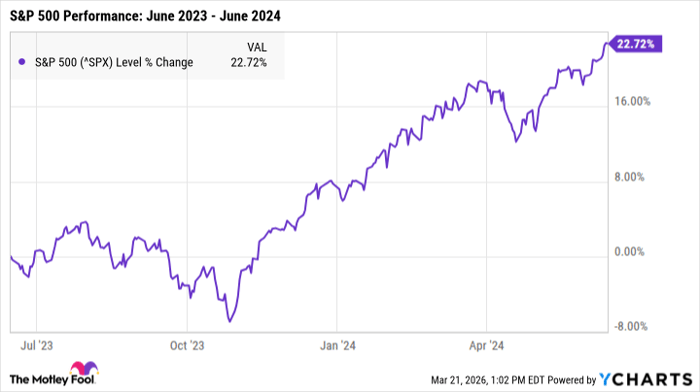
^SPX data by YCharts
This isn't to say that those economists were uninformed in their forecast, but rather to highlight the fact that the market doesn't always play by the rules. No matter how strong the recession odds are, there's no way to guarantee that it will happen.
If you sell your stocks and a recession doesn't occur anytime soon, you'll risk missing out on potentially lucrative gains. Also, if you decide to reinvest later after prices have surged, you'll have to pay higher prices to rebuy the stocks you just sold.
While uncertainty around the future is tough to stomach, preparing your investments now can make it somewhat more bearable. The more steps you can take to safeguard your portfolio, the more protected you'll be -- no matter what lies ahead for the economy.
Should you buy stock in S&P 500 Index right now?
Before you buy stock in S&P 500 Index, consider this:
The Motley Fool Stock Advisor analyst team just identified what they believe are the 10 best stocks for investors to buy now… and S&P 500 Index wasn’t one of them. The 10 stocks that made the cut could produce monster returns in the coming years.
Consider when Netflix made this list on December 17, 2004... if you invested $1,000 at the time of our recommendation, you’d have $495,179!* Or when Nvidia made this list on April 15, 2005... if you invested $1,000 at the time of our recommendation, you’d have $1,058,743!*
Now, it’s worth noting Stock Advisor’s total average return is 898% — a market-crushing outperformance compared to 183% for the S&P 500. Don't miss the latest top 10 list, available with Stock Advisor, and join an investing community built by individual investors for individual investors.
See the 10 stocks »
*Stock Advisor returns as of March 23, 2026.
Katie Brockman has no position in any of the stocks mentioned. The Motley Fool has no position in any of the stocks mentioned. The Motley Fool has a disclosure policy.
Recommended Articles


