


Better Growth Stock in 2026: Uber or DoorDash?
Key Points
Over 200 million people use Uber's platform each month for ride-hailing, food delivery, and commercial freight services.
DoorDash dominates the food delivery industry in the U.S., but the company continues to expand its global footprint.
Both Uber and DoorDash are leaning into autonomous technologies to improve their businesses, but one looks like a better buy than the other.
- 10 stocks we like better than Uber Technologies ›
Uber Technologies (NYSE: UBER) operates the world's largest ride-hailing network, but it also has a global presence in segments like food delivery and commercial freight. The company is gearing up to be a major player in the autonomous vehicle revolution, which could transform its business.
DoorDash (NASDAQ: DASH), on the other hand, operates America's most popular last-mile logistics network, delivering food and retail goods to consumers on behalf of thousands of businesses. While Uber has aggressively expanded into new verticals over the years, DoorDash has focused on perfecting its core business.
Will AI create the world's first trillionaire? Our team just released a report on the one little-known company, called an "Indispensable Monopoly" providing the critical technology Nvidia and Intel both need. Continue »
Both companies are growing nicely and have plenty of long-term potential. But which one is the better buy in 2026?

Image source: Getty Images.
The case for Uber
Over 200 million people use Uber every month, so the company is unquestionably successful already, but its next phase of growth is likely to come from the shift to autonomous ride-hailing and delivery services. Uber has already signed agreements with more than 20 companies developing self-driving vehicles. That includes Alphabet's Waymo, which is currently completing over 450,000 paid autonomous trips every single week.
The potential benefits of autonomy could be enormous. During 2025, Uber reported a record $193.4 billion in gross bookings, which represented the dollar value of every ride, food order, and commercial delivery its platform facilitated. But the 9.7 million drivers operating in its network took home a whopping $85.4 billion throughout the year, which was the single biggest piece of those gross bookings.
After deducting other costs, like the money forwarded to restaurants for their food orders, Uber's 2025 revenue was $52 billion. Then, after accounting for operating expenses, the company's adjusted (non-GAAP) profit for the year was $5.2 billion. In other words, only a small portion of Uber's gross bookings actually make it to the top and bottom lines.
However, by deploying autonomous vehicles, Uber could pocket a large chunk of the $85.4 billion it paid to human drivers last year, immediately boosting its revenue and earnings without taking on a single additional customer.
Plus, autonomous vehicles can be deployed wherever they are required, which will improve the efficiency of Uber's network. Moreover, they can operate around the clock, potentially capturing even more bookings than human drivers ever could.
The case for DoorDash
DoorDash has a U.S. market share of over 60% in the food delivery industry, making it the dominant player by a wide margin. But the company has become so much more over the last few years, with a presence in over 40 countries where it delivers not only food, but also groceries, retail goods, and more.
Like Uber, DoorDash is also leaning into autonomous solutions to reduce costs. The company processed $102 billion in gross order volume during 2025, with a hefty $20 billion going to drivers alone. As a result, it launched a self-driving robot called Dot last year, which is capable of making small deliveries in metro areas without human intervention.
Dot is only operating in Phoenix, Arizona, right now, but DoorDash plans to roll it out more broadly. Plus, the company signed a deal with Serve Robotics (NASDAQ: SERV) last year, which has deployed a fleet of 2,000 last-mile delivery robots across multiple American cities. The partnership will enable DoorDash to direct some customer orders to one of Serve's robots instead of a human driver (where possible).
DoorDash had a great 2025, generating a record $13.7 billion in total revenue, which was up 28% year over year. That growth rate accelerated compared to 2024, when the company's revenue increased by 24%, which highlights the business's momentum right now. DoorDash also generated $935 million in generally accepted accounting principles (GAAP) net income during 2025, which was up by a whopping 660%.
After stripping out one-off and non-cash expenses, DoorDash also delivered an eye-popping $2.7 billion in adjusted earnings before interest, tax, depreciation, and amortization (EBITDA). The company's substantial profits are a welcome sight for shareholders who endured years of steep losses while management focused solely on growth.
The verdict
DoorDash's accelerating revenue growth and soaring profits are impressive. But I think Uber has a much larger opportunity to capitalize on the autonomous revolution because of its more diverse business. After all, it spent over four times as much money on drivers compared to DoorDash last year, so it has more room to benefit from running autonomous services.
Uber CEO Dara Khosrowshahi believes the shift to autonomous driving will create a multitrillion-dollar opportunity for his company over the long term, which opens the door to significant potential upside in its stock.
Plus, when you compare the valuation of these two stocks, Uber looks far more attractive. DoorDash stock is trading at a price-to-sales (P/S) ratio of 5.4 as I write this, whereas Uber stock is much cheaper with a P/S ratio of just 3.2.
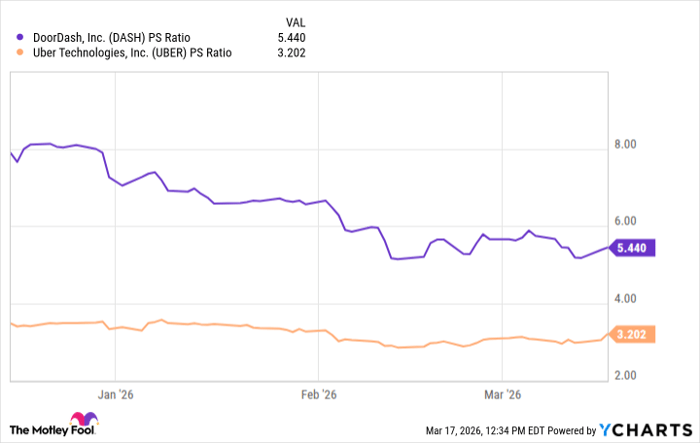
DASH PS Ratio data by YCharts
As a result, with a bigger long-term opportunity and a cheaper valuation today, Uber stock looks like the obvious pick.
Should you buy stock in Uber Technologies right now?
Before you buy stock in Uber Technologies, consider this:
The Motley Fool Stock Advisor analyst team just identified what they believe are the 10 best stocks for investors to buy now… and Uber Technologies wasn’t one of them. The 10 stocks that made the cut could produce monster returns in the coming years.
Consider when Netflix made this list on December 17, 2004... if you invested $1,000 at the time of our recommendation, you’d have $494,747!* Or when Nvidia made this list on April 15, 2005... if you invested $1,000 at the time of our recommendation, you’d have $1,094,668!*
Now, it’s worth noting Stock Advisor’s total average return is 911% — a market-crushing outperformance compared to 186% for the S&P 500. Don't miss the latest top 10 list, available with Stock Advisor, and join an investing community built by individual investors for individual investors.
See the 10 stocks »
*Stock Advisor returns as of March 21, 2026.
Anthony Di Pizio has no position in any of the stocks mentioned. The Motley Fool has positions in and recommends Alphabet, DoorDash, Serve Robotics, and Uber Technologies. The Motley Fool has a disclosure policy.
Recommended Articles


